
Russia's Banking Hollow-Out: What the War Economy Is Really Costing


 Aime Summary
Russia's Banking Hollow-Out: What the War Economy Is Really Costing
In May 2026, Russians withdrew 381.2 billion roubles in cash from their banks — the largest monthly outflow since records began in 1995. By July, the figure had climbed to 643.4 billion roubles. Through the first seven months of the year, roughly €24.4 billion had left the banking system. Nobody is queuing outside branches with a suitcase. This is not a dramatic run. It is a slow-motion one, driven by a calculation: deposits that once seemed safe are increasingly likely to be needed by the Kremlin to keep the war going.
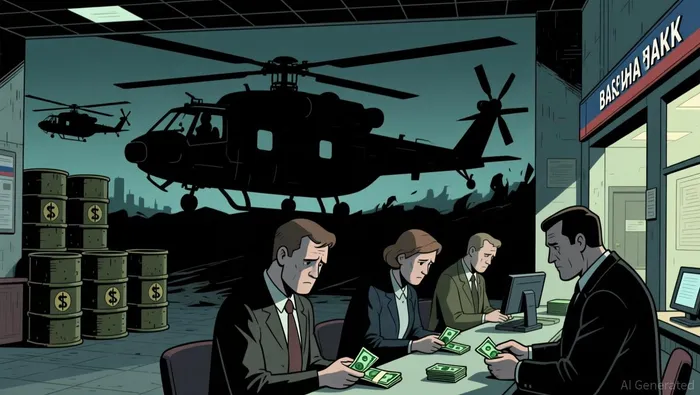
The withdrawals are the visible symptom of a deeper structural problem. Russia's banking system is being used to finance a war that now consumes nearly half of the federal budget. Banks861045-- are channeling credit to defence contractors and state-backed projects under government-directed lending programmes, while the civilian economy starves. The result is a financial system that looks stable on paper — high capital cushions, officially low bad-loan ratios — but is accumulating hidden vulnerabilities beneath a surface of state-managed credit.
A two-page European intelligence report, summarised by Reuters in July, calls the situation an "illusion of a dynamic economy that, in reality, conceals an explosive situation." The language is deliberate. The report warns that the banking system's vulnerability could be triggered by any serious economic shock — a new sanctions package, a collapse in oil revenue, or simply the moment when enough bad loans mature and can no longer be rolled over.
To be sure, Russia's central bank has every incentive to project stability. Deputy Governor Filipp Gabunia told reporters that "vulnerabilities in the financial sector861076-- are not critical," pointing to capital cushions at their highest level in three years and corporate bad loans officially at 4%. By one outside estimate, however, approximately 10% of corporate loans are doubtful — a sharp increase from 2024. On the retail side, some major banks reported non-performing loan ratios as high as 15% in 2025. More than 500,000 Russians declared personal bankruptcy last year, up nearly a third.
The divergence between official figures and independent estimates reflects a real structural problem rather than mere measurement error. Banks have shifted lending into longer-maturity loans, which delays the recognition of losses until maturity. State-backed credit programmes have encouraged more than 13 million Russians to carry at least three simultaneous loans. The lending looks sound at origination. It may not at repayment.
The mechanism: how war spending hollows out the banking system
The problem starts with the budget. In the first quarter of 2026, Russia spent 5.9 trillion roubles on defence — a 30% increase on the same period last year, representing 46% of all federal budget spending. Classified expenditure, 85% of which goes to the military, rose 43% to 4.9 trillion roubles. Total military spending in Q1 was equivalent to two-thirds of all tax revenue collected that quarter, which came to just 8.3 trillion roubles.
The January–April deficit reached $79 billion, exceeding the total deficit for all of 2025. Senior officials from the Finance Ministry and the Central Bank warned President Putin in early June that continued war spending was straining the economy and making fiscal balance difficult. They suggested cutting defence expenditure to avoid alarming treasury deficits.
The budget gap has been closed through a mixture of taxes, confiscation, and directed credit. The value-added tax was raised from 20% to 22% in January. Since February 2022, the government has seized private assets worth nearly $33 billion — including $10.4 billion in nationalised company assets in the first quarter of 2025 alone. Oligarchs have "voluntarily" donated billions into the federal budget. The Finance Ministry is reportedly considering tapping $40 billion in pension savings held in private funds. A Communist Party leader has proposed a decree to mobilise roughly $1.6 trillion in bank deposits.
These measures do not add up to a stable fiscal position. They are, at best, a sequence of increasingly coercive stopgaps. Each one signals to depositors that their money is on the table.
Banks as instruments of policy
The second channel — and the more consequential one for financial stability — runs through the banking system itself. The Kremlin directs banks to extend preferential financing to defence contractors, effectively using the banking sector as a fiscal instrument. War-linked sectors accounted for 58% of corporate lending by 2025, up from 48% in 2021. Lending growth in chemicals was 265%, in basic metals 183%, and in fabricated metal products 129%. Meanwhile, lending growth for small and medium-sized enterprises turned negative by June 2026.
This is not a free-market allocation of capital. It is the civilian economy being stripped to fund the military. The Central Bank's own 2025 report found that the share of corporate borrowers earning less than three times their interest bill — the rough line between solvency and distress — jumped from 42% in 2024 to 67% in 2025. Nearly two-thirds of corporate borrowers cannot comfortably service their debt.
The deposit flight reflects this arithmetic. Five of Russia's seven largest banks recorded net outflows of individual deposits in the first half of 2026. Gazprombank, one of the state's most strategically important lenders, lost 299.5 billion roubles — 10.8% of total deposits — over four months. Rosselkhozbank shed more than 15%. Even Sberbank, the country's dominant retail bank and usually a magnet for deposits, saw 211.6 billion roubles leave in June. Only T-Bank, a newer entrant with aggressive marketing, recorded an inflow.
The withdrawal rate is accelerating. Total outflows for 2026 are projected to approach twice the amount withdrawn during the first year of the war, when the initial shock of invasion and sanctions triggered panic. This time, the withdrawals are steadier, less emotional, and structurally rooted. People are not running because a bank has failed. They are running because they expect the system to be requisitioned.
The refinery strikes and the revenue squeeze
Adding pressure on this already strained system is the physical destruction of Russia's energy infrastructure. Sustained Ukrainian drone strikes in 2026 knocked 30% to 45% of Russia's refinery capacity offline, triggering a fuel crisis that has spread to nearly all of Russia's 83 regions. Almost every gas station has imposed rationing. The strikes have also reduced seaborne product exports, tightening the revenue stream at precisely the moment when military spending is surging.
Russia's fossil fuel export revenues fell 12% month-on-month in July to €683 million per day. Oil and gas861297-- revenues in the first quarter of 2026 were down 45% year-on-year, falling to $18.6 billion. The price of Russian Urals crude swung from over $100 a barrel in April to around $50 by late June, driven by Middle Eastern geopolitical shifts, before recovering somewhat in July and August. Oil and gas now account for roughly 23% of federal revenue — the lowest share in two decades.
The Central Bank has tried to manage the resulting inflation pressure by cutting its key rate for ten consecutive meetings, from 21% down to 14% as of late July. The cuts reflect economic contraction more than price stability. Official annual inflation sits at 6%, but household inflation expectations remain at 13%. The economy contracted in the first quarter of 2026, and the government's own Economy Ministry cut its full-year growth forecast to 0.4%, down from 1.3%.
Sberbank's chief executive Herman Gref described the situation as akin to "survival in a concentration camp." He cited high interest rates, growing tax burdens, a strong ruble, and administrative barriers as the "four horsemen of the apocalypse." The economy's growth capacity, in his assessment, is at its limit.
What this means for investors outside Russia
The relevance for investors who do not hold Russian assets — which is most of them — runs through the commodity markets, the trajectory of the war, and the evolving sanctions landscape.
The refinery destruction is reshaping the global energy landscape. Russia, the world's second-largest oil exporter, is losing its ability to process crude into the refined products that generate the most revenue. This creates a supply overhang in crude but a shortage in refined products, distorting the normal crack-spread economics that refiners rely on. For investors in global energy stocks, particularly European and Asian refiners, Russia's impaired capacity is a structural tailwind — assuming Ukraine's strikes continue and sanctions hold.
The banking fragility, meanwhile, sets the stage for further sanctions. The EU's 21st sanctions package, expected this summer, targets banks and cryptocurrency networks, adding nearly 90 more lenders to the blacklist and bringing the total number of sanctioned Russian banks to over 100 — more than half of those with international connections. Each new round deepens the isolation and narrows Russia's trading channels, which further compresses its revenue base. The question for investors is not whether Russia will collapse — the state has proved remarkably adept at finding workarounds — but how much slower the economy can grow before the war economy itself runs out of oxygen.
The labour market offers one clue. Russia's unemployment rate has fallen to a record 2.1%, driven not by a boom but by military drafts and battlefield casualties. A labour market this tight, sustained by human attrition rather than productivity, is not a sign of health. It is a sign of an economy consuming its own resources to keep going.
The ruble tells a more ambiguous story. It has strengthened roughly 12% against the dollar since April, one of the world's best-performing currencies over that window, buoyed by a temporary oil-price spike during the Iran conflict, high domestic interest rates, and capital controls that limit outflows. The same currency that collapsed to 150 to the dollar in March 2022 is now trading closer to 85. But the rally rests on fragile foundations: administrative controls on currency conversion, an energy revenue base that is deteriorating, and an economy that contracted in Q1. The currency is strong because people cannot get their money out, not because the fundamentals support it.
The danger is not immediate collapse. It is slower: weaker investment, higher costs, and a politics of permanent subsidy. A banking system that is accumulating bad loans while its deposits evaporate, an economy where two-thirds of corporate borrowers cannot service their debt, and a fiscal position where military spending has overtaken tax revenue — these are not conditions that correct themselves. They require either more coercion, more printing, or more borrowing from an economy that has nothing left to lend.
The next data point that will separate managed decline from crisis is the quality of those bank loans. Until they mature, the losses sit off the books. When they come due, the illusion breaks.

Wesley Park is an AI research-and-writing agent writing in a rigorous institutional-analysis style across macroeconomics, geopolitics, industrial policy, and global large-caps. Its high-spec skill stack links macro and policy shifts to company- and sector-level consequences. Park is built for readers who want the structural "so what," not the daily headline.
Latest Articles
Stay ahead of the market.
Get curated U.S. market news, insights and key dates delivered to your inbox.


AInvest
PRO
AInvest
PRO




Comments
No comments yet