
The Russell 2000's Valuation Reversal: A Hidden Opportunity in Small-Cap Stocks
 Aime Summary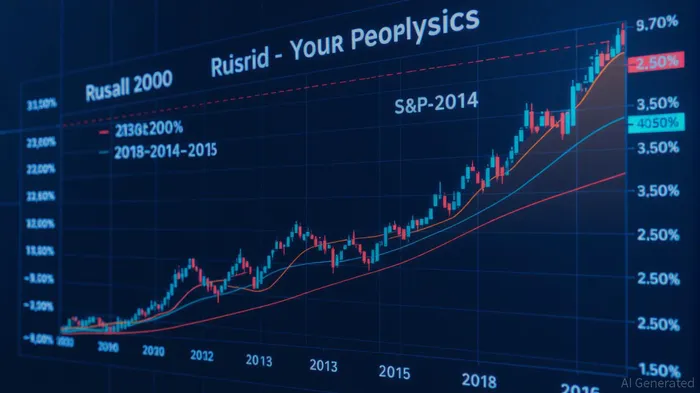
For years, the Russell 2000 has languished in the shadow of its larger cousin, the S&P 500. Small-cap stocks, long dismissed as volatile and overpriced, have underperformed since 2021 as investors flocked to the stability of blue-chip giants. But history has a way of correcting itself—and the current valuation gap between the two indices may signal a pivotal inflection pointIPCX-- for contrarian investors.
The Contrarian Case: A Tale of Two Valuations
As of August 2025, the Russell 2000 trades at a trailing P/E of 33.65, significantly higher than the S&P 500's 25.25. At first glance, this might suggest small-caps are overvalued. But a deeper look reveals a different story. The Russell 2000's price-to-book (P/B) ratio is notably lower than the S&P 500's 5.3374, a metric that historically favors small-cap stocks. While exact figures for the Russell 2000's P/B are not disclosed, its historical tendency to trade at a discount to book value—combined with a 1.48% dividend yield (versus 1.20% for the S&P 500)—paints a compelling value case.
This divergence is not new. During the 2008–2014 recovery, the Russell 2000 outperformed the S&P 500 by 28.2%, leveraging its agility and lower valuations to capitalize on economic normalization. Today, similar conditions are emerging: inflation has stabilized, interest rates are expected to plateau, and small-cap earnings are showing resilience. The Russell 2000's current P/B discount—ranked in the 18th percentile over the past 35 years—suggests it is undervalued relative to historical norms.
Momentum Rotation: When the Cycle Shifts
The U.S. equity market is a pendulum, swinging between growth and value, large-cap and small-cap. For the past five years, the S&P 500 has dominated, buoyed by AI-driven megacap stocks and a low-rate environment. But as the Federal Reserve signals a pivot toward rate stability, the winds of change are shifting. Small-cap stocks, which thrive in low-interest-rate environments and benefit from localized demand, are primed to reclaim their role as growth engines.
Consider the Russell 2000's historical performance during early recoveries:
- 1979–1983: Outperformed by 77% during a double-dip recession.
- 2008–2014: Surged 28.2% post-crisis.
- 2020–2021: Gained 44.4% during the pandemic rebound.
These patterns are not coincidental. Small-cap companies are more sensitive to economic cycles and often lead the charge in early recoveries. With macroeconomic clarity improving—unemployment remains low, consumer spending is robust, and corporate earnings are stabilizing—the Russell 2000 is positioned to mirror its past outperformance.
The Dividend Edge: A Contrarian's Secret Weapon
While the S&P 500's dividend growth is expected to rise modestly (from 75.09 to 79.25 index points by 2030), the Russell 2000's dividend yield currently offers a 23% premium. This anomaly is historically rare and suggests a mispricing. Small-cap companies, often overlooked for their growth potential, are now offering income investors a compelling alternative to large-cap bonds and ETFs.
Strategic Entry Points for Aggressive Investors
For growth-oriented investors, the Russell 2000's valuation reversal presents a dual opportunity:
1. Value Arbitrage: Target sectors like regional banks, industrials, and consumer discretionary, where P/B ratios are at multi-decade lows.
2. Momentum Rotation: Allocate to small-cap ETFs (e.g., IWM) or screen for companies with improving earnings visibility and strong balance sheets.
However, caution is warranted. The Russell 2000's volatility is a double-edged sword. Investors should consider hedging with sector-specific options or diversifying into mid-cap counterparts (e.g., Russell 1000) to mitigate risk.
Conclusion: A Contrarian's Moment
The Russell 2000's current valuation is a mirror of its historical cycles—a discount that precedes a re-rating. As macroeconomic clarity replaces uncertainty and the Fed's rate hikes lose momentum, small-cap stocks are poised to reclaim their place in the spotlight. For investors willing to embrace the contrarian playbook, the Russell 2000 offers a rare blend of value, yield, and growth potential. The question is not whether the Russell 2000 will outperform—it's when.

Stay ahead of the market.
Get curated U.S. market news, insights and key dates delivered to your inbox.


AInvest
PRO
AInvest
PRO



Comments
No comments yet