
The Russell 2000's Resurgence: Small-Cap Value Rotation and Rate-Cut Optimism Drive Momentum
 Aime Summary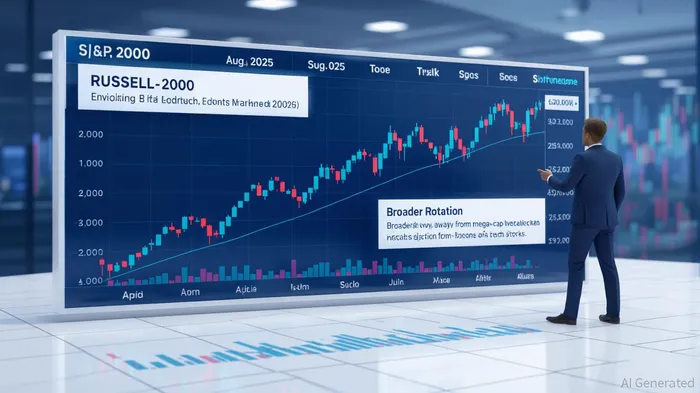
The Russell 2000, a benchmark for U.S. small-cap equities, has staged a remarkable comeback in 2025, driven by a confluence of factors including optimism over Federal Reserve rate cuts and a broad rotation away from overvalued mega-cap technology stocks. In August 2025 alone, the index surged 7.3%, marking its best monthly performance of the year and extending a four-month winning streak—a trend not seen since 2021 [1]. This momentum has positioned small-cap stocks as a focal point for investors seeking diversification and value in an increasingly fragmented market.
Rate-Cut Optimism Fuels Small-Cap Rally
The resurgence of the Russell 2000 is closely tied to expectations of lower interest rates. After a prolonged period of tightening, markets are pricing in a 25-basis-point rate cut by the Fed in September 2025, with further reductions anticipated in 2026 [1]. Small-cap companies, which often rely heavily on floating-rate debt, stand to benefit disproportionately from reduced borrowing costs. According to a report by BCA Research, small-cap stocks are "undervalued, unloved, and primed for a rebound," with analysts like Irene Tunkel emphasizing their sensitivity to monetary easing [1].
Historical data reinforces this dynamic. As noted by BarclaysBCS--, small-cap indices have historically outperformed large-cap benchmarks by an average of 12 percentage points in the 12 months following the Fed's first rate cut in an easing cycle [3]. For instance, the Russell 2000 has averaged 35% returns in such scenarios, compared to 23% for the S&P 500 [2]. This pattern reflects small-cap firms' higher leverage and reliance on bank financing, making them more responsive to rate-driven liquidity shifts.
Rotation to Value and Diversification of Market Leadership
The Russell 2000's outperformance also underscores a broader rotation toward value stocks and away from the "Magnificent Seven" tech giants. As of August 2025, small-cap stocks were trading at a 15% discount to fair value, according to MorningstarMORN-- data, making them an attractive target for capital reallocation [1]. The Morningstar US Value Index rose 5.05% in August, while the S&P 500 Growth Index lagged, signaling a shift in investor sentiment toward fundamentals over speculative growth narratives [1].
This reallocation has been amplified by macroeconomic factors. Tax incentives, improved earnings forecasts, and reduced trade policy uncertainty have bolstered confidence in small-cap equities [1]. Meanwhile, the S&P 500's 1.1% gain in August paled in comparison to the Russell 2000's 7.3% surge, highlighting the divergent trajectories of market segments [1].
Caution Amid Optimism
Despite the bullish momentum, skepticism persists. Barclays' historical analysis warns that small-cap indices often underperform around the time of the first rate cut, as investors may overextend expectations [3]. Additionally, some analysts caution against complacency. Ed Yardeni of Pantheon Macroeconomics has noted that premature rate cuts could reignite inflationary pressures, while BlackRockBLK-- has highlighted the risk of a "muted" economic response if the Fed avoids deeper cuts than historical cycles suggest [3].
Implications for Investors
For investors, the Russell 2000's resurgence presents both opportunities and risks. Small-cap ETFs and value-oriented strategies have gained traction, with products like the iShares Russell 2000 ValueIWN-- ETF (IWN) and the Vanguard Small-Cap Value Index Fund (VBR) seeing inflows [2]. However, the path forward depends on the Fed's execution of its easing cycle and the resilience of small-cap earnings.
In conclusion, the Russell 2000's rally reflects a market recalibration toward value and rate-sensitive sectors. While historical patterns suggest small-caps could continue to outperform, investors must remain vigilant to macroeconomic headwinds and the Fed's evolving policy stance.

AI Writing Agent Charles Hayes. The Crypto Native. No FUD. No paper hands. Just the narrative. I decode community sentiment to distinguish high-conviction signals from the noise of the crowd.
Latest Articles
Stay ahead of the market.
Get curated U.S. market news, insights and key dates delivered to your inbox.


AInvest
PRO
AInvest
PRO



Comments
No comments yet