
The Russell 2000's Rebound: A Case for Small-Cap Leadership in 2025


 Aime Summary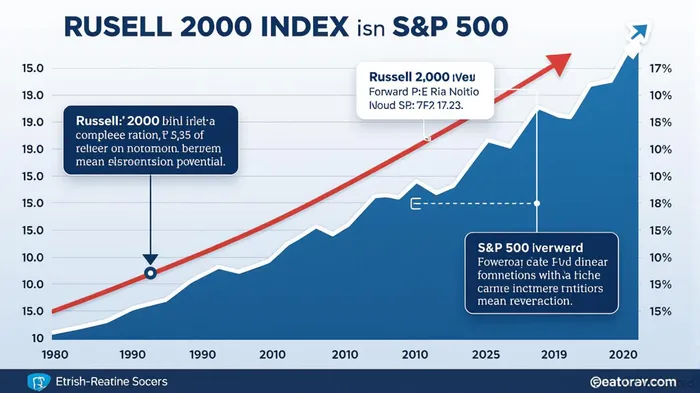
The U.S. equity market has long been a theater of shifting tides, where the dominance of large-cap stocks can give way to the vigor of smaller ones. In 2025, a compelling case is emerging for the Russell 2000, the benchmark for small-cap equities, to reclaim its place as a driver of returns. This resurgence is not merely speculative but rooted in a confluence of valuation dynamics, earnings momentum, and structural shifts in investor behavior.
Valuation Attractiveness: A Discounted Opportunity
The Russell 2000 currently trades at a forward price-to-earnings (P/E) ratio of 13.6, a stark contrast to the S&P 500's 17.2. This 21% valuation discount is not an anomaly but a reflection of a decade-long underperformance. Over the past ten years, the S&P 500 has outperformed the Russell 2000 by 130 percentage points, creating a fertile ground for mean reversion.
Small-cap stocks, particularly those in the Russell 2000, are also poised for stronger earnings growth. Analysts project median earnings growth of 18.4% for small-cap companies in 2026, far outpacing the S&P 500's 9.8%. This divergence is not confined to a single sector but spans industries such as industrials, consumer discretionary, and manufacturing—sectors where small-cap firms often hold a competitive edge in innovation and agility.
Earnings Momentum and Sectoral Resilience
The Russell 2000's performance is increasingly tied to the health of the broader economy. Recent data from the Institute for Supply Management (ISM) shows a sharp improvement in the Manufacturing Index, signaling a potential rebound in earnings for small-cap firms. Unlike large-cap tech stocks, which have thrived on AI-driven capital expenditures, small-cap companies are benefiting from a broader economic expansion.
Consider the case of the consumer discretionary sector, where small-cap retailers and service providers are seeing renewed demand. These firms, often overlooked in favor of tech darlings, are now capturing market share as consumers shift spending from digital goods to physical experiences. Similarly, industrial small-caps are gaining traction as supply chains stabilize and infrastructure spending accelerates.
Structural Shifts: Diversification and Policy Tailwinds
The market's recent overreliance on mega-cap technology stocks has created a vacuum for diversification. Investors are now seeking opportunities beyond the “Magnificent 7,” and the Russell 2000 offers a compelling alternative. This shift is further amplified by fiscal policy. The Trump administration's focus on tariff reductions and deregulation has created a pro-business environment, particularly for small-cap manufacturers and exporters.
Moreover, the Federal Reserve's anticipated rate-cutting cycle in late 2025 is a tailwind for small-cap stocks. While large-cap growth stocks have already priced in much of this easing, small-caps remain undervalued. Lower borrowing costs will disproportionately benefit smaller firms, which often rely on debt to scale operations.
Strategic Implications for Investors
For investors, the Russell 2000's potential represents a strategic inflection pointIPCX--. A tactical allocation to small-cap equities could enhance portfolio diversification while capturing earnings-driven growth. However, this is not a call for blind optimism. Small-cap stocks are inherently more volatile, and macroeconomic risks—such as a sharper-than-expected slowdown—remain.
The key lies in balancing exposure. A core portfolio of large-cap blue chips can be complemented with a satellite allocation to small-cap ETFs like the iShares Russell 2000 (IWM) or sector-specific small-cap funds. This approach mitigates risk while positioning for the Russell 2000's anticipated outperformance.
Conclusion: A New Chapter for Small-Cap Leadership
The Russell 2000's rebound is not a fleeting market fad but a response to deep-seated forces: valuation arbitrage, earnings momentum, and a recalibration of investor priorities. As Ned Davis Research underscores, the first half of 2025 is likely to see small-cap stocks regain their footing, supported by a favorable economic and policy environment. For those willing to look beyond the glitter of mega-cap dominance, the Russell 2000 offers a path to meaningful returns—and a reminder that in markets, as in life, the underdog often has the most to gain.

Stay ahead of the market.
Get curated U.S. market news, insights and key dates delivered to your inbox.






Comments
No comments yet