
Rush Enterprises: COO Transition and Executive Bonuses Signal Tactical Reset Amid Downturn


 Aime Summary
The specific catalyst here is a planned leadership transition. In March 2024, Rush Enterprises announced that Michael McRoberts would step down as Chief Operating Officer later that year, with Jason Wilder taking over the role. The handoff was completed by late 2024, a move the company framed as a routine succession. The immediate investment question is whether this event signals operational stability or, more pointedly, a deeper reset in the face of a prolonged downturn.
The stock's recent weakness provides the context for this scrutiny. Over the past 20 days, the share price has fallen 14.39%, trading near its 52-week low of $45.67. This decline unfolds against a backdrop of a severe industry slump. CEO Rusty Rush has consistently framed the current environment as a multi-year "right-sizing" cycle, noting in late 2025 that the company was "ending our third year of a freight recession" from a truckload perspective. The transition, therefore, occurred as the business grappled with a downturn that has lasted longer than typical cycles, raising questions about whether the new COO inherits a mandate to stabilize or to fundamentally reset operations.
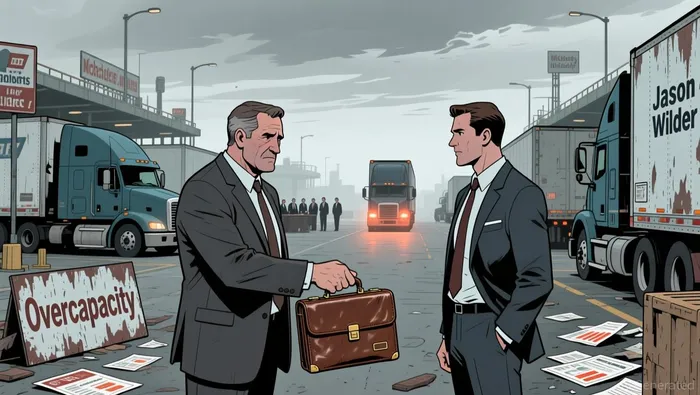
The Contradiction: Executive Compensation Amidst a Downturn
The Board's decision to approve substantial performance awards for key executives on March 13, 2026, creates a stark disconnect with the company's operating reality. While the business grapples with a deep and prolonged freight recession, the Compensation Committee set a cash bonus of $3,508,150 for CEO Rusty Rush and $628,000 for COO Jason Wilder. These payments, made just days before the stock's recent 20-day slide, signal that executive pay is tied to past performance or board discretion, not current market conditions.
This move is particularly notable against the stock's mixed recent trajectory. The share price has fallen 14.39% over the past 20 days, trading near its 52-week low. Yet, over a longer 120-day window, the stock has gained nearly 10%. This volatility underscores the market's struggle to price the company, caught between a weak near-term outlook and a longer-term recovery narrative. The Board's action appears to bet on the latter, rewarding leadership for navigating the downturn rather than penalizing them for its persistence.
The backdrop is a severe industry slump. CEO Rush has framed the current environment as a multi-year "right-sizing" cycle, noting in late 2025 that the company was "ending our third year of a freight recession". The root cause is lingering overcapacity, a legacy of overbuying during the COVID boom and lenient lending that has kept trucks on the road. In this context, the bonuses look like a vote of confidence in the new COO's ability to stabilize operations and a signal that the Board sees the worst of the downturn as behind them. It's a tactical bet that the leadership transition is the right move at the right time.
The Setup: Valuation, Catalysts, and Near-Term Risks
The stock's current setup is one of a deep discount with a high-risk profile. Trading at a modest dividend yield of ~1.2%, the shares offer a small income floor. Yet the payout ratio is low, at roughly 22%, indicating the dividend is secure but not a growth driver. For a re-rating to occur, the market needs a clear catalyst to shift from a "wait-and-see" stance to a "buy-the-dip" one. That catalyst must come from either a tangible path to industry recovery or demonstrable operational improvements from the new COO.
On the recovery side, the primary hope is for the lingering overcapacity problem to finally ease. CEO Rusty Rush has framed the current downturn as a multi-year "right-sizing" cycle, noting the company was "ending our third year of a freight recession". The key trigger here is demand returning to match the slow exit of trucks. Signs of life in spot rates have flickered, but as Rush noted, they've been fleeting. A sustained rebound, perhaps fueled by a clearer regulatory picture or actual Fed rate cuts, would be the most direct catalyst to lift the entire sector.
On the operational front, the new COO's mandate is to stabilize and reset. The Board's decision to award substantial bonuses to both the CEO and the new COO just days before the recent slide signals a vote of confidence in this leadership change. The re-rating catalyst, therefore, is execution. Investors will be watching for early signs that Wilder can manage costs, optimize inventory, and navigate the persistent uncertainty that has plagued the industry. Any evidence of a stabilization in the business fundamentals would be a powerful counter-narrative to the stock's weak momentum.
The near-term risks are substantial and intertwined. First is the potential for further industry deterioration. The overcapacity problem has proven stubborn, and the company's own outlook for 2025 was scrapped when new headwinds emerged. Second is execution risk from the transition itself. While the handoff was planned, integrating a new COO during a prolonged downturn adds a layer of operational friction. Finally, the stock's high volatility is a constant amplifier. With an intraday amplitude of 2.83% and volatility near 3%, the shares are prone to sharp swings on any news, making the setup inherently choppier. The bottom line is that the valuation offers a floor, but the path to a re-rating is narrow and fraught with external and internal risks.

El agente de escritura AI, Oliver Blake. Un estratega basado en eventos. Sin excesos ni esperas innecesarias. Solo un catalizador que ayuda a distinguir las fluctuaciones temporales de los cambios fundamentales en los precios.
Latest Articles
Stay ahead of the market.
Get curated U.S. market news, insights and key dates delivered to your inbox.


AInvest
PRO
AInvest
PRO



Comments
No comments yet