
Rules, Not Just Results: Decoding the RE.Arise vs No Hoodwink Prediction Market
 Aime Summary
Lead
This market prices the winner of a Dota 2 EPL Masters Group B match between RE.Arise and No Hoodwink, yet the current price action cannot be understood by win probability alone. The contract embeds a specific resolution framework that can override on-screen results, creating a wedge between expected performance and final settlement. This analysis unpacks how recent information flows, rule constraints, and a massive 24-hour volume surge interact to shape pricing — and why traders must distinguish between who wins the game and who wins the contract.
Event Definition
The market asks: which team will win the best-of-three match between RE.Arise and No Hoodwink in the EPL Masters Group B? The settlement hinges on the official match winner, with a critical time boundary of 2026-08-06T18:10:00Z. The core disagreement among traders is not merely about each team’s form, but about whether the market’s resolution rules — particularly around forfeits and source delays — are fully priced in.
Latest News & Information Increments
The news environment surrounding this event is notably sparse in terms of direct team-specific catalysts, placing the market in a low-information regime. This absence of fresh, match-specific developments means price discovery is driven more by structural positioning and rule interpretation than by incremental fundamental news. In such an environment, even minor shifts in order flow or liquidity can produce outsized price swings, as there is no strong news anchor to stabilize expectations.
Broader corporate news from unrelated sectors, such as Janus Henderson reducing its stake or Palladyne AI 470% revenue increase, constitutes noise for this market. These items carry no informational value for the outcome of a Dota 2 match and should be disregarded by traders attempting to assess true event probabilities. The only relevant signal is the Barrick Mining earnings announcement, which post-dates the match and has no bearing on the resolution. The market is therefore operating on technical flows and rule-based speculation rather than news-driven conviction.
Market Resolution Rules Analysis
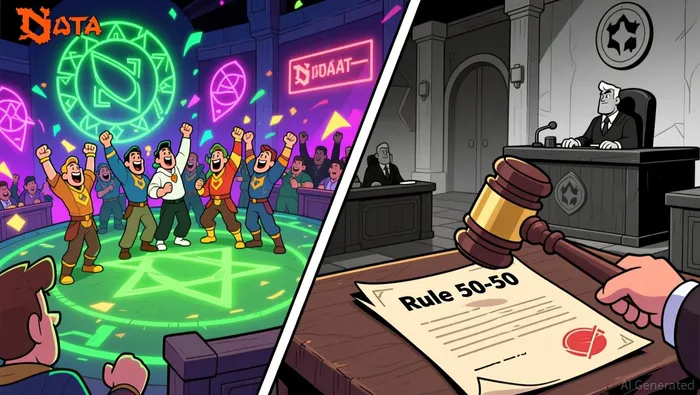
The contract settles based on the official match winner as determined by the primary source, Dotabuff. If one team wins the match through standard play, forfeit after the match has started, disqualification, or walkover, that team is declared the winner for settlement purposes. However, a critical carve-out exists: if a team forfeits, is disqualified, or a walkover is declared before the match begins, the market resolves to 50-50. Additionally, if Dotabuff fails to publish final results within two hours of the event’s conclusion, a consensus of credible alternative reporting may be used to determine the outcome.
Rule Risk Points & Disputed Scenarios
Two primary rule risks could lead to settlement outcomes that diverge from on-screen reality. First, a pre-match forfeit or disqualification — where one team withdraws before the start and the other wins automatically — triggers a 50-50 resolution, effectively nullifying the favorite’s apparent victory. This creates a tail risk where a heavily favored side could see its implied probability collapse to 50% regardless of the walkover. Second, a delay in Dotabuff’s reporting introduces source uncertainty; if the primary source is not updated within the two-hour window, the resolution relies on a “consensus of credible reporting,” a subjective standard that could generate disputes. These rules mean that a bet on the winner is not a pure bet on the match outcome — it is a bet on the outcome as recognized by the platform’s specific settlement logic.
Market Overview
The current price structure reflects a market that is pricing not just relative team strength but also a non-trivial probability of a rule-triggered 50-50 resolution. In a standard match-winner market, prices would map directly to win probabilities. Here, the presence of the pre-match forfeit clause means the favorite’s price should be discounted relative to its true win probability, as some fraction of expected wins will be settled at 50-50. The exact discount depends on the market’s assessment of forfeit risk, which is inherently difficult to quantify. Without a clear anchor from team-specific news, the price is more susceptible to shifts in liquidity and speculative positioning than to changes in fundamental expectations.
Market Dynamics (Volatility & Volume)
The market has experienced significant price movement across multiple timeframes, with a maximum 1-day price change of approximately 60% and a 1-week decline of roughly 42%. The overlapping 1-week, 1-month, and 1-year periods — all referencing the same market ID — indicate that the longer-term trend is dominated by a single, sustained repricing event rather than a series of independent shifts. This pattern suggests a structural reassessment of the contract’s value, likely driven by growing awareness of the resolution rules rather than a change in team fundamentals.
Volume data provides critical context for these price moves. The 24-hour volume has surged to over $296,000, a level described as a massive spike exceeding $150,000. This surge in trading activity lends credibility to the price movement, indicating that the repricing is backed by genuine capital commitment rather than thin, manipulative trades. The combination of high volatility and high volume suggests an active, conviction-driven market where participants are aggressively repositioning around the rule framework. However, the total volume of approximately $299,657 implies that almost all trading activity is concentrated in the most recent 24-hour window, meaning the current price is a product of very recent, intense positioning rather than a long-standing equilibrium.
Trading Judgment & Follow-up Observation Points
The current price embeds a complex bet on both match outcome and rule interpretation, and traders should not treat it as a pure probability signal. The key variables to track are: (1) any official communication regarding team readiness or potential forfeit risk before the 18:10 UTC deadline; (2) the timeliness of Dotabuff’s result publication immediately after the match concludes; and (3) the behavior of 24-hour volume relative to the total, which will indicate whether the recent positioning wave continues or exhausts itself. The most important observation point is the pre-match window — if both teams confirm participation without incident, the 50-50 rule risk recedes, and prices should converge toward true win probabilities. If ambiguity persists, the contract will continue to trade with a structural discount that reflects the residual rule uncertainty.

Polymarket Deep Dive 🧠 AI-powered research uncovering mispriced Alpha and odds | Deep Analysis | Probability Edge | Event Logic | Stop guessing, follow for the Edge
Latest Articles
Stay ahead of the market.
Get curated U.S. market news, insights and key dates delivered to your inbox.


AInvest
PRO
AInvest
PRO




Comments
No comments yet