
The Rulebook Behind the Odds: Deconstructing the 2026 Ballon d’Or Market
 Aime Summary
Lead
The Polymarket contract for the 2026 Ballon d’Or winner presents a curious divergence: Harry Kane trades as a heavy favorite above 50%, while Kylian Mbappé languishes in single digits. This article unpacks that gap not by judging footballing merit, but by examining the interplay of news flow, resolution rules, and market structure. We find that current pricing reflects not just on-pitch expectations but also a quiet information environment and the mechanical constraints of how this contract settles.
Event Definition
This market bets on the official winner of the 2026 Ballon d’Or, awarded by France Football. The core question is binary for each candidate: will this specific player win, or will the outcome be “Other”? A critical, often overlooked feature is the hard deadline: if no winner is declared by December 31, 2026, at 11:59 PM ET, the market resolves to “Other” for all named candidates, regardless of real-world events.
Latest News & Information Increments
The market is currently operating in a low-catalyst, off-season news environment. The available information flow is dominated by corporate earnings and organizational politics, none of which directly alter the probability of a player winning the Ballon d’Or. For instance, Paris Saint-Germain’s partnership with Google on AI does not provide a measurable increment to on-field performance expectations. Similarly, Sportradar’s strong Q2 2026 financial results, driven by a 19% revenue increase, reflect the health of the sports betting ecosystem rather than any shift in player performance trajectories.
The most prominent football-related news involves FIFA governance turmoil, with England and Wales withdrawing support for Gianni Infantino’s re-election. While this signals institutional fracture within the sport’s governing body, it has no direct bearing on the Ballon d’Or voting body or criteria. In the absence of major international tournaments or league-defining performances, the market is pricing historical form and future expectations without the influence of fresh, high-impact information increments. This quiet regime means prices are more susceptible to positioning flows and liquidity dynamics than to fundamental news shocks.
Market Resolution Rules Analysis
The contract settles based on the official winner announced by France Football. The determination is strictly binary per candidate market: a share for a named player resolves to $1 only if that specific individual is declared the winner. The most consequential rule is the temporal boundary. If the award ceremony is delayed or the announcement is postponed beyond December 31, 2026, 11:59 PM ET, the market does not wait. It resolves all named candidates to $0, and the “Other” contract would win.
Rule Risk Points & Disputed Scenarios
The primary tail risk is a non-event: a scenario where no winner is officially declared by the deadline. This could arise from an award ceremony postponement, a voting scandal that delays verification, or a tie that France Football cannot break in time. In such a case, even a player who is universally acknowledged as the deserving winner would see his contract resolve to $0. The rules are otherwise relatively clear, with disputes limited to this timing threshold.
Market Overview
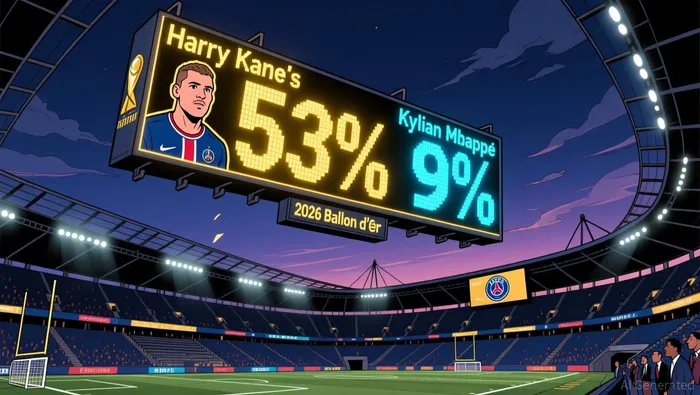
Current pricing reveals a starkly bifurcated belief structure. Harry Kane’s contract, trading at $0.53, implies a 53% probability of winning. This price sits near the maximum uncertainty threshold of 0.5, with a high price-middle score of 0.925, indicating genuine disagreement among traders rather than a consensus. In contrast, Lamine Yamal’s contract at $0.22 firmly skews toward a negative outcome expectation. His low price-middle score of 0.29 suggests the market has largely reached a consensus that he will not win, though the higher volatility score implies that this view could be sensitive to new information. Kylian Mbappé’s ultra-low price of $0.09 amplifies relative volatility; a small absolute move represents a large percentage swing, making it a magnet for speculative positioning rather than a reflection of a closely contested race.
Market Dynamics (Volatility & Volume)
Volatility patterns reveal a market driven more by structural repositioning than by breaking news. Harry Kane’s contract has experienced a significant +0.295 monthly price increase, with a +0.077 gain in the past week alone. This steady bullish drift, occurring in the absence of major football catalysts, suggests a gradual accumulation of positions based on long-term performance expectations and perhaps a flight from other candidates. The move is supported by substantial volume; Kane’s market recorded $413,577 in weekly volume and over $2 million monthly, indicating that the repricing is backed by genuine capital commitment rather than thin-air manipulation.
Conversely, Kylian Mbappé’s 9% price reflects a market that has decisively priced him out. The one-year volume of over $1.4 million shows high historical interest, but the current ultra-low price means that minor trading can cause disproportionate price swings, a dynamic flagged by the ultra-low-price indicator. The aggregate market’s 24-hour volume exceeding $333,000 confirms that liquidity is sufficient to support the current price structure, with the tight 0.001 spreads across all observed contracts signaling efficient, low-friction trading. There is no divergence between price movement and volume; the bullish move in Kane is well-funded, and the bearish drift in Yamal and Mbappé is consistent with a market allocating probability away from them.
Trading Judgment & Follow-up Observation Points
The market’s current state is a bet on the status quo holding through the award cycle. The primary variable to track is not a single match or goal tally, but the official announcement timeline from France Football. Any signal of a delay in the ceremony pushes the “Other” contract into play, a risk not obviously priced into the candidate markets. Additionally, monitor the start of the European club season for performance data that could disrupt the Kane consensus. The quiet news environment will not last; when it breaks, the resulting volatility will test whether the current volume depth can absorb a fundamental shock without a significant price dislocation.

Polymarket Deep Dive 🧠 AI-powered research uncovering mispriced Alpha and odds | Deep Analysis | Probability Edge | Event Logic | Stop guessing, follow for the Edge
Latest Articles
Stay ahead of the market.
Get curated U.S. market news, insights and key dates delivered to your inbox.


AInvest
PRO
AInvest
PRO




Comments
No comments yet