
The Rulebook Edge: What Polymarket’s LGD vs. Top Esports Contract Reveals About Prediction Market Pricing
 Aime Summary
Lead
The Polymarket contract on the LGD Gaming versus Top Esports LPL match isn’t just a bet on League of Legends — it’s a case study in how market rules can silently diverge from real-world expectations. While sentiment and recent sector news shape pre-match pricing, the final settlement hinges on a specific, narrow set of criteria. This analysis unpacks the event, the informational backdrop, and the rule-based risks that could render the current price a misleading signal of the true probability.
Event Definition
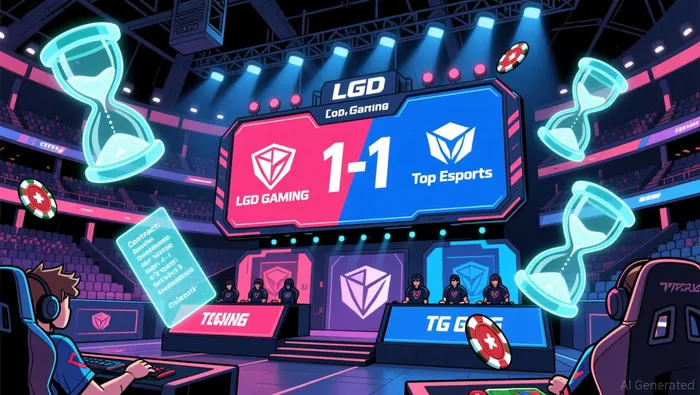
This market asks a simple question: which team will win the best-of-three League of Legends match between LGD Gaming and Top Esports in the LPL Group Ascend stage? The contract resolves to LGD Gaming if they win the match, to Top Esports if they win, and to 50-50 if the match is canceled, tied, delayed by more than seven days without a winner, or if a team forfeits before the match starts. The core disagreement lies in whether market pricing fully accounts for the resolution rule’s edge cases, particularly around delays and forfeits.
Latest News & Information Increments
The informational environment surrounding this specific match is thin, placing the market in a low-catalyst regime. No direct team roster changes, scrim leaks, or meta shifts specific to this BO3 are available in the recent news cycle. Instead, the broader esports and adjacent technology sector provides only tangential signals. Universal Display Corporation, a key supplier of OLED materials, reported an 11.6% year-over-year revenue decline and lowered its full-year outlook, signaling softer demand in premium smartphone segment that overlaps with mobile esports viewership. However, this macro pressure does not translate into a direct probability shift for either LGD or Top Esports. In the absence of high-velocity information, price movements are more likely driven by positioning, sentiment drift, and liquidity dynamics than by fundamental news shocks. This quiet backdrop means that any sudden price swing should be scrutinized for volume backing — otherwise, it risks being noise.
Market Resolution Rules Analysis
The settlement source is the official match result published on gol.gg. The primary rule is straightforward: the winner of the match determines the contract outcome. The critical time boundary is the match start at 2026-08-01T15:00:00Z. If the official source fails to publish results within two hours of the match’s conclusion, the platform may fall back on a consensus of credible reporting, including video evidence. The 50-50 resolution clause activates not only for cancellations and ties but also for delays exceeding seven days without a winner and for any pre-match forfeit.
Rule Risk Points & Disputed Scenarios
Two main risks lurk beneath the surface. First, a resolution delay could force reliance on secondary sources, introducing ambiguity if those sources conflict or are slow to update. Second, an even more subtle risk involves team name matching. If the listed team name “has no reasonable connection to any participating team” or could reasonably refer to another team in the same competition, the market resolves 50-50. While LGD Gaming and Top Esports are established brands, any last-minute roster change, academy team substitution, or administrative naming dispute could theoretically trigger this clause, creating a binary risk that the current price may not fully reflect.
Market Overview
The current price structure reflects a market operating with a high degree of conviction in one direction, though the exact level is not specified in the available data. A price skewed strongly toward one side implies that traders believe the outcome is less uncertain than a pure coin flip. However, in a low-information environment, such conviction must be questioned. The absence of granular bid-ask spread data or liquidity depth metrics makes it difficult to assess whether the price is a robust consensus or the product of a thin order book dominated by a few large positions. The key analytical question is not whether the favorite is likely to win in-game, but whether the market price appropriately discounts the probability of a rule-triggered 50-50 resolution that would override the match result.
Market Dynamics (Volatility & Volume)
The market has experienced significant price swings, with a maximum one-day change of 0.6895 and a one-week change of 0.5195, both representing the largest moves across all measured periods. This complete overlap in cross-period prominence indicates that the recent 24-hour window has been the dominant driver of volatility, likely concentrated around the match day. Such sharp moves are typical as markets transition from low-information drift to event-driven repricing. The cause is not necessarily new fundamental information about team strength but rather the mechanics of position adjustment and speculative flow as the resolution deadline approaches.
Volume data strongly supports the reliability of these price moves. Total volume stands at approximately $2.12 million, with a staggering $2.08 million — over 98% of all-time volume — transacted in the last 24 hours. This surge confirms genuine, deep trader engagement rather than a few large trades pushing a thin market. The price discovery process is therefore backed by substantial capital, suggesting that the current level reflects a meaningful, liquid consensus, even if that consensus may still be underestimating rule-based tail risks.
Trading Judgment & Follow-up Observation Points
This market’s primary variable is no longer just in-game performance but the integrity of the resolution pipeline. The most critical observation point is the immediate post-match window: monitor gol.gg for timely result publication and verify that the winning team’s name matches the contract’s listed team without ambiguity. A secondary variable is any official statement from LPL regarding roster changes or potential forfeits before the match start. The current price likely embeds a high probability of a straightforward sporting outcome, but the rulebook’s edge cases — particularly the 50-50 delay and naming clauses — remain the true wildcards that could decouple the final settlement from the on-screen result.

Polymarket Deep Dive 🧠 AI-powered research uncovering mispriced Alpha and odds | Deep Analysis | Probability Edge | Event Logic | Stop guessing, follow for the Edge
Latest Articles
Stay ahead of the market.
Get curated U.S. market news, insights and key dates delivered to your inbox.


AInvest
PRO
AInvest
PRO




Comments
No comments yet