
The Rulebook Behind the Ballon: Why the 2026 Polymarket Contract Is a Study in Event Risk
 Aime Summary
Lead
The Polymarket contract for the 2026 Ballon d’Or winner is pricing in a near-coin-flip probability for Harry Kane, yet the market’s structure is less about footballing merit and more about a strict settlement deadline. While news flow around the sport’s data economy is accelerating, the contract’s resolution rules introduce a binary cliff that raw news cannot price. This piece dissects the gap between sportive reality and contractual finality, examining why current prices reflect not just player odds, but a wager on institutional punctuality.
Event Definition
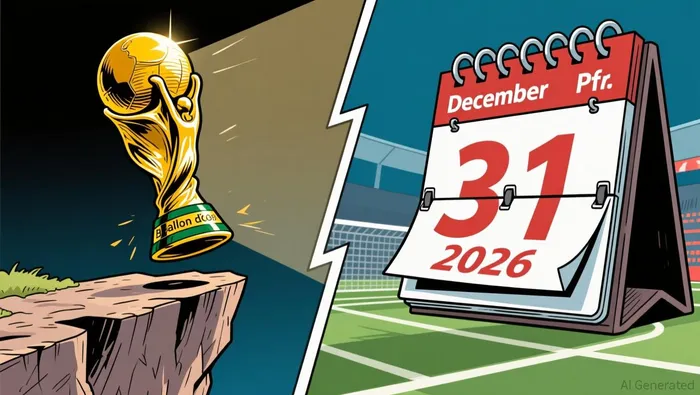
This market asks traders to predict the winner of the 2026 Ballon d’Or, the prestigious individual award presented by France Football. The contract settles to the named winner if one is officially declared by December 31, 2026, at 11:59 PM ET. If no winner is declared by that hard deadline, the market resolves to “Other,” regardless of any subsequent announcement. The core disagreement today is not simply who will win the award, but whether the award’s administrative timeline will align with the platform’s settlement window.
Latest News & Information Increments
The current news environment is dominated by commercial and structural developments in sports data rather than direct on-pitch catalysts for Ballon d’Or candidates. SportradarSRAD-- reported a 19% year-over-year revenue increase to €378 million for the second quarter, with U.S. revenue climbing 16% to €101.8 million. This signals robust institutional demand for the data infrastructure that underpins modern football analytics. In a parallel move, Sportradar announced a multi-year global agreement with Kalshi, the world’s largest prediction market, positioning itself as an official data and solutions provider. This partnership directly links the sports data backbone to the prediction market sector, potentially improving data integrity but not altering individual player award probabilities.
On the club and technology front, Paris Saint-Germain partnered with Google to designate Google Gemini as its official AI assistant, a deal that includes a branded space at the Parc des Princes stadium. While this reflects the growing entanglement of AI and elite football, it constitutes noise for the Ballon d’Or contract. The market is operating in a low-information regime for player-specific award narratives. In such an environment, price stability can be deceptive; thin catalysts mean positions are vulnerable to sudden repricing when genuine award-season signals finally emerge. The absence of injury news, voting-body leaks, or major tournament performances means the current price structure is largely a bet on status quo expectations and deadline mechanics.
Market Resolution Rules Analysis
The contract settles based on the official winner declared by France Football. The critical constraint is temporal: the declaration must occur by December 31, 2026, at 11:59 PM ET. If the awarding body delays its announcement beyond this cutoff — whether due to organizational changes, sponsorship disputes, or editorial calendar shifts — the market resolves to “Other,” even if a player is universally acknowledged as the winner shortly thereafter. The settlement object is binary in practice: a named winner before the deadline, or “Other.”
Rule Risk Points & Disputed Scenarios
The primary risk is a failure to declare a winner by the deadline. If France Football postpones the ceremony or the official publication of results past December 31, 2026, the entire market resolves to “Other,” vaporizing positions on all named contenders. A secondary, though lower-probability, risk lies in the contract’s reliance on a single official source. Any ambiguity in France Football’s announcement format — for instance, a preliminary leak versus an official publication — could generate disputes, though the rule’s plain language privileges the official declaration. These structural features mean that a trader correctly identifying the best footballer of 2026 can still lose their position if the announcement schedule slips.
Market Overview
Harry Kane’s “Yes” contract trades at 0.53, implying a roughly 53% probability of victory. This near-even pricing reflects a deeply contested market rather than a consensus view. Lamine Yamal’s “Yes” contract sits at 0.217, indicating the market assigns a low probability to his winning in this specific cycle. The divergence in price structure is stark: Kane’s market shows higher liquidity, with a liquidity number around 332,600 compared to Yamal’s 261,405, and tighter pricing efficiency. Kane’s tradability and activity scores are notably higher, suggesting that the market is not merely pricing a higher chance of victory but also attracting more sophisticated order flow. The bid-ask spread for both markets is identically narrow at 0.001, which can mask the reality that depth is asymmetric. The weighted scores — 0.7052 for Kane versus 0.5448 for Yamal — reinforce that the market views Kane’s outcome as more predictable, though this confidence may partly derive from the deadline-driven “Other” risk being priced unevenly across contracts.
Market Dynamics (Volatility & Volume)
The one-month maximum price change reached 0.295, a significant swing that likely captured the transition from the club season’s end into the summer speculation window. Over the past week, Kane’s contract rose by 0.083, moving from a lower baseline to its current mid-point, while Yamal’s experienced a 0.037 decline. These weekly moves establish directional conviction, yet one-day changes remain modest — 0.005 for Kane and 0.006 for Yamal — indicating that immediate intraday volatility is contained. The overlap of Kane’s contract in both one-week and one-month volatility rankings confirms it is the locus of repricing activity. This price action appears driven by a gradual repositioning toward the perceived frontrunner rather than a sharp news catalyst, consistent with a market digesting deadline risk.
Volume data confirms genuine backing for these price levels. Total trading volume has reached an exceptional $25.7 million, demonstrating massive global interest. The 24-hour volume alone surged past $333,000, placing it in a high-activity regime. Crucially, there is no divergence between price movement and volume: the weekly repricing in Kane’s contract is accompanied by deep liquidity and elevated activity scores. This suggests the current 0.53 price is not a thin, easily manipulated level but a genuine equilibrium between buyers and sellers. The market is liquid enough to absorb position shifts without excessive slippage, lending credibility to the price signal.
Trading Judgment & Follow-up Observation Points
The current price embeds a dual bet: that Harry Kane is the on-pitch favorite, and that France Football will execute its announcement without administrative delay. Traders should track three variables going forward. First, any official communication from France Football regarding the 2026 ceremony date is paramount; a scheduled date beyond December 31 would instantly reprice all “Yes” contracts toward zero. Second, monitor the autumn international break for voting-body sentiment leaks, which will be the first genuine information to challenge the current low-catalyst regime. Third, watch for volume spikes in the “Other” contract, which would signal that sophisticated capital is beginning to price the deadline risk independently of player merit.

Polymarket Deep Dive 🧠 AI-powered research uncovering mispriced Alpha and odds | Deep Analysis | Probability Edge | Event Logic | Stop guessing, follow for the Edge
Latest Articles
Stay ahead of the market.
Get curated U.S. market news, insights and key dates delivered to your inbox.


AInvest
PRO
AInvest
PRO




Comments
No comments yet