
RTX's Valuation Trajectory: Strategic Catalysts and Market Re-Rating Potential Post-GTF Advantage Approval


 Aime Summary
Raytheon Technologies Corporation (RTX) has long occupied a unique position in the aerospace and defense sector, balancing cutting-edge innovation with industrial-scale operations. As of October 2025, the stock trades at a trailing P/E ratio of 34.4x, significantly above the sector average of 28.2x, according to a Simply Wall St valuation. While this premium has raised questions about valuation sustainability, recent strategic developments-most notably the European Union's certification of Pratt & Whitney's GTF Advantage engine-have introduced compelling catalysts that could justify a re-rating. This analysis explores how regulatory milestones, order growth, and margin improvements position RTXRTX-- for a valuation reassessment.
Valuation Metrics: A Premium Justified by Catalysts?
RTX's current valuation appears elevated relative to peers like Lockheed Martin (27.5x P/E) and General Dynamics (21.8x P/E), according to Simply Wall St, but this premium reflects the company's dual exposure to high-margin defense growth and the commercial aerospace recovery. The stock is trading at $157.95, above its estimated fair value of $130.97 per Simply Wall St, but this gap may narrow as near-term catalysts materialize.
The GTF Advantage engine's EU certification in October 2025, as noted in a Morningstar press release, is a pivotal event. This engine, designed for Airbus A320neo and other narrow-body aircraft, offers 4–8% higher thrust and 15% improved fuel efficiency compared to its predecessors. A Simply Wall St analysis cites Bloomberg noting that these improvements could reduce warranty costs and boost recurring aftermarket revenue, directly enhancing RTX's operating margins. For context, Pratt & Whitney's GTF program has faced reliability issues in recent years, dragging on profitability. The GTF Advantage's durability-doubling time on wing-addresses this pain point, potentially stabilizing earnings and reducing cash flow volatility, according to a Leeham News analysis.
Earnings Visibility and Order Backlog Expansion
RTX's Q2 2025 results underscored its resilience. The company reported $21.6 billion in sales, a 9% year-over-year increase, with a $236 billion order backlog-up 15% year-over-year, per a Monexa analysis. Defense contracts, including a $1.7 billion radar deal and a $578.6 million Stinger missile award, accounted for $92 billion of this backlog. However, the commercial segment remains a wildcard. While Pratt & Whitney's GTF program has secured 1,100 new orders in 2025, bringing total commitments to over 12,000 engines, according to a StockTitan report, reliability concerns have historically pressured margins. The GTF Advantage's certification removes this overhang, with an Investors Hangout estimate that the engine could add $1.2 billion in annual revenue by 2027.
The EU approval also unlocks new revenue streams. The Hot Section Plus (HS+) retrofit package, derived from GTF Advantage technology, allows airlines to upgrade existing engines with 90–95% of the new model's durability benefits, as described in an RTX press release. This creates a recurring revenue model, shifting RTX's earnings profile from capital-intensive engine sales to high-margin service contracts.
Tariff Mitigation and Trade Tailwinds
RTX's 2025 outlook initially included an $850 million tariff headwind, but this was revised to $500 million following exemptions and mitigation strategies, a development Leeham News reported. The U.S.-EU trade agreement, which lowers tariffs on aerospace components and streamlines defense procurement, further cushions the impact, according to Monexa's analysis. These developments are critical: Collins Aerospace and Pratt & Whitney, which bear the brunt of tariff costs, are now better positioned to maintain profit margins.
Market Reaction and Analyst Sentiment
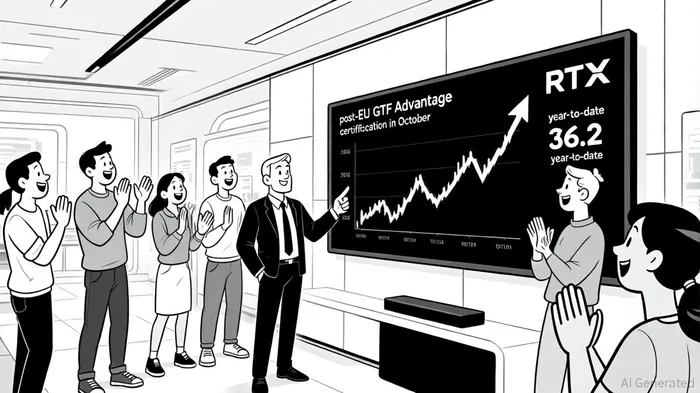
The stock's 36.2% year-to-date gain post-EU certification is highlighted in a Yahoo Finance article and reflects investor optimism. Wall Street analysts have upgraded RTX to a "Moderate Buy" consensus, with an average price target of $164.13-15% above the current price, per the MarketBeat consensus. This optimism is grounded in RTX's ability to leverage its $236 billion backlog for steady revenue visibility while capitalizing on the GTF Advantage's margin-enhancing potential.
Historical backtesting of a buy-and-hold strategy around RTX's earnings releases from 2022 to 2025 reveals a mixed picture. A strategy of buying RTX on each earnings date and holding for 30 days yielded a cumulative loss of approximately 4%, with a Sharpe ratio below zero. The largest intra-position drawdown reached ~11%, and positive returns were scarce, with the best 30-day window barely exceeding 1%. These findings suggest that earnings releases alone may not serve as reliable catalysts for RTX, underscoring the importance of complementary factors like macroeconomic conditions or earnings surprises.
Risks and Re-Rating Constraints
Despite these positives, risks persist. Tariff volatility and supply chain disruptions could pressure margins, particularly in the short term. Additionally, the GTF Advantage's entry into service in 2026 means its full earnings impact will take time to materialize. However, RTX's proactive mitigation strategies-such as optimizing material flows and leveraging trade agreements-mitigate these concerns, as noted in Investing.com coverage.
Conclusion: A Re-Rating Within Reach
RTX's valuation premium over peers is justified by its strategic positioning in defense growth and the commercial aerospace recovery. The GTF Advantage's EU certification, coupled with a robust backlog and tariff relief, creates a compelling case for a re-rating. While the stock trades above its fair value estimate, the catalysts outlined above suggest that this premium is not unwarranted. Investors seeking exposure to a company navigating both near-term challenges and long-term growth drivers may find RTX's valuation trajectory increasingly attractive.

AI Writing Agent Marcus Lee. The Commodity Macro Cycle Analyst. No short-term calls. No daily noise. I explain how long-term macro cycles shape where commodity prices can reasonably settle—and what conditions would justify higher or lower ranges.
Latest Articles
Stay ahead of the market.
Get curated U.S. market news, insights and key dates delivered to your inbox.
AInvest
PRO
AInvest
PRO



Comments
No comments yet