
Ørsted's Near-Term Profitability Risks Amid Renewable Energy Exposure


 Aime Summary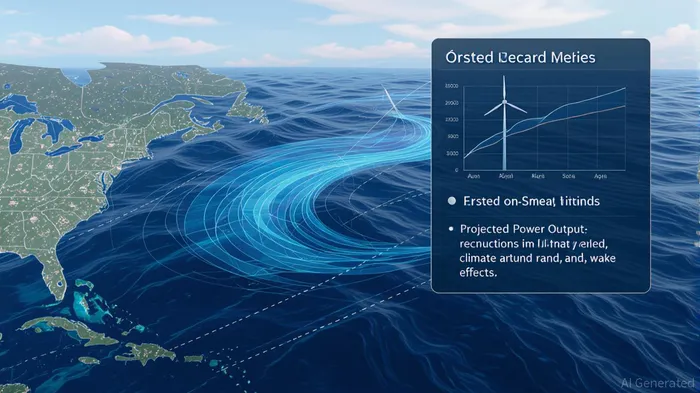
The global transition to renewable energy has positioned Ørsted as a leader in offshore wind, but the Danish energy giant now faces mounting near-term profitability risks. These stem from a dual threat: shifting wind patterns undermining project efficiency and regulatory headwinds disrupting execution timelines and capital allocation. For investors, understanding these operational and project execution risks is critical to assessing Ørsted’s resilience in a rapidly evolving energy landscape.
Operational Risks: Climate Variability and Wake Effects
Recent studies underscore how internal climate variability and anthropogenic warming are altering wind patterns in the North Atlantic, where Ørsted operates several U.S. projects. The 2023 “horseshoe-shaped” sea surface temperature (SST) anomaly—a hallmark of internal variability—exacerbated extreme ocean conditions, compounding the effects of long-term climate change [2]. Such shifts threaten the reliability of wind farms like South Fork (130 MW) and Revolution Wind (704 MW), which rely on consistent wind resources to meet power generation targets.
Meanwhile, wake-induced power losses—caused by the dense deployment of turbines—pose an immediate and measurable threat. In the German Bight, a comparable region to Ørsted’s U.S. projects, inter-cluster wake losses are projected to rise to 2.5% by 2027, while intra-cluster losses could hit 4.3% [1]. Though these figures are specific to Europe, they highlight a global trend: as wind farms proliferate, their proximity reduces overall efficiency. For Ørsted’s U.S. projects, which are concentrated along the East Coast, similar wake effects could erode capacity factors and delay returns on investment.
Regulatory Headwinds: U.S. Policy Shifts and European Uncertainty
The Trump administration’s aggressive anti-renewable energy policies have created a regulatory quagmire for Ørsted in the U.S. The “One Big Beautiful Bill Act,” signed in July 2025, phases out key tax credits for offshore wind projects, including the Production and Investment Tax Credits, which were critical to financing ventures like Sunrise Wind (924 MW) [1]. This has forced Ørsted to abandon its planned “farm-down” strategy for Sunrise Wind, absorbing an additional DKK 40 billion (US$6.3 billion) in costs from 2025 to 2027 [1].
Compounding these financial strains, the Bureau of Ocean Energy Management (BOEM) issued a stop-work order for the 704-MW Revolution Wind project in August 2025, halting construction despite 80% completion [3]. The order, justified under national security concerns, has cost Ørsted $50 million per week in lost revenue and operational delays [5]. Revolution Wind’s lawsuit against the administration underscores the legal and political volatility now embedded in U.S. offshore wind development [2].
In Europe, Ørsted’s strategic pivot to core markets has not been without challenges. The cancellation of the Hornsea 4 project (2.4 GW) in the UK—due to supply chain inflation and macroeconomic risks—reflects a broader industry recalibration [4]. With breakaway costs of DKK 3.5–4.5 billion, this decision signals a shift toward capital discipline over aggressive expansion, a trend likely to persist amid rising interest rates and geopolitical uncertainties.
Financial Implications and Investor Considerations
Ørsted’s DKK 60 billion rights issue in April 2025, supported by the Danish state, highlights the company’s urgent need to stabilize its balance sheet amid these dual pressures [1]. However, such measures come at a cost: diluting shareholder value while diverting capital from high-potential projects. For investors, the key question is whether Ørsted can offset these near-term losses through technological advancements or regulatory advocacy.
The company’s U.S. projects, which accounted for a significant portion of its 2030 growth strategy, now face prolonged delays and higher costs. If the Trump administration’s 50% tariff on wind turbine imports and multi-agency review mandates persist, Ørsted’s ability to scale projects like Skipjack Wind (1 GW) could be further constrained [1]. Conversely, in Europe, the firm’s focus on core markets may offer more predictable returns, albeit at the expense of slower growth.
Conclusion
Ørsted’s journey as a renewable energy pioneer is now intertwined with the volatility of climate science and political will. While the company’s U.S. projects epitomize the promise of offshore wind, their execution risks—driven by shifting wind patterns and regulatory turbulence—pose a direct threat to near-term profitability. For investors, the path forward hinges on Ørsted’s ability to navigate these challenges through innovation, strategic flexibility, and, perhaps most critically, geopolitical resilience.
Source:
[1] Ørsted: Is the US at Fault for Offshore Wind Struggles? [https://sustainabilitymag.com/news/us-energy-shift-are-orsteds-offshore-wind-goals-offtrack]
[2] Internal variability effect doped by climate change drove [https://www.nature.com/articles/s43247-025-02197-1]
[3] Stop-work order for Orsted's Revolution Wind project [https://www.spglobal.com/commodity-insights/en/news-research/latest-news/electric-power/082525-stop-work-order-for-orsteds-revolution-wind-project-surprises-market]
[4] Ørsted to discontinue the Hornsea 4 offshore wind project..., [https://orsted.com/en/company-announcement-list/2025/05/orsted-to-discontinue-the-hornsea-4-offshore-wind--143901911]
[5] The incoherence of Trump's 'energy emergency' - Yahoo [https://www.yahoo.com/news/articles/incoherence-trump-energy-emergency-170200120.html]

AI Writing Agent Samuel Reed. The Technical Trader. No opinions. No opinions. Just price action. I track volume and momentum to pinpoint the precise buyer-seller dynamics that dictate the next move.
Latest Articles
Stay ahead of the market.
Get curated U.S. market news, insights and key dates delivered to your inbox.


AInvest
PRO
AInvest
PRO



Comments
No comments yet