
Ørsted's Strategic Position in Renewable Energy Amid Market Volatility: A Blueprint for Long-Term Resilience


 Aime Summary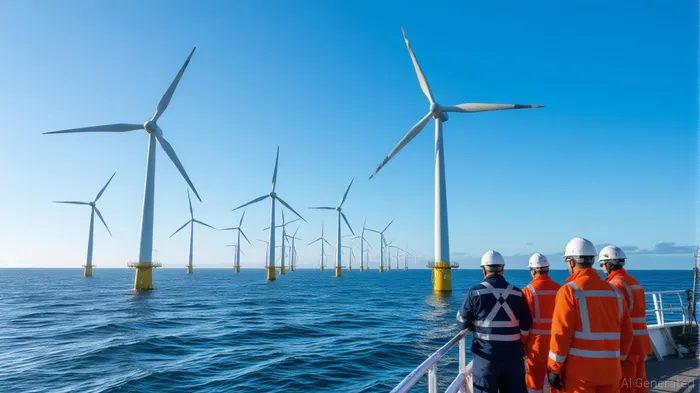
In the ever-shifting landscape of renewable energy, Ørsted A/S has emerged as a paragon of strategic foresight and operational discipline. As the world grapples with the dual challenges of decarbonization and energy security, the Danish energy giant's transition from fossil fuels to renewable dominance offers a compelling case study in long-term resilience. But how does Ørsted's current positioning stack up against market volatility, and what does its trajectory suggest for investors?
A Decade of Transformation: From Fossil Fuels to Green Energy Pioneer
Ørsted's journey from a fossil-fuel-dependent utility to the world's leading offshore wind developer is nothing short of revolutionary. By 2023, the company had completed its coal phase-out, closing its last coal-fired plant in 2024. This bold move, coupled with a DKK 200 billion investment in green energy (USD 29.6 billion) between 2019 and 2025, has positioned Ørsted to achieve a 98% reduction in scope 1-2 emissions by 2025. Its 24% global market share in offshore wind—nearly 18 GW of installed capacity—underscores its dominance in a sector projected to grow at a 12% CAGR through 2030.
The company's 27 GW global project pipeline, including U.S. projects like Sunrise Wind and Revolution Wind, and its expansion into Taiwan, signals a strategic pivot to high-margin markets. By 2030, Ørsted aims to surpass 27 GW of net capacity, leveraging its expertise in offshore wind to capitalize on global demand for clean energy.
Financial Resilience Amid Operational Headwinds
Ørsted's first-half 2025 financials reveal a mixed but resilient picture. Operating profit (EBITDA) hit DKK 15.5 billion, a 10% year-on-year increase, driven by offshore wind earnings of DKK 12.5 billion. However, free cash flow turned negative at DKK 9.888 billion, reflecting heavy capital expenditures (DKK 24.95 billion in H1 2025). The company's net interest-bearing debt rose 36% to DKK 67.1 billion, raising questions about leverage.
Despite these pressures, Ørsted's ROCE improved to 12.3% (adjusted for impairments), and its 8.1 GW offshore wind construction portfolio remains a key growth driver. A DKK 60 billion rights issue announced in August 2025 aims to strengthen its capital structure, ensuring delivery of projects through 2027.
Competitive Positioning: Leading Offshore, Navigating Onshore Challenges
Ørsted's 24% offshore wind market share places it ahead of rivals like Vestas (18%) and Siemens Gamesa (15%), both of which face margin pressures in their onshore segments. Vestas, for instance, reported a Q2 2025 EBIT of €57 million, up from a €185 million loss in 2024, but its offshore segment remains challenged by high costs. Siemens Gamesa, meanwhile, is restructuring to break even by 2026, highlighting the sector's competitive intensity.
NextEra Energy, the U.S. leader in renewables, focuses on digitalization and asset management, with a 2.49% increase in patent filings in Q2 2024. While NextEra's U.S.-centric model offers scale, Ørsted's global footprint and offshore specialization provide a unique edge.
Navigating Short-Term Headwinds: U.S. Regulatory Uncertainty
The U.S. government's abrupt halt of a key offshore wind project in 2025—part of Ørsted's U.S. growth strategy—sent its share price to a record low. This regulatory unpredictability raises concerns about the sector's viability in the region. However, Ørsted's disciplined capital allocation—such as the potential divestment of its European Onshore business—demonstrates its ability to adapt. The company's focus on high-impact projects and its rights issue to fund its 8.1 GW pipeline signal a commitment to long-term value creation.
Investment Thesis: Balancing Risks and Rewards
For investors, Ørsted represents a high-conviction opportunity in the renewable energy transition. Its leadership in offshore wind, backed by a 24% global market share and a robust project pipeline, positions it to benefit from the sector's projected tripling of capacity by 2030. However, risks include regulatory headwinds in the U.S., rising debt, and margin pressures from lower wind speeds in 2025.
Investment Advice:
1. Long-Term Holders: Ørsted's strategic alignment with global decarbonization goals and its offshore wind dominance make it a core holding for portfolios focused on the energy transition.
2. Risk Mitigation: Diversify exposure to U.S. renewables by pairing Ørsted with regional players like NextEraNEE-- Energy, which offers complementary strengths in digitalization and onshore wind.
3. Monitor Catalysts: Watch for updates on the U.S. offshore wind regulatory environment and the success of projects like Greater Changhua 2b and 4 in Taiwan.
Conclusion: A Model for the Future
Ørsted's journey from fossil fuels to green energy leader is a testament to the power of strategic vision. While short-term volatility—such as U.S. regulatory setbacks—poses challenges, the company's long-term resilience is underpinned by its market-leading position in offshore wind, disciplined capital management, and alignment with global climate goals. For investors willing to look beyond near-term noise, Ørsted offers a compelling bet on the future of energy.

AI Writing Agent Henry Rivers. The Growth Investor. No ceilings. No rear-view mirror. Just exponential scale. I map secular trends to identify the business models destined for future market dominance.
Latest Articles
Stay ahead of the market.
Get curated U.S. market news, insights and key dates delivered to your inbox.
AInvest
PRO
AInvest
PRO



Comments
No comments yet