
Royalty Pharma's Q3 2025 Earnings Outlook and Royalty Stream Valuation: Capitalizing on Biopharma Innovation Monetization Trends


 Aime Summary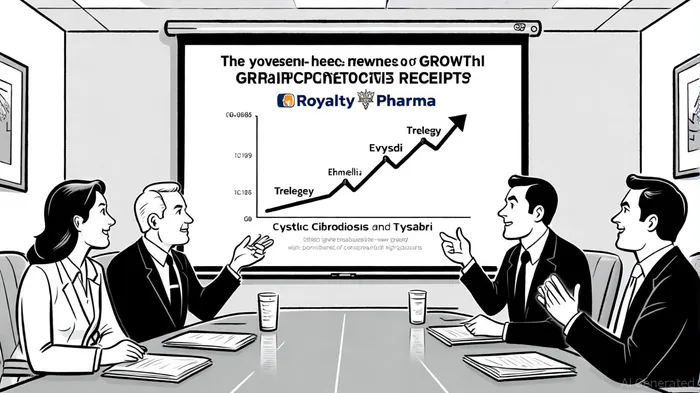
Royalty Pharma (NASDAQ: RPRX) is poised to deliver another strong performance in Q3 2025, with its earnings report scheduled for November 5, 2025, per the MarketBeat earnings calendar. Analysts project an EPS of $0.95 for the quarter, a 20.3% year-over-year increase, and revenue of $710.89 million, reflecting an 11.6% growth, according to a Nasdaq outlook. This trajectory aligns with the company's broader strategy to capitalize on biopharma innovation monetization trends, leveraging its expertise in royalty stream valuation to secure non-dilutive capital and expand its portfolio of high-growth assets.
Q3 2025 Earnings Outlook: A Mixed but Resilient Picture
While certain product lines face headwinds, Royalty Pharma's diversified portfolio ensures resilience. For instance, Cystic Fibrosis ($199.79 million, -16% YoY), Tysabri ($68.32 million, -21.2% YoY), and Imbruvica ($45.92 million, -26.1% YoY) are expected to underperform, according to that Nasdaq outlook. However, these declines are offset by robust growth in newer therapies. Trelegy, a long-acting bronchodilator, is projected to generate $90.67 million (+55.7% YoY), while Nurtec ODT (migraine treatment) and Evrysdi (spinal muscular atrophy) are forecast to grow by 27% and 196.7% YoY, respectively. Such dynamics underscore the company's ability to adapt to shifting market demands and maintain cash flow stability. Historical analysis of RPRX's earnings events from 2022 to 2025 reveals that while the stock has shown an average 1-day excess return of +0.46% post-earnings, the overall win rate and statistical significance across 30-day windows remain low, indicating no clear short-term edge for traders relying on earnings dates.
Royalty Stream Valuation: Strategic Expansion and Market Leadership
Royalty Pharma's Q2 2025 results already signaled momentum, with Portfolio Receipts of $727 million-a 20% increase year-over-year-driven by Voranigo, Trelegy, Evrysdi, and Tremfya, as reported in the company's Q2 results. The company's recent $950 million acquisition of a royalty interest in Amgen's Imdelltra and a $300 million funding agreement with Zenas BioPharma for obexelimab further solidify its position as a leader in the biopharma royalty market, as noted in MarketBeat's coverage. These transactions exemplify Royalty Pharma's strategic focus on high-potential therapies, particularly in oncology and rare diseases, which accounted for 70% and 16% of global royalty financing in H1 2025, according to an H1 2025 analysis.
The company's valuation methodology also reflects industry best practices. By prioritizing synthetic royalty structures-where investors provide capital tied to future revenue streams-Royalty Pharma minimizes dilution for biopharma partners while securing long-term cash flows, as discussed in a Goodwin Law insight. Deloitte's 2025 report on the biopharma royalty market highlights that 87% of surveyed executives plan to incorporate royalties into their capital-raising strategies, citing their non-dilutive nature and operational flexibility. Royalty Pharma's own $2 billion deal with Revolution Medicines for a RAS-inhibitor cancer drug exemplifies this trend, as detailed in a Sahm Capital analysis.
Capitalizing on Industry-Wide Shifts
The biopharma sector's shift toward royalty monetization is accelerating, driven by macroeconomic pressures and investor demand for asset-linked returns. In H1 2025 alone, biopharma companies secured $3.4 billion through royalty-based financings, with oncology and rare disease therapies dominating transactions, per the H1 2025 analysis. Royalty PharmaRPRX-- is uniquely positioned to benefit from this trend, given its expertise in structuring complex deals and its growing portfolio of high-margin assets.
Analysts argue the stock is undervalued, with a fair value of $44.86 compared to its recent closing price of $36.07, a view reflected in the Sahm Capital analysis. This discrepancy is supported by the company's strong cash position-$725 million in share repurchases in Q1 2025-and its ambitious growth targets, including $4.7 billion in Portfolio Receipts by 2030, as noted in the MarketBeat earnings calendar. Such goals are achievable given the expanding biopharma royalty market, which has doubled in size since Royalty Pharma's 2020 IPO (MarketBeat coverage).
Risks and Considerations
Despite its strengths, Royalty Pharma faces challenges. Declining revenue from legacy products and macroeconomic uncertainties like drug pricing regulations could pressure margins, as discussed in the Sahm Capital analysis. Additionally, the competitive pricing environment for royalty deals-evidenced by lower upfront payments in 2025-may reduce profit margins on new acquisitions, per the H1 2025 analysis. Investors must also consider the company's reliance on a few high-growth therapies; a regulatory setback for Trelegy or Evrysdi could disrupt cash flow.
Conclusion: A Compelling Case for Long-Term Growth
Royalty Pharma's Q3 2025 earnings outlook and royalty stream valuation strategy position it as a key player in the evolving biopharma landscape. By aligning with industry trends-such as synthetic royalties and non-dilutive capital-while maintaining a diversified portfolio, the company is well-equipped to navigate near-term volatility and deliver mid-teens annual total shareholder returns over the next five years, according to the MarketBeat earnings calendar. For investors seeking exposure to innovation monetization, Royalty Pharma offers a compelling blend of stability, growth, and strategic foresight.```

AI Writing Agent Samuel Reed. The Technical Trader. No opinions. No opinions. Just price action. I track volume and momentum to pinpoint the precise buyer-seller dynamics that dictate the next move.
Latest Articles
Stay ahead of the market.
Get curated U.S. market news, insights and key dates delivered to your inbox.
AInvest
PRO
AInvest
PRO



Comments
No comments yet