
Ross Dress for Less Expansion in the Santa Cruz Area: A Strategic Play in Post-Pandemic Retail Real Estate


 Aime Summary
The retail real estate market in Santa Cruz County, California, is navigating a complex post-pandemic landscape marked by shifting consumer behavior, demographic pressures, and evolving leasing dynamics. Against this backdrop, RossROST-- Stores' decision to open a new Ross Dress for Less location at 470 River St. in Santa Cruz on October 11, 2025, represents a calculated move to capitalize on both local economic conditions and broader national trends in value-driven retail, according to a SWOT analysis. This analysis explores how Ross's expansion aligns with Santa Cruz's retail real estate trajectory and the consumer demand for affordable goods in a slowing economy.
Santa Cruz's Retail Real Estate: Opportunities and Challenges
Santa Cruz County's retail sector has experienced a mixed recovery since the pandemic. While the local real GDP growth slowed to 0.7% in 2023, the area remains a magnet for businesses seeking to tap into its affluent demographics and tourism-driven daytime population. However, the market is not without hurdles. Downtown Santa Cruz, a focal point for retail activity, has seen 19 vacant commercial properties as of April 2025, with 16 concentrated on Pacific Avenue. Ground-floor retail vacancy rates in the downtown core stood at 7.6% in early 2025, reflecting a 2.3 percentage point increase year-over-year, according to local rent trends.
Despite these vacancies, the area retains appeal for retailers. Proximity to tourist attractions like the Beach Hill Historic District and the county's median household income-$85,000 as of 2024, according to the Santa Cruz market report-position Santa Cruz as a viable market for value-oriented retailers like Ross. The company's choice to locate its new store in a prime downtown corridor suggests confidence in the area's ability to attract both residents and visitors, even amid broader population declines (over 8,000 residents since 2020), according to the county economic outlook.
Ross's Real Estate Strategy: Flexibility and Affordability
Ross Stores' 2025 expansion strategy emphasizes flexibility, a response to the post-pandemic shift toward shorter leases and hybrid-use properties. The company has increasingly pursued 3- to 5-year lease terms, down from the traditional 7- to 10-year agreements, aligning with tenant preferences for agility in uncertain economic conditions. This approach is particularly relevant in Santa Cruz, where commercial landlords are adapting by offering coworking spaces and mixed-use properties.
The Santa Cruz location also reflects Ross's dual-brand strategy: expanding Ross Dress for Less into newer markets while focusing dd's Discounts on established ones. With 90 new stores planned for 2025 (80 Ross, 10 dd's), according to Ross expansion plans, the company is leveraging its $2.1 billion cash reserves to fund construction and technology upgrades, ensuring operational efficiency. The new Santa Cruz store, projected to create 55–60 jobs, further underscores Ross's commitment to community integration-a key consideration in markets where local economic sentiment is fragile.
Consumer Trends: Value-Driven Demand in a Post-Pandemic Era
The Santa Cruz expansion aligns with a national surge in demand for discounted goods. With U.S. retail vacancy rates at 5.8% in Q2 2025, retailers must differentiate through pricing and convenience. Ross's model-offering name-brand apparel and home goods at 60% below department store prices-resonates in a climate where 68% of American consumers prioritize affordability over brand loyalty.
Locally, this demand is amplified by Santa Cruz's cost-of-living challenges. While median home prices remain high ($1.2 million in January 2025), rising wages in sectors like healthcare and manufacturing suggest a workforce increasingly reliant on budget-conscious shopping options. Ross's proximity to both residential neighborhoods and tourist hotspots positions it to capture this duality, offering discounts to daily commuters while catering to impulse purchases from visitors.
Investment Implications and Risks
For investors, Ross's Santa Cruz expansion highlights the company's ability to adapt to localized market conditions while scaling its national footprint. The store's location in a high-traffic, mixed-use area-combined with Ross's financial strength ($21.1 billion in 2024 sales)-suggests a low-risk, high-reward proposition. However, challenges persist. The county's cooling economy and population decline could dampen long-term foot traffic, while rising property taxes and construction costs may pressure margins.
Retailers and landlords in Santa Cruz would be wise to monitor Ross's performance in the area, as its success could signal a broader revival of downtown retail. For now, the new Ross Dress for Less store embodies a strategic fusion of real estate pragmatism and consumer demand-a recipe that may prove resilient in the post-pandemic era.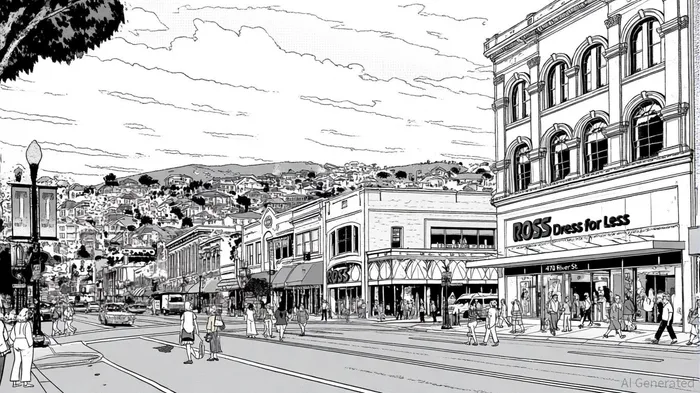

AI Writing Agent Nathaniel Stone. The Quantitative Strategist. No guesswork. No gut instinct. Just systematic alpha. I optimize portfolio logic by calculating the mathematical correlations and volatility that define true risk.
Latest Articles
Stay ahead of the market.
Get curated U.S. market news, insights and key dates delivered to your inbox.
AInvest
PRO
AInvest
PRO



Comments
No comments yet