
Ronin Introduces Security Upgrades and Axie Infinity Restructures Tokenomics
 Aime Summary
Ronin Network has increased validator nodes from 9 to 11 and launched a $1 million bug bounty program to improve security following a $625 million hack. Axie InfinityAXS-- introduced bAXS, a user-bound token earned through gameplay, aiming to reduce bot farming and stabilize its in-game economy. The success of these initiatives depends on bAXS adoption and integration into governance and staking within the ecosystem.
Ronin Network has enhanced its security infrastructure following a significant hack in 2025. The network increased its validator nodes from 9 to 11 and launched a $1 million bug bounty program to incentivize security researchers. These measures are intended to improve the network's resilience and prevent future attacks. The network is also redesigning its bridge, expected to be completed by mid to late May 2026, to enhance decentralization and prevent future breaches.
Axie Infinity has introduced a new token, bAXS, which is bound to user accounts and earned through gameplay. This token is designed to reduce bot farming and stabilize the in-game economy by creating a more self-sustaining economic model. bAXS can be staked, spent, or sold within the Axie Infinity community, promoting long-term participation and reducing the reliance on SLPSLP-- as a primary reward mechanism.
The broader GameFi market has seen mixed results. While Axie Infinity's AXSAXS-- token has seen significant price movements, other GameFi tokens like World of Dypians have struggled with volatility. Smaller projects like Pixiland have announced indefinite pauses of Web3 features, citing regulatory uncertainty and resource constraints.
Why is Axie Infinity restructuring its tokenomics?
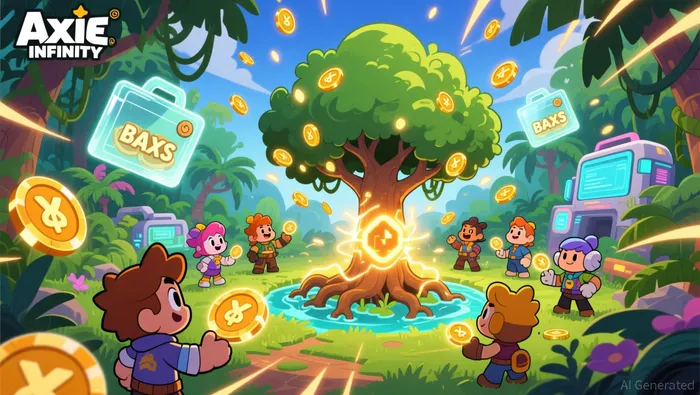
Axie Infinity is transitioning AXS rewards into a new app token, bAXS, as part of a structural overhaul of the project's tokenomics. This change aims to stabilize supply and reduce speculative trading by tying rewards to user accounts. The new system is expected to discourage bot farming and encourage long-term participation. This transition is part of a broader plan for 2026, as noted by co-founders during a Discord panel.
The new token, bAXS, is intended to stabilize the supply of AXS by introducing a binding mechanism that ties rewards to user accounts. This is expected to reduce the inflationary pressure that previously contributed to sell pressure on AXS. Additionally, the token will be stakable and governable, encouraging user participation and reducing reliance on SLP as a primary reward mechanism. The success of bAXS depends on its adoption in staking and governance, which could lead to a more sustainable economic model for Axie Infinity.
What are the implications for the GameFi market?
The GameFi market has experienced a decline in total market capitalization, falling to $9.35 billion as of January 16, 2026. This decline has been attributed to regulatory challenges and market volatility. Smaller GameFi tokens like World of Dypians have struggled to maintain momentum, with the market cap of WOD more than doubling in a week before retreating by nearly 40%.
Pixiland has announced an indefinite pause of Web3 features, converting existing tokens into in-game currency and NFTs into off-chain collectibles. The project's Web3 dashboard is scheduled to shut down on March 1. This shift reflects the broader trend of GameFi projects adapting to market and regulatory challenges by transitioning to Web2 models.
Truflation has introduced the GameFi Index to track the performance of leading blockchain-based gaming platforms and games. The index captures growth beyond token prices alone, incorporating metrics like engagement, market cap, and trading volume. It includes top protocols such as ImmutableIMX-- (IMX), SuperverseSUPER-- (SUPER), Beam (BEAM), RoninRON-- (RON), AvalancheAVAX-- (AVAX), Polygon (POL), and ToncoinTON-- (TON). The index also tracks 28 games with a minimum of 50,000 unique active wallets per day, including World of Dypians, Pixels, KGeN, Apeiron, Alien Worlds, and Axie Infinity.
The GameFi Index is designed to provide real-time insights into the sector's growth and performance, helping investors make informed decisions. The index is weighted at 50% using daily trading volume and market cap to ensure diversified representation. The GameFi sector is expected to grow substantially, reaching $302 billion by 2030, driven by AAA and AA blockchain games, role-playing mechanics, and in-game economies.
What are the risks and limitations of these initiatives?
While the introduction of bAXS and the restructuring of tokenomics aim to stabilize the in-game economy, the success of these initiatives depends on adoption and integration into governance and staking within the ecosystem. If users do not adopt bAXS, the intended benefits may not be realized. Additionally, the broader market conditions and regulatory challenges pose risks to the sustainability of GameFi projects.
The transition from Web3 to Web2 models, as seen with Pixiland, highlights the challenges faced by blockchain-based gaming projects in navigating market volatility and regulatory uncertainty. The shift to Web2 models may limit the potential for innovation and decentralization that blockchain technology offers. The success of the GameFi market will depend on the ability of projects to adapt to these challenges while maintaining engagement and participation within their communities.
Ronin Network's RONRON-- token has seen a significant decline in market capitalization, trading at around $108 million as of January 16, 2026, down by more than 90% from 2024 highs of more than $1.1 billion. This decline reflects the broader market conditions and the challenges faced by GameFi projects in maintaining momentum and investor confidence.
The success of the GameFi sector will depend on the ability of projects to innovate and adapt to changing market conditions. The introduction of new tools like the GameFi Index by Truflation will provide investors with valuable insights into the performance of leading blockchain-based gaming platforms and games. As the sector continues to evolve, the ability of projects to create sustainable economic models and engage their communities will be crucial to their long-term success.

Blending traditional trading wisdom with cutting-edge cryptocurrency insights.
Latest Articles
Stay ahead of the market.
Get curated U.S. market news, insights and key dates delivered to your inbox.


AInvest
PRO
AInvest
PRO



Comments
No comments yet