
Romania’s Producer Prices Surge to 12.69%, Complicating Rate Cuts
 Aime Summary
- Romania’s Producer Price Index (PPI) accelerated to 12.69% year-over-year in July, up from 12.05% in June, indicating persistent inflationary pressures at the wholesale level.
- The sharp increase in producer prices suggests that cost-push inflation remains entrenched, potentially complicating efforts by the National Bank of Romania (BNR) to stabilize price growth.
- Investors are closely watching this data as it serves as a leading indicator for consumer inflation, which directly impacts the BNR’s interest rate policy and the broader macroeconomic outlook.
- While the data confirms ongoing price pressures, the lack of a specific forecast in the release highlights the unpredictable nature of current input cost dynamics in the region.
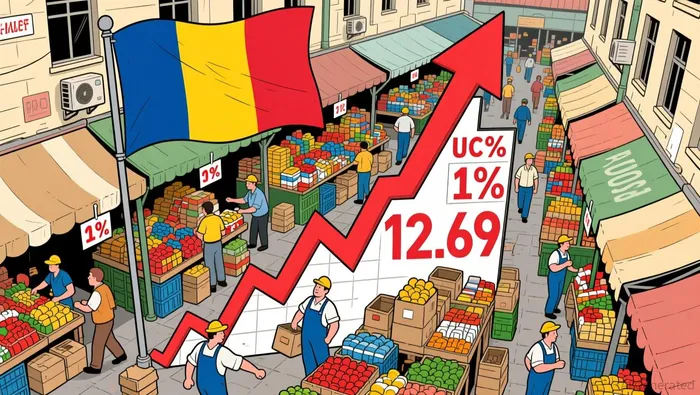
The latest macroeconomic data from Romania underscores a continued challenge in taming inflation at the producer level, with the Producer Price Index (PPI) recording a notable acceleration in July. According to the most recent release, the PPI for wholesale goods in the country rose by 12.69% year-over-year in July, a significant jump from the 12.05% growth rate observed in the previous month. This upward revision in the data signals that the disinflationary trends, which may have been hoped for in earlier months, are currently stalling or reversing. For macro-aware investors and analysts, this development is a critical signal that underlying price pressures within the supply chain remain robust, potentially delaying any aggressive easing of monetary policy by the central bank.
What Does The Romania PPI Acceleration Signal For The Economy?
The Producer Price Index is a vital barometer for measuring the average change in selling prices received by domestic producers for their output. In the context of the Romanian economy, a rise in PPI is not merely a statistical update but a fundamental indicator of cost-push inflation dynamics. The acceleration from 12.05% to 12.69% suggests that input costs for businesses are rising at a faster pace than in June. This can be driven by various factors, including global commodity price fluctuations, currency volatility affecting import costs, or domestic supply chain constraints. When producers face higher costs for raw materials and energy, these expenses are often passed down the supply chain, eventually impacting the prices consumers pay for goods and services.
Historically, producer inflation is considered a leading indicator for consumer inflation. The fact that PPI is accelerating implies that consumer price inflation may also face upward pressure in the coming months, unless there is a significant drop in demand or a sharp decline in global input costs. For the National Bank of Romania (BNR), this data reinforces the complexity of the current inflationary environment. While headline consumer inflation might show some signs of moderation due to base effects or specific sectoral dynamics, the persistence of high producer prices indicates that the underlying inflationary engine is still running hot. This divergence between producer and consumer metrics often requires central banks to adopt a cautious approach, ensuring that premature policy easing does not allow inflation expectations to become unanchored.
Why Are Investors Watching Wholesale Prices In Romania Now?
For investors tracking European emerging markets, the Romanian PPI data provides crucial insights into the resilience of domestic demand and the health of corporate sectors. High producer prices can have a dual impact on the economy. On one hand, they reflect strong demand for goods, which can be positive for corporate revenues. On the other hand, if these costs cannot be fully passed on to consumers due to price sensitivity or competitive pressures, corporate profit margins may be squeezed. This margin compression can lead to reduced capital expenditure and hiring, potentially slowing economic growth. Therefore, the 12.69% reading is a double-edged sword, signaling both economic activity and potential profitability challenges for Romanian firms.
Furthermore, this data point is essential for assessing the policy reaction function of the BNR. The central bank’s mandate is primarily focused on price stability, and persistent inflation at the producer level often forces policymakers to maintain restrictive monetary conditions for longer than markets might anticipate. If the BNR interprets this acceleration as a sign of entrenched inflation, it may signal that interest rates will remain elevated to dampen demand and cool price growth. For fixed-income investors, this implies that bond yields may not decline as quickly as expected, while for equity investors, it suggests that sectors sensitive to input costs may face headwinds. The absence of a specific forecast in the recent release further highlights the uncertainty surrounding these dynamics, making each monthly data point increasingly significant for recalibrating macroeconomic models and investment strategies.
In conclusion, the acceleration of Romania’s PPI to 12.69% in July serves as a stark reminder of the persistent inflationary forces at play in the region. As the economy navigates these challenges, the interplay between producer costs, consumer prices, and monetary policy will remain a key focus for market participants. Investors should continue to monitor subsequent releases for signs of whether this trend is a temporary blip or a new baseline for price growth in Romania.

Stay ahead of the market.
Get curated U.S. market news, insights and key dates delivered to your inbox.


AInvest
PRO
AInvest
PRO




Comments
No comments yet