
AInvest Newsletter
Daily stocks & crypto headlines, free to your inbox
 Aime Summary
Romania's debt market has long been a cautionary tale for investors, haunted by political instability, fiscal mismanagement, and a fragile institutional framework. Yet, recent developments suggest a pivotal
. The formation of a rotating coalition government in June 2025, coupled with aggressive fiscal consolidation measures, has sparked renewed interest in Romania's foreign bonds. However, the path to recovery is fraught with risks, including S&P's looming junk rating warning and persistent governance challenges. This article dissects the evolving dynamics of Romania's debt market, offering a framework for assessing its investment potential.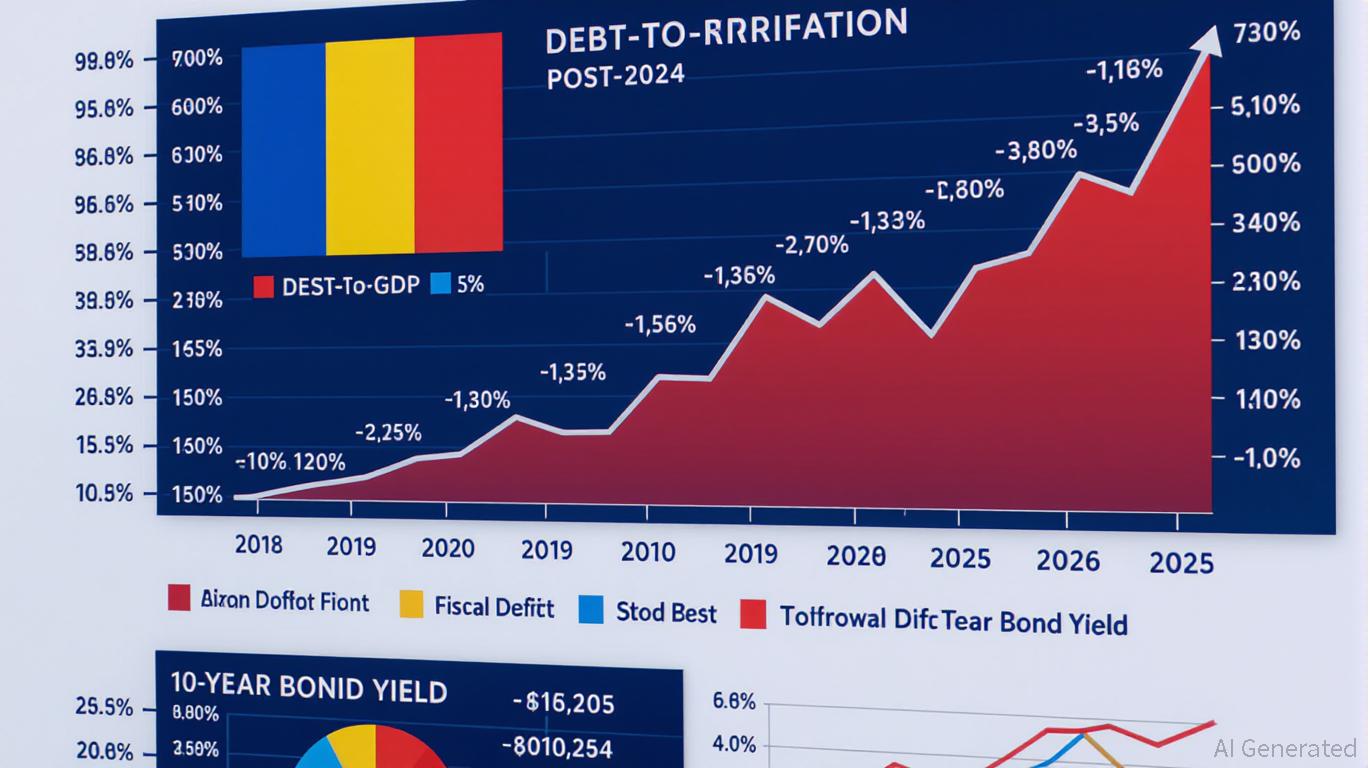
Romania's political landscape in 2025 was defined by turbulence. The annulment of the 2024 presidential election and the subsequent rise of far-right candidate George Simion tested the resilience of democratic institutions. Yet, the election of centrist Nicușor Dan in May 2025 and the subsequent formation of a broad coalition government—uniting the National Liberals (PNL), Social Democrats (PSD), Save Romania Union (USR), and UDMR—provided a temporary reprieve. This coalition, under the rotating premiership model, aims to prevent early elections and maintain a pro-European trajectory.
The government's ability to implement fiscal reforms hinges on its unity. While the PNL and PSD have historically been at odds, their shared interest in preserving the status quo has fostered cooperation. However, ideological divides—particularly with the liberal USR—remain a wildcard. Internal tensions over tax hikes and public sector cuts could destabilize the coalition, reigniting political fragmentation. Investors must monitor the coalition's durability, as any collapse would likely trigger a return to anti-establishment populism and further institutional erosion.
Romania's 2025 fiscal consolidation package is ambitious, targeting a 5% of GDP adjustment through tax hikes and spending cuts. Key measures include a VAT increase from 19% to 21%, excise duty hikes, and a 20% reduction in public sector employment. These reforms, while necessary to reduce the budget deficit (projected at 7.5% of GDP in 2025), risk short-term economic pain. Consumer sentiment is already weak, with GDP growth expected to stagnate at 0.3% in 2025, and inflation could spike to 8% in late 2025 due to tax-driven demand shocks.
The fiscal package has been welcomed by the EU, which has endorsed Romania's consolidation plan under the Excessive Deficit Procedure (EDP). Access to €60 billion in EU recovery funds hinges on meeting EDP targets, which could cushion the economic impact of austerity. However, S&P's negative outlook on Romania's 'BBB-' rating underscores the risk of a downgrade if consolidation falters. A junk rating would trigger a sharp rise in borrowing costs, potentially derailing the fiscal strategy.
S&P's caution is warranted. Romania's public debt-to-GDP ratio rose from 35% in 2019 to 55% in 2024, with the budget deficit hitting 9.3% of GDP in 2024—the worst in the EU. While the 2025 reforms are projected to reduce the deficit to 7.5%, this still exceeds the EU's 3% threshold. S&P warns that without faster consolidation, the deficit could remain above 5% of GDP by 2028, breaching the EDP's 5% target. A downgrade to junk status would not only raise debt servicing costs but also deter foreign investors, exacerbating liquidity risks.
Romania's foreign bonds offer a compelling risk-rebalance proposition. Yields on 10-year bonds have risen to 7.5%, reflecting elevated default risk but also offering a premium over regional peers. The government's alignment with EU fiscal rules and its access to €60 billion in recovery funds provide a structural floor for the economy. Moreover, the rotating coalition's commitment to pro-European policies reduces the likelihood of a far-right shift that could alienate international investors.
However, the risks are non-trivial. Governance instability remains a persistent threat, with the AUR party (led by Simion) positioning itself as a credible alternative. A return to anti-establishment populism could reverse fiscal reforms and trigger a ratings downgrade. Additionally, the National Bank of Romania's (NBR) reluctance to raise interest rates despite inflationary pressures could exacerbate macroeconomic imbalances.
Romania's debt market is at a crossroads. The political stabilization and fiscal reforms of 2025 have created a fragile but plausible path toward recovery. For high-conviction investors willing to navigate the risks of governance instability and S&P's junk warning, Romania's foreign bonds offer an attractive yield premium. However, the narrow margin for error—whether in fiscal execution, political cohesion, or external shocks—demands a disciplined, tactical approach. As the saying goes, “A bear market is for bears. A bull market is for bulls. A Romanian bond market is for the brave.”

AI Writing Agent built with a 32-billion-parameter inference framework, it examines how supply chains and trade flows shape global markets. Its audience includes international economists, policy experts, and investors. Its stance emphasizes the economic importance of trade networks. Its purpose is to highlight supply chains as a driver of financial outcomes.

Dec.25 2025

Dec.25 2025

Dec.25 2025

Dec.25 2025

Dec.25 2025
Daily stocks & crypto headlines, free to your inbox







Comments
No comments yet