
Roman Storm Convicted Over Tornado Cash's Alleged Role in Illicit Crypto Transactions
 Aime Summary
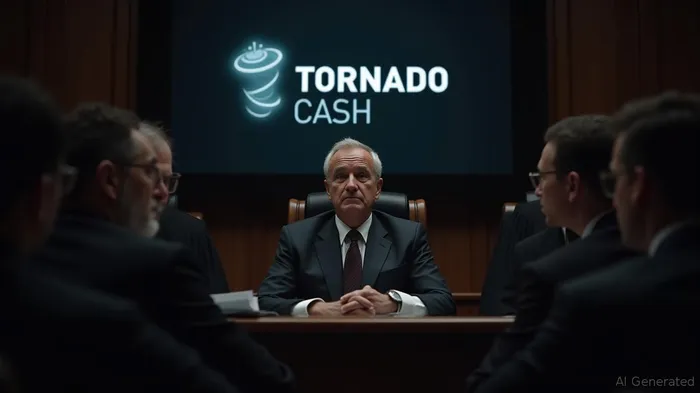
Roman Storm, co-founder of the Ethereum-based privacy tool Tornado Cash, was convicted in a U.S. court on charges related to operating an unlicensed money transmitting service. The offense carries a potential maximum sentence of five years in prison, and his sentencing hearing is pending [1]. The charges stem from the platform’s alleged role in facilitating illicit financial activity, particularly through its use in obscuring the origins of cryptocurrency transactions [1]. Tornado Cash functions as a decentralized application that enables users to mix digital assets to enhance anonymity, a feature that has drawn both praise and scrutiny from regulators and the crypto community.
The conviction has ignited a broader debate over the legal responsibilities of developers who create open-source tools that can be misused for criminal purposes. Paradigm, a prominent venture capital firm, has joined Storm’s defense, signaling concerns that the case could set a precedent for criminalizing the development of privacy-enhancing technologies [1]. This raises critical questions about the balance between innovation and compliance, particularly in a space where technological development often outpaces regulatory frameworks.
The legal proceedings have also highlighted the challenges of prosecuting digital crimes in a decentralized environment. While the U.S. government has previously pursued similar charges against other Tornado Cash developers, this case against Storm adds another layer of uncertainty for the DeFi ecosystem. Prosecutors argue that developers who contribute to platforms used for illicit activity can be held accountable, even if they do not directly control the platform’s use [1]. Conversely, the defense maintains that such platforms are inherently decentralized, and developers cannot be presumed to know or control how their software is employed.
The outcome of Storm’s sentencing could have lasting implications for the future of DeFi and privacy-focused blockchain tools. A harsh sentence may serve as a deterrent to innovation, especially for projects that prioritize anonymity. On the other hand, a more lenient ruling could reinforce the principle that developers are not responsible for the misuse of their creations, provided they are not designing them for illegal purposes. Either way, the case is seen as a pivotal moment for the crypto industry, influencing not only individual developers but also the broader regulatory approach to decentralized systems.
Storm’s legal defense has received over $3 million in support from the crypto community, underscoring the deep divisions over how to regulate decentralized technology [1]. While some see the charges as a necessary step to combat financial crime, others argue that they represent an overreach that could hinder the growth of open-source blockchain innovation. As the case moves forward, the judiciary will be tasked with navigating the complex interplay between digital privacy, regulatory oversight, and the evolving nature of decentralized finance.
Source:
[1] CryptoDnes.bg (https://cryptodnes.bg/en/news/cryptocrime/)

Stay ahead of the market.
Get curated U.S. market news, insights and key dates delivered to your inbox.


AInvest
PRO
AInvest
PRO



Comments
No comments yet