
The Role of Tariffs in Inflation Amid Policy Shifts


 Aime Summary
The interplay between tariffs and inflation has become a focal point in modern fiscal policy debates, particularly as governments and central banks navigate the delicate balance between protecting domestic industries and maintaining price stability. Recent developments underscore a growing disconnect between policy rhetoric-often emphasizing tariffs as tools to curb inflation-and the nuanced economic realities they generate. This analysis examines how tariff policies have influenced inflationary pressures in 2024–2025, highlights discrepancies between official statements and empirical outcomes, and offers insights for investors navigating this evolving landscape.
Tariffs and Inflation: A Complex Relationship
Conventional economic theory posits that tariffs raise consumer prices by increasing the cost of imported goods, thereby exerting upward pressure on inflation. However, recent studies challenge this narrative. A 2024–2025 San Francisco Fed working paper by and found that higher tariffs may actually reduce inflation in the short term, albeit at the cost of higher unemployment. The researchers analyzed 150 years of tariff data and concluded that tariffs function more as aggregate demand shocks, dampening economic activity and inflation simultaneously according to the study. This contradicts traditional models and suggests that the inflationary impact of tariffs is not straightforward.
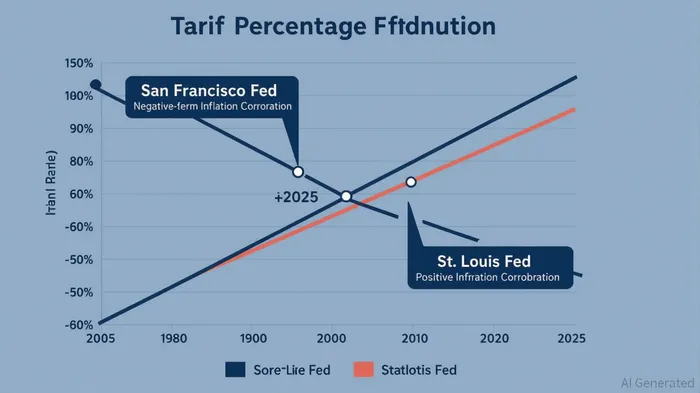
Conversely, the St. Louis Fed's analysis of 2025 data reveals a different picture. Using the personal consumption expenditures (PCE) price index-the Federal Reserve's preferred inflation metric-the study found that tariffs contributed to a measurable rise in consumer prices, particularly for durable goods like vehicles and electronics. Model-based estimates indicate . This duality-tariffs both lowering and raising inflation-highlights the complexity of their macroeconomic effects.
Policy Rhetoric vs. Economic Reality
The disconnect between fiscal policy statements and economic outcomes becomes evident when examining recent political and central bank actions. In August 2025, signed an executive order increasing tariffs on Canadian goods , while also announcing a 90-day pause on tariffs with Mexico after securing trade agreements with Japan, the U.K., and others. These moves were framed as measures to protect domestic industries and stabilize prices, yet the U.S. , a side effect of higher tariffs according to analysis.
Meanwhile, the Federal Reserve's response to these developments has been measured. Despite tariffs contributing to 10.9% of headline PCE inflation, the Fed opted for a 25-basis point in Q3 2025, signaling potential for two more cuts by year-end. This suggests that policymakers are prioritizing labor market concerns-such as the unemployment risks highlighted by the San Francisco Fed study-over the inflationary pressures from tariffs according to research. The Fed's rhetoric, which has acknowledged tariffs' role in inflation, appears to be tempered by broader economic resilience and shifting priorities.
Implications for Investors
For investors, the mixed signals from tariff policies and central bank responses necessitate a nuanced approach. First, sector-specific risks remain pronounced. Durable goods industries, such as automotive and electronics, face direct inflationary pressures from tariffs, while labor-intensive sectors may suffer from higher unemployment according to analysisand the St. Louis Fed study. across sectors and geographies could mitigate these risks.
Second, the Federal Reserve's focus on broader economic fundamentals-rather than narrowly targeting tariff-driven inflation-implies that monetary policy will remain accommodative in the near term. This could support equities and risk assets, but investors should monitor how prolonged tariff policies might reshape global supply chains and input costs.
Finally, the "disconnect" between policy rhetoric and economic outcomes underscores the importance of real-time data analysis. While officials may frame tariffs as inflation-fighting tools, the empirical evidence suggests their effects are multifaceted and context-dependent. Investors must remain agile, factoring in both headline-driven policy shifts and the underlying economic mechanics they trigger.
Conclusion
The role of tariffs in inflation remains a contentious and evolving issue. While recent studies reveal a complex interplay between tariffs, inflation, and unemployment, policymakers continue to navigate these dynamics with a mix of caution and pragmatism. For investors, the key takeaway is clear: the disconnect between fiscal policy rhetoric and economic reality demands a data-driven, adaptive strategy. As the 2025 landscape unfolds, staying attuned to both the stated intentions of policymakers and the empirical outcomes of their actions will be critical to navigating market uncertainties.

Delivering real-time insights and analysis on emerging financial trends and market movements.
Latest Articles
Stay ahead of the market.
Get curated U.S. market news, insights and key dates delivered to your inbox.






Comments
No comments yet