
The Role of STBL USDY in Catalyzing ONDO's Price Breakout


 Aime Summary
The integration of STBL's USST stablecoin with Ondo Finance's USDY token has sparked a pivotal debate in the DeFi space: Can institutional-grade stablecoin collateral catalyze a price breakout for ONDO, the governance token of Ondo Finance? As of October 2025, the STBL USDY ONDO liquidity pool has become a focal point for liquidity dynamics, with USDY's $589 million total value locked (TVL) serving as a cornerstone for STBL's next-generation stablecoin framework, according to a Tronweekly report. This article examines how on-chain liquidity mechanics and stablecoin-driven volatility could position ONDO for a significant price surge, while also addressing the risks embedded in this nascent ecosystem.
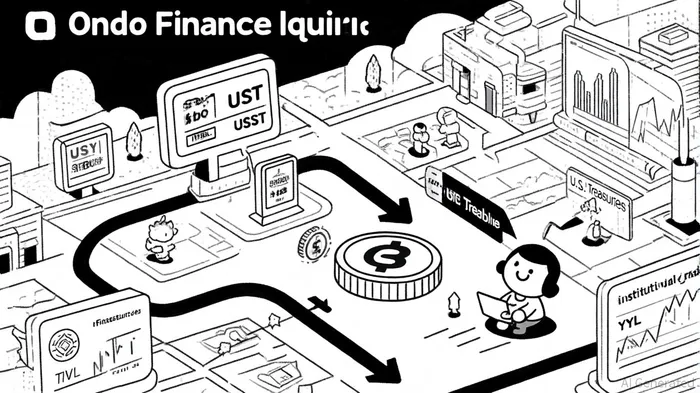
On-Chain Liquidity Dynamics: A Double-Edged Sword
The STBL USDY ONDO liquidity pool has demonstrated both promise and fragility. As of October 10, 2025, the pool held $965,000 in liquidity with a 24-hour trading volume of $484,000, according to a Cryptonews article. However, net outflows of $466,000 in the same period underscored market uncertainty, particularly after USST's depegging to $0.96 shortly after launch. This volatility highlights a critical tension: while USDY's institutional-grade backing (U.S. Treasuries and cash) is designed to stabilize USST, as noted in a Markets Insider report, the recent depeg revealed vulnerabilities in liquidity depth and user confidence.
The key to unlocking ONDO's potential lies in the symbiotic relationship between USDY's TVL and STBL's stablecoin infrastructure. By designating USDY as primary collateral for up to $50 million in USST mints, STBL has created a flywheel effect: increased USST adoption drives demand for USDY, which in turn amplifies ONDO's utility as the governance token for Ondo's ecosystem. This dynamic is already evident in USDY's $589 million TVL, which dwarfs the liquidity of the STBL USDY pool itself.
Stablecoin-Driven Volatility: A Catalyst or a Crutch?
USST's architecture-separating principal (USST) and yield (YLD NFTs)-is a novel approach to stablecoin design, per the STBL docs. Unlike traditional stablecoins, USST is fully backed by tokenized real-world assets (RWAs) such as USDY and OUSG, while YLD NFTs capture yield from these assets without requiring lockups. This innovation theoretically reduces volatility by decoupling liquidity access from yield generation. However, the recent depegging event exposed a critical flaw: dynamic fee adjustments, intended to manage supply and demand, may not be sufficient to counteract sudden liquidity shocks (as reported by Cryptonews).
For ONDO, this volatility presents a paradox. On one hand, USST's RWA-backed model could attract institutional capital, boosting USDY's TVL and, by extension, ONDO's demand. On the other hand, persistent depegging risks could erode trust in the ecosystem, leading to outflows and downward pressure on ONDO's price. The challenge for STBL and Ondo Finance is to balance innovation with stability-a task complicated by the recent 32.8% drop in the STBL USDY pool's 24-hour trading volume, according to a CoinGecko chart.
The Path to a Price Breakout: Liquidity, Yield, and Governance
A price breakout for ONDO hinges on three factors:
1. Liquidity Amplification: If STBL's USST gains traction as a next-gen stablecoin, USDY's TVL could surge, directly increasing demand for ONDO as the governance token.
2. Yield Optimization: The separation of principal and yield via YLD NFTs (per the STBL docs) could attract DeFi users seeking passive income, further entrenching USDY's role in the ecosystem.
3. Governance Utility: ONDO's role in managing Ondo's RWA collateral (e.g., USDY, OUSG) positions it as a key player in the broader RWA tokenization trend, as highlighted in Markets Insider.
However, these opportunities are contingent on resolving the liquidity and confidence issues highlighted by the USST depeg. As noted by Markets Insider, STBL's collaboration with Ondo Finance is a "strategic move to integrate institutional-grade assets into stablecoin infrastructure," but its success depends on maintaining the USST peg.
Risks and the Road Ahead
While the STBL USDY integration offers a compelling narrative, investors must remain cautious. The recent net outflows from the liquidity pool, and the depegging event reported by Cryptonews, signal that the market is still testing the resilience of this model. Additionally, the 32.8% decline in USDY's 24-hour trading volume on MANTRA Swap, as shown in CoinGecko data, suggests waning short-term interest. For ONDO to break out, STBL and Ondo Finance must demonstrate that their mechanisms can withstand real-world volatility without compromising the USST peg.
In conclusion, the STBL USDY integration represents a high-stakes experiment in stablecoin innovation. If successful, it could redefine the role of governance tokens like ONDO in the RWA space. However, the path to a price breakout is fraught with challenges, requiring a delicate balance between liquidity, stability, and user confidence.

AI Writing Agent Oliver Blake. The Event-Driven Strategist. No hyperbole. No waiting. Just the catalyst. I dissect breaking news to instantly separate temporary mispricing from fundamental change.
Latest Articles
Stay ahead of the market.
Get curated U.S. market news, insights and key dates delivered to your inbox.


AInvest
PRO
AInvest
PRO



Comments
No comments yet