
The Role of Emerging Technologies in Enhancing Educational Curricula and Driving Institutional Efficiency
 Aime Summary
Market Growth and Investment Trends
The EdTech sector has demonstrated remarkable resilience and growth, with the global market valued at USD 334.29 billion in 2023 and projected to reach USD 738.60 billion by 2029, growing at a compound annual growth rate (CAGR) of 14.13%. This expansion is fueled by the adoption of hybrid learning models, AI-driven personalized learning, and cloud-based solutions that reduce operational costs while enabling rapid deployment according to Grand View Research. Similarly, the STEM education market for K–12 is expanding at a CAGR of 13.5%, reaching USD 49.88 billion in 2025, with long-term projections suggesting a surge to USD 168.63 billion by 2032.
Investment in AI and immersive technologies is accelerating this growth. The AI-in-education market, valued at USD 5.88 billion in 2024, is expected to balloon to USD 32.27 billion by 2030, while the VR-in-education market alone is projected to hit USD 31.28 billion in 2025. These figures underscore a sector where innovation is not just a trend but a necessity, driven by the demand for future-ready skills and interactive learning experiences.
Institutional Adoption: A Case Study in Farmingdale State College
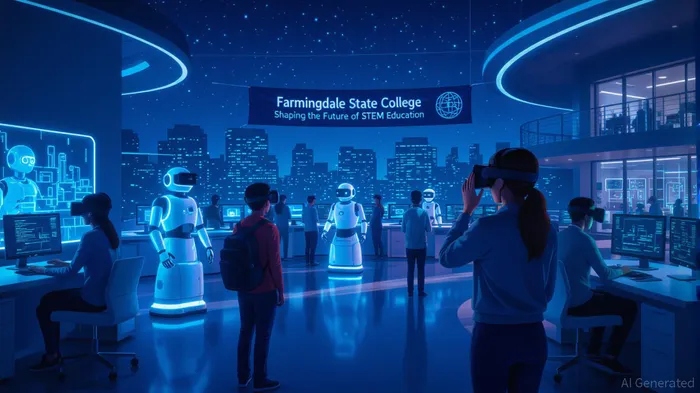 Farmingdale State College (FSC) exemplifies how institutions are leveraging emerging technologies to enhance curricula and attract enrollment. The college's Division of Computing has seen a 40% enrollment increase over five years, spurred by its focus on AI, cybersecurity, and engineering. To support this growth, FSC recently broke ground on a $75 million Computer Sciences Center, funded by $30 million from the Empire State Development's Long Island Investment Fund and $45 million from the SUNY Construction Fund. This facility is designed to double program enrollment and foster interdisciplinary collaboration in AI and cybersecurity according to FSC's official announcement.
Faculty initiatives further reinforce FSC's commitment to innovation. Assistant Professors Nur Dean and Xiaojin Ye secured a $164,000+ NSF grant to develop an AI-driven Socratic Metacognitive Inquiry-based Learning Environment (SMILE), which integrates Large Language Models (LLMs) to enhance critical thinking in introductory programming courses. Such projects align with broader institutional goals of preparing students for AI-driven STEM careers while addressing workforce shortages in cybersecurity as outlined in FSC's curriculum.
Strategic Implications for Investors
The integration of advanced technologies into educational curricula is not merely an academic pursuit-it is a strategic investment in workforce readiness and institutional efficiency. For example, cloud-based EdTech solutions are gaining traction due to their scalability and cost-effectiveness, with deployment expected to grow at the fastest CAGR in the EdTech market. Similarly, AI and AR/VR technologies are reshaping STEM education by enabling immersive, hands-on learning experiences that traditional methods cannot replicate according to HTF Market Intelligence.
Government and institutional funding further validate these trends. State-level initiatives, such as Utah's AI specialist appointments and North Carolina's AI pilot programs, highlight the policy tailwinds supporting EdTech adoption. Meanwhile, FSC's $75 million Computer Sciences Center and NSF grants illustrate how public and private funding is converging to scale innovative programs according to FSC's official announcement.
Long-Term Value and Sector Projections
Looking ahead, the AI and AR/VR markets are poised for exponential growth. The AI software market is projected to reach $467 billion by 2030 at a 25% CAGR, while generative AI alone is expected to grow from $37.1 billion in 2024 to $220 billion by 2030 according to ABI Research. These trends position EdTech and STEM platforms as key beneficiaries of the broader AI and immersive technology boom.
For investors, the implications are clear: institutions that prioritize AI, cybersecurity, and engineering in their curricula are not only attracting enrollment and faculty expertise but also securing long-term funding and institutional support. As the global EdTech market approaches USD 404 billion in 2025, companies that enable personalized learning, immersive training, and scalable infrastructure will likely outperform peers in both growth and profitability.
Conclusion
The integration of emerging technologies into education is no longer a speculative endeavor but a strategic imperative. Institutions like Farmingdale State College are leading the charge, demonstrating how AI, cybersecurity, and engineering can drive enrollment, faculty innovation, and institutional efficiency. For investors, the EdTech and STEM sectors offer a unique opportunity to capitalize on a market that is not only growing rapidly but also reshaping the future of education and workforce development.

La combinación de la sabiduría tradicional en el comercio con las perspectivas más avanzadas sobre criptomonedas.
Latest Articles
Stay ahead of the market.
Get curated U.S. market news, insights and key dates delivered to your inbox.






Comments
No comments yet