
The Role of Education in Fostering Future Tech Talent: A Strategic Investment Opportunity


 Aime Summary
STEM as a Catalyst for Economic Growth
Research underscores the direct correlation between robust STEM education systems and economic competitiveness. Countries like Switzerland and Sweden, which prioritize STEM, consistently rank among the most innovative economies, demonstrating how investment in technical education fuels technological leadership and global market dominance. In the United States, STEM-related occupations are projected to grow by 6.9% by 2032, outpacing the average for all professions, highlighting the sector's pivotal role in workforce readiness and economic resilience. Beyond individual careers, STEM education addresses global challenges such as climate change and cybersecurity through applied scientific solutions, while entrepreneurship in STEM fields amplifies its economic impact by turning ideas into viable businesses according to analysis.
Institutional Leadership: Farmingdale State College as a Model
Farmingdale State College (FSC) exemplifies how institutions can align STEM education with regional economic needs. The college's interdisciplinary Science, Technology, and Society (STS) program has achieved an 80% employment rate for 2025 graduates within six months of graduation, reflecting its success in meeting workforce demands. Programs in data science, AI ethics, and technical communication prepare students for careers in biotechnology and renewable energy, sectors poised for expansion.
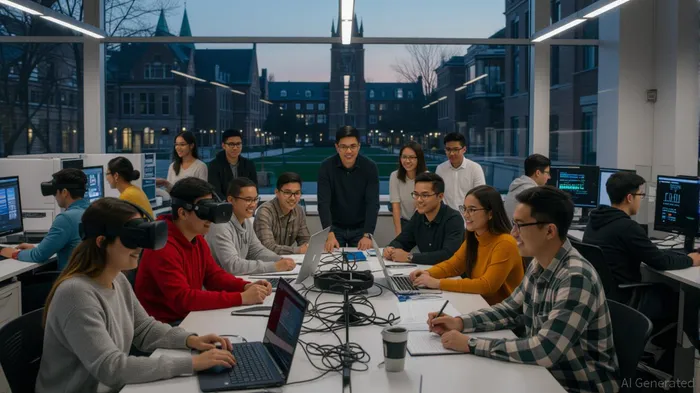 A landmark $75 million investment in FSC's Center for Computer Sciences-funded by $30 million from New York's Long Island Investment Fund and $45 million from the SUNY Construction Fund-will double enrollment in technology programs and address critical workforce shortages in cybersecurity and AI. Designed as the first zero net carbon ready building on campus, the center supports FSC's 40% enrollment growth in computer science programs over the past five years and fosters collaboration between academia and industry partners. Initiatives like the STEM Diversity Summit further close equity gaps by promoting inclusivity, ensuring underrepresented groups gain access to high-skilled tech careers according to reports.
Investment Potential in EdTech and STEM Programs
The financial allure of STEM education extends beyond institutional impact. The global EdTech market, valued at $277.2 billion in 2025, is projected to surge to $907.7 billion by 2034, driven by AI-powered personalized learning and immersive tools like VR/AR. STEM education in K-12 is also expanding, with the market reaching $43.93 billion in 2024 and expected to grow to $49.88 billion in 2025 at a 13.5% CAGR. Investors are prioritizing platforms that align academic programs with AI and STEM workforce needs, achieving 20–75% higher ROI through systemic AI adoption.
Case studies highlight the sector's potential. MIT's $350 million AI college integrates AI across disciplines, while OpenClassrooms has helped 43,000 learners advance careers through apprenticeship-based programs. However, challenges such as U.S. tariffs on imported STEM materials and rising operational costs necessitate scalable, strategic solutions. Institutions and investors focusing on comprehensive AI strategies and workforce readiness are well-positioned to capitalize on EdTech's rapid expansion.
Strategic Implications for Investors
The convergence of STEM education, EdTech innovation, and workforce alignment presents a compelling investment thesis. Institutions like Farmingdale State College demonstrate how targeted infrastructure and programmatic investments yield measurable economic returns, while the EdTech sector's projected growth underscores its scalability. For investors, prioritizing STEM-focused initiatives-whether through institutional partnerships, EdTech platforms, or workforce development programs-offers dual benefits: fostering societal progress and securing long-term financial gains.
As the global economy continues its digital transformation, education will remain the bedrock of innovation. Those who recognize its strategic value today will shape the technological and economic landscapes of tomorrow.

Mezclando la sabiduría tradicional en el comercio con las perspectivas de vanguardia relacionadas con las criptomonedas.
Latest Articles
Stay ahead of the market.
Get curated U.S. market news, insights and key dates delivered to your inbox.


AInvest
PRO
AInvest
PRO



Comments
No comments yet