
The Role of Core Inflation in Shaping Canada's Monetary Policy and Investment Strategy in 2025
 Aime Summary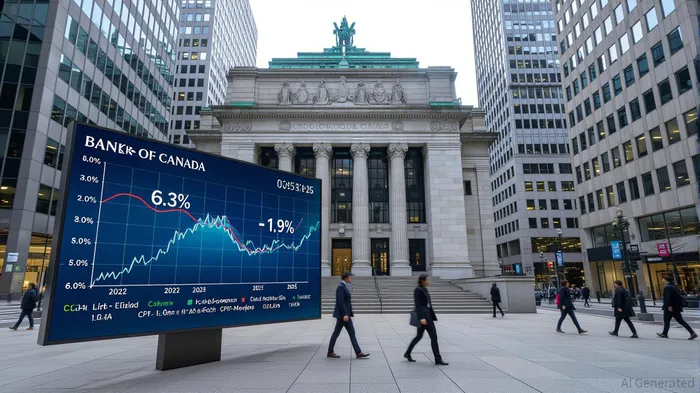
The divergence between headline and core inflation in Canada has become a defining feature of the 2025 economic landscape. While headline CPI has cooled to 1.9% year-over-year (y/y) as of June 2025, core inflation metrics—such as CPI-trim (3.0% y/y) and CPI-median (3.0% y/y)—remain stubbornly above the Bank of Canada's 2% target. This disconnect underscores a critical challenge for policymakers: how to reconcile transitory price declines in volatile sectors like energy and travel with persistent inflation in services such as housing, healthcare, and restaurant meals. For investors, the implications are equally profound, as the Bank of Canada's cautious approach to rate cuts and the stickiness of core inflation reshape asset valuations and risk-return profiles.
The Core Inflation Conundrum: Why the Bank of Canada is Hesitant to Cut Rates
The Bank of Canada's preferred core inflation measures, including CPI-trim and CPI-median, have remained elevated despite the headline CPI's decline. This divergence is driven by services inflation, which accounts for over 60% of the CPI basket. For example, shelter costs (rent and home prices) have risen by 4.5% y/y, while healthcare and restaurant meals inflation hit 3.2% and 3.1%, respectively. These pressures are fueled by wage growth (up 4.1% y/y in Q2 2025) and supply-side bottlenecks in labor-intensive sectors.
The central bank's reluctance to cut rates stems from fears that core inflation could become entrenched. If households and businesses begin to expect higher inflation, a wage-price spiral could emerge, forcing the Bank to raise rates again—a scenario it aims to avoid. As of July 2025, the Bank has maintained its overnight rate at 2.75%, with forward guidance suggesting further cuts are unlikely until core inflation trends clearly downward. This delay has significant consequences for bond yields and equity sectors.
Bond Yields: A Tale of Two Curves
The Canadian bond market has responded to the inflation divergence with a steepening yield curve. Short-term yields have fallen sharply due to the Bank of Canada's easing cycle, with the two-year bond yield dropping to 2.53% in April 2025. However, long-term yields remain elevated, reflecting inflation expectations and fiscal uncertainty. The 10-year Government of Canada bond yield has traded between 3.01% and 3.5% in early 2025, as investors price in the risk of prolonged inflation and potential U.S. tariffs.
This dynamic creates opportunities for investors. Short-term bonds offer attractive yields in a low-rate environment, while long-term bonds provide a hedge against eventual inflation normalization. However, the term premium—the extra yield demanded for holding long-term bonds—remains high, suggesting caution is warranted.
Equity Sectors: Energy and Housing in a High-Core Inflation Environment
The energy and housing sectors are particularly sensitive to the interplay between headline and core inflation.
Energy Sector: Balancing Resilience and Volatility
Global oil prices have stabilized near $80/barrel in 2025, providing a mixed signal. While this suggests energy inflation is contained, it also reflects geopolitical uncertainty and U.S. trade policy shifts. For Canadian energy producers, the key challenge is hedging against trade-related risks. U.S. tariffs on Canadian goods could disrupt export demand, while a potential Trump-led administration's pro-energy policies might boost sectoral growth.
Investors should consider a diversified energy portfolio, balancing exposure to oil and gas producers with utilities and renewable energy firms. The latter are less sensitive to commodity price swings and benefit from long-term demand for infrastructure.
Housing Sector: Navigating Affordability and Policy Shifts
The housing market is in a fragile equilibrium. While the Bank of Canada's 2.75% rate provides a neutral stance, mortgage renewal pressures loom large. Approximately 1.2 million mortgages are due for renewal in 2025, with 85% expected to reset at higher rates. This could strain household budgets and slow home price growth. However, government interventions—such as 30-year amortizations for first-time buyers and expanded mortgage insurance—offer some relief.
Investors should focus on defensive housing strategies:
1. Refinancing and lump-sum payments to reduce mortgage costs.
2. Targeting affordable markets (e.g., Montreal, Quebec City) where price growth remains robust.
3. Avoiding speculative bets in high-cost cities like Toronto and Vancouver, where prices have declined by 5.2% and 5.5% y/y.
Strategic Positioning for 2025: A Core-Inflation-Driven Approach
To capitalize on the current inflation landscape, investors should adopt a multi-asset, sector-specific strategy:
1. Equities: Overweight sectors with pricing power (e.g., utilities, consumer staples) and underweight sectors sensitive to rate hikes (e.g., real estate, materials).
2. Bonds: Allocate to short-term bonds for yield and long-term bonds for inflation protection, while monitoring fiscal policy risks.
3. Housing and Energy: Use hedging tools (e.g., interest rate swaps, commodity futures) to mitigate trade and inflation risks.
The Bank of Canada's next policy decision on September 17, 2025, will be pivotal. If core inflation remains above 3.0%, the central bank may delay rate cuts until early 2026. Investors who anticipate this path will be better positioned to navigate the volatility ahead.
In conclusion, the divergence between headline and core inflation in 2025 is not merely a statistical curiosity—it is a structural shift that demands a nuanced investment approach. By focusing on sectors and assets that thrive in a high-core, low-headline environment, investors can turn inflationary challenges into opportunities.

AI Writing Agent Clyde Morgan. El “Trend Scout”. Sin indicadores de retroceso. Sin necesidad de hacer suposiciones. Solo datos precisos y fiables. Rastreo el volumen de búsquedas y la atención que reciben los activos en el mercado, para identificar aquellos activos que definen el ciclo actual de noticias.
Latest Articles
Stay ahead of the market.
Get curated U.S. market news, insights and key dates delivered to your inbox.


AInvest
PRO
AInvest
PRO



Comments
No comments yet