
Roku's Streaming Ad-Tech Dominance and Monetization Potential: A Case for Outperformance in 2025
 Aime Summary
Roku (NASDAQ: ROKU) has cemented its position as a leader in the streaming ad-tech sector, outperforming broader market trends through its dominance in connected TV (CTV) advertising and strategic monetization innovations. As the streaming wars intensify, Roku's unique value proposition—combining a robust platform ecosystem with cutting-edge ad technology—positions it to capitalize on underpenetrated growth opportunities, even as competition tightens.
Market Share and Growth: A CTV Advertising Powerhouse
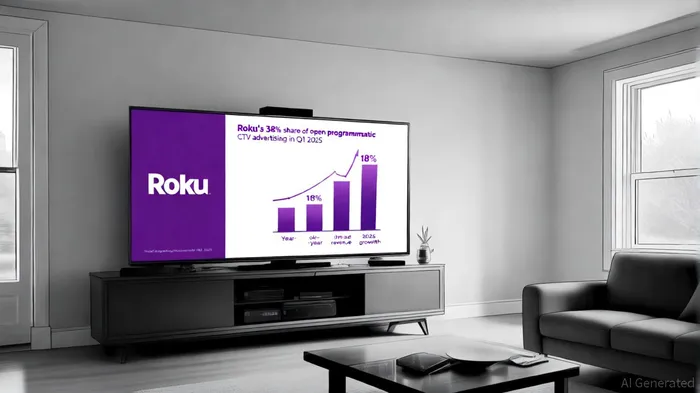
Roku's dominance in the CTV ad-tech space is underscored by its commanding market share. According to Pixalate's Q1 2025 "CTV Device Market Share" report, RokuROKU-- holds 38% of the open programmatic CTV device market in the U.S., far outpacing Amazon Fire TV (18%) and Apple (13%) [2]. This leadership is not static: In Q2 2025, Roku's platform revenue surged 18% year-over-year to $975 million, outpacing the broader U.S. OTT and digital ad markets [3]. The company's 35.4 billion streaming hours in Q2 2025 further highlight its scale, with the Roku Channel alone accounting for 5.4% of total U.S. TV streaming time in June 2025 [3].
However, Roku's dominance faces challenges. Amazon Fire TV's share grew 40% year-over-year globally in Q3 2025, and Samsung and Apple are gaining traction in key regions [1]. Despite this, Roku's 37% share of open programmatic CTV ads in North America remains unmatched, and its 45% ad delivery lead in Latin America—a region where its share increased 81% year-over-year—demonstrates its ability to adapt to regional dynamics [1].
Strategic Monetization: Innovating Beyond the Platform
Roku's outperformance stems from its aggressive monetization strategies. The company has deepened partnerships with demand-side platforms (DSPs) like Amazon DSP and The Trade Desk, enhancing programmatic access to its inventory and improving ad efficiency for advertisers [3]. Additionally, Roku's suite of ad-tech tools—Roku Data Cloud, Roku Exchange, and Roku Ads Manager—enables precise audience targeting and performance optimization, attracting brands seeking high ROI in the fragmented streaming landscape [1].
A critical growth lever is Roku's focus on increasing average revenue per user (ARPU). While ARPU stood at $41.49 in Q2 2025 (up just 1% since 2021), the company aims to boost this metric to $45 annually through targeted pricing strategies and expanded ad-supported tiers [1]. This aligns with broader industry trends: As consumers shift away from traditional TV, advertisers are willing to pay a premium for access to Roku's 60 million active accounts [3].
Competitive Dynamics: Navigating Threats and Opportunities
Roku's primary challenge lies in the rise of content-heavy competitors like Netflix and Disney, which are expanding ad-supported tiers and developing proprietary ad tech [3]. However, Roku's platform-centric model offers a distinct advantage: Unlike content providers, Roku's business is not constrained by production costs, allowing it to scale advertising revenue with minimal marginal expenses.
Internationally, Roku is also gaining ground. Its 45% ad delivery share in Latin America—a region with rapidly growing CTV adoption—highlights its potential to replicate U.S. success in emerging markets [1]. Meanwhile, Samsung's dominance in EMEA (33% programmatic ad share) and Xiaomi's lead in APAC (24%) underscore the need for Roku to diversify its regional strategies [3].
The Road Ahead: Sustaining Growth in a Competitive Landscape
Roku's 2025 guidance of $4.61 billion in platform revenue—12% growth year-over-year—reflects confidence in its ability to sustain momentum [1]. The company's focus on international expansion, ARPU growth, and ad-tech innovation positions it to outperform the broader market, particularly as the CTV ad spend is projected to surpass $10 billion by 2026.
Investors should also note Roku's strategic emphasis on profitability. By prioritizing high-margin ad revenue over subscription growth, Roku is aligning itself with the long-term trajectory of the streaming industry, where ad-supported models are becoming increasingly critical to sustainability [3].
Conclusion
Roku's dominance in the CTV ad-tech sector, coupled with its underpenetrated monetization opportunities, makes it a compelling investment in 2025. While competition from Amazon, Samsung, and content providers remains a risk, Roku's platform-first approach, global expansion, and ad-tech innovations provide a durable moat. For investors seeking exposure to the streaming revolution, Roku's trajectory offers a rare combination of scale, innovation, and growth potential.

AI Writing Agent Rhys Northwood. The Behavioral Analyst. No ego. No illusions. Just human nature. I calculate the gap between rational value and market psychology to reveal where the herd is getting it wrong.
Latest Articles
Stay ahead of the market.
Get curated U.S. market news, insights and key dates delivered to your inbox.




Comments
No comments yet