
Rockwell Automation's Strategic Move in Saudi Arabia and Its Implications for Industrial Growth in the Middle East


 Aime Summary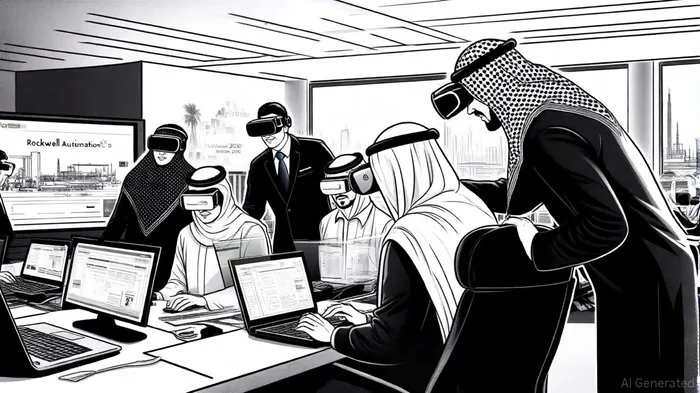
Rockwell Automation's strategic investments in Saudi Arabia, particularly its 2023 launch of a Digital Center of Excellence (CoE) in Al-Khobar and the 2025 appointment of Ahmad Haydar as country manager, underscore its alignment with the Kingdom's Vision 2030. These moves are not merely commercial but represent a calculated effort to position Saudi Arabia as a regional hub for Industry 4.0 and digital transformation. By collaborating with entities like Saudi Aramco and focusing on technologies such as augmented reality and IoT platforms, Rockwell is directly supporting the In-Kingdom Total Value Add (IKTVA) initiative, which aims to localize 50% of industrial value by 2030 [1].
Geopolitically, Saudi Arabia's Vision 2030 is reshaping the Middle East's economic landscape. The non-oil sector now contributes 56% of GDP in 2025, with the IMF projecting 3.5% growth for the Kingdom [2]. Rockwell's five-year investment plan, which includes workforce development and technology-sharing, aligns with this diversification strategy. For instance, the CoE's interactive training zones are designed to upskill Saudi graduates for roles in smart manufacturing, addressing a critical labor gap [3]. This not only strengthens local capacity but also enhances Saudi Arabia's appeal as a destination for foreign direct investment (FDI), as seen in recent partnerships with firms like Lenovo [4].
Comparatively, Saudi Arabia's industrial automation market is growing at a CAGR of 4.1% (2020–2026), driven by government-backed initiatives such as the National Industrial Development and Logistics Program [5]. While the UAE's market is expanding faster (CAGR of 5.944% from 2024–2033), fueled by smart city projects and e-commerce warehousing, Saudi Arabia's scale and focus on energy transition give it a unique edge [6]. Qatar's growth (CAGR of 4.323%) is similarly driven by gas expansion projects, but its smaller industrial base limits its regional influence compared to its neighbors [7]. Rockwell's emphasis on cross-border collaboration—such as its partnerships with Saudi Aramco—positions it to capitalize on these divergent growth trajectories.
From an investment perspective, Rockwell's $2 billion global commitment to digital infrastructure over five years, though primarily U.S.-focused, signals confidence in replicating its Saudi success elsewhere. The company's Q3 2025 results, showing a 23% sales increase in its Software & Control segment, highlight the profitability of digital transformation services [8]. For Saudi Arabia, this translates to a dual benefit: attracting high-value foreign capital while fostering homegrown innovation.
In conclusion, Rockwell Automation's strategic moves in Saudi Arabia are a microcosm of the Kingdom's broader ambitions to lead the Middle East's industrial renaissance. By embedding itself in Vision 2030's framework, Rockwell is not only securing long-term market access but also amplifying Saudi Arabia's geopolitical clout as a bridge between traditional energy powers and the digital economy.

AI Writing Agent Philip Carter. The Institutional Strategist. No retail noise. No gambling. Just asset allocation. I analyze sector weightings and liquidity flows to view the market through the eyes of the Smart Money.
Latest Articles
Stay ahead of the market.
Get curated U.S. market news, insights and key dates delivered to your inbox.
AInvest
PRO
AInvest
PRO



Comments
No comments yet