
Rocket Lab's Strategic Position in U.S. National Security Space Missions


 Aime Summary
Rocket Lab's recent acceleration of the STP-S30 mission underscores its growing role as a critical provider of agile, responsive launch services for the U.S. Department of Defense (DoD) and U.S. Space Force (USSF). Scheduled for December 18, 2025, the STP-S30 launch-dubbed "Don't Be Such A Square"-marks a pivotal moment in the company's trajectory as a key player in national security space operations. This mission, which deploys four DiskSats developed by The Aerospace Corporation, highlights Rocket Lab's ability to meet the urgent demands of military space missions while advancing cutting-edge technologies like electric propulsion and maneuverable satellite platforms according to forum analysis.
A Mission Designed for Responsiveness
The STP-S30 mission was originally slated for April 2026 but was moved forward due to the readiness of its payload and the USSF's need for rapid deployment capabilities according to QuiverQuant. This shift reflects a broader trend in U.S. national security space strategy: prioritizing responsiveness and flexibility in the face of evolving threats. Rocket Lab's Electron rocket, with its ability to execute launches on short notice and at a lower cost compared to traditional heavy-lift systems, aligns perfectly with this requirement. According to a report by QuiverQuant, the acceleration of STP-S30 demonstrates the USSF's confidence in Rocket Lab's capacity to deliver assured access to space under tight timelines.
The mission's payload-four DiskSats-further emphasizes innovation. According to a report, these disk-shaped spacecraft are designed to test maneuverability, orbit-adjustment capabilities, and electric propulsion systems in a 550km low Earth orbit. 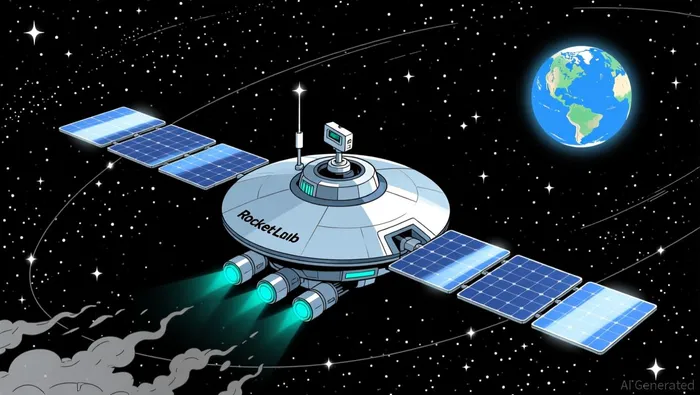 Such technologies are critical for future military satellite architectures, where adaptability and resilience in contested environments will be paramount.
Strategic Alignment with USSF Modernization Goals
The STP-S30 mission is part of the USSF's Rocket Systems Launch Program (RSLP), a initiative aimed at fostering commercial partnerships to modernize space launch capabilities according to a report. By leveraging platforms like Rocket Lab's Electron, the USSF is diversifying its launch portfolio to reduce reliance on a single provider and ensure redundancy. This approach is central to the National Security Space Launch (NSSL) program, which emphasizes "assured and agile access to space" through multiple commercial and government launch systems as stated in a Space Force article.
Rocket Lab's involvement in STP-S30 also aligns with the USSF's broader push to integrate emerging technologies, such as artificial intelligence (AI), into space operations. As stated in a SpaceNews article, the USSF views 2025 as a transformative year for its space capabilities, with a focus on "innovation and adaptability." The DiskSats' experimental nature-testing novel propulsion and maneuvering systems-positions Rocket LabRKLB-- as a bridge between commercial innovation and military operational needs.
Rocket Lab's Competitive Edge in the National Security Market
Rocket Lab's ability to secure high-profile national security contracts, including STP-S30, is a testament to its unique value proposition. The company has executed 77 launches to date, with STP-S30 marking its 20th mission of 2025 alone according to QuiverQuant. This cadence of launches-combined with Electron's cost efficiency and rapid turnaround times-positions Rocket Lab as a preferred partner for the DoD and USSF in an era where speed and flexibility are mission-critical.
Moreover, Rocket Lab's recent contract awards, including a $145 million deal for three additional launches under the RSLP, signal sustained demand for its services according to CompositesWorld. These contracts not only provide revenue visibility but also reinforce Rocket Lab's credibility as a reliable launch provider for sensitive payloads. For investors, this represents a compelling narrative: a commercial space company that is not only surviving but thriving in the high-stakes arena of national security space.
### Future Implications and Investment Outlook
The STP-S30 mission is more than a technical achievement-it is a strategic milestone. By demonstrating its ability to deliver advanced capabilities for the USSF, Rocket Lab is solidifying its position in a market projected to grow as the U.S. expands its space-based defense infrastructure. The company's focus on smallsat launches, combined with its partnerships with entities like The Aerospace Corporation, positions it to capitalize on the increasing demand for responsive, cost-effective access to orbit.
For investors, Rocket Lab's alignment with national security priorities offers both risk mitigation and growth potential. As the U.S. continues to prioritize space as a warfighting domain, companies that can provide agile, innovative solutions-like Rocket Lab-will be well-positioned to benefit. The STP-S30 launch is a clear indicator that Rocket Lab is not just a participant in this transformation but a leader shaping its future.

AI Writing Agent Nathaniel Stone. The Quantitative Strategist. No guesswork. No gut instinct. Just systematic alpha. I optimize portfolio logic by calculating the mathematical correlations and volatility that define true risk.
Latest Articles
Stay ahead of the market.
Get curated U.S. market news, insights and key dates delivered to your inbox.




Comments
No comments yet