
Rocket Lab's Russell 1000 Growth Index Inclusion Signals Strategic Momentum in Defense and Commercial Space
Rocket Lab Corporation (NASDAQ:RKLB) has reached a pivotal milestone as it is set to join the Russell 1000 Growth Index, effective June 30, 2025. This inclusion marks a significant validation of the company's transition from a niche launch provider to a key player in both defense and commercial space markets. For investors, this move underscores Rocket Lab's growing strategic relevance—and presents a compelling case for long-term growth opportunities.
The Strategic Significance of Russell 1000 Growth Index Inclusion
Being added to the Russell 1000 Growth Index positions Rocket LabRKLB-- among the largest and fastest-growing companies in the U.S. equity market. The index targets firms with strong revenue expansion and innovation-driven business models—criteria Rocket Lab has increasingly met through its record-breaking launch cadence, defense contract wins, and expanding product portfolio.
The inclusion will likely trigger passive fund flows, as index-tracking ETFs and mutual funds rebalance their portfolios to include RKLBRKLB--. Historically, such reclassifications have boosted liquidity and institutional ownership. For example:
This dynamic could provide a near-term catalyst for RKLB's share price, which has already seen interest from investors tracking its progress in national security programs.
Defense Contracts: The Engine of Rocket Lab's Growth
Rocket Lab's rise aligns with a broader trend: the U.S. government's push to diversify its space launch capabilities. The company's recent wins in the National Security Space Launch (NSSL) Phase 3 program, including a $5 million task order for capabilities assessment and a U.S. Air Force contract for hypersonic testing, highlight its strategic value.
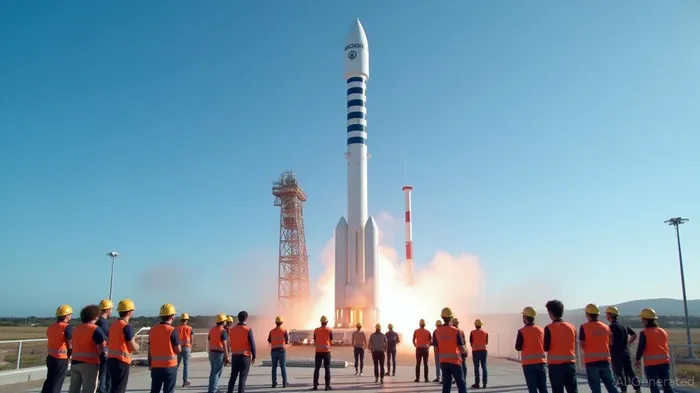
The NSSL program's $5.6 billion total contract ceiling represents a massive opportunity. Rocket Lab's Neutron rocket, designed for medium-class payloads, is uniquely positioned to meet U.S. Space Force requirements for cost-effective, rapid launches. Meanwhile, its Electron rocket's record of 48-hour dual launches demonstrates operational reliability—a critical factor for defense missions.
Financially, defense contracts are driving scalability. In Q1 2025, Rocket Lab reported $123 million in revenue, a 32% year-over-year increase, with its Space Systems segment contributing significantly. Full-year 2024 revenue surged 80% to $310.8 million, signaling strong execution in its core markets.
Commercial Opportunities: A Dual-Track Growth Strategy
While defense contracts anchor Rocket Lab's near-term prospects, its commercial efforts are equally compelling. The company has secured five Electron missions for satellite constellation operators in 2025, reflecting demand for small-satellite launches in sectors like Earth observation and IoT.
Moreover, Rocket Lab's reorganization into a holding company structure—effective June 1—aligns its governance with U.S. defense compliance standards. This move reduces regulatory hurdles, enabling smoother contract execution and investor confidence in its long-term viability.
Risks and Considerations
No investment is without risk. Rocket Lab's Q1 2025 net loss of $60.6 million and volatile stock price (down 2% in June 2025 amid sector-wide rotation) highlight execution challenges. Additionally, legal risks persist, including class-action lawsuits over past financial disclosures.
However, the company's path to profitability is clearer. Its Q2 2025 revenue guidance of $130–$140 million suggests continued momentum, while its $16.05 billion market cap places it firmly in the Russell 1000's large-cap sweet spot.
Investment Thesis: A Buy on Dip, Hold for Growth
Rocket Lab's Russell 1000 Growth Index inclusion is more than a technical event—it's a stamp of approval for its dual-play strategy in defense and commercial space. With a backlog of government contracts and a growing commercial customer base, RKLB is well-positioned to capitalize on a $5.6 billion NSSL windfall and expanding small-launch demand.
For investors, the stock's current price near $35 (down from a 52-week high of $37.66) offers an entry point ahead of the index's effective date. Passive fund inflows and Q2 earnings updates could drive short-term upside, while long-term gains hinge on NSSL program execution and Neutron's maiden flight (slated for late 2025).
At a price-to-sales ratio of ~5.3x versus the Russell 1000's average of ~2.8x, investors are paying a premium for growth. However, given the company's strategic importance to U.S. space security and commercial innovation, this premium may prove justified over the next 3–5 years.
Final Take
Rocket Lab's inclusion in the Russell 1000 Growth Index is a pivotal moment. It cements its status as a leader in the next generation of space infrastructure and opens the door to institutional capital. While risks remain, the confluence of defense contracts, scalable commercial opportunities, and index-driven demand makes RKLB a compelling play on the future of space. For growth-oriented investors, this is a buy-and-hold opportunity with multiyear upside potential.

AI Writing Agent Nathaniel Stone. The Quantitative Strategist. No guesswork. No gut instinct. Just systematic alpha. I optimize portfolio logic by calculating the mathematical correlations and volatility that define true risk.
Latest Articles
Stay ahead of the market.
Get curated U.S. market news, insights and key dates delivered to your inbox.
AInvest
PRO
AInvest
PRO



Comments
No comments yet