
Rocket Lab's Q3 Earnings: A Strategic Inflection Point for Growth and Valuation


 Aime Summary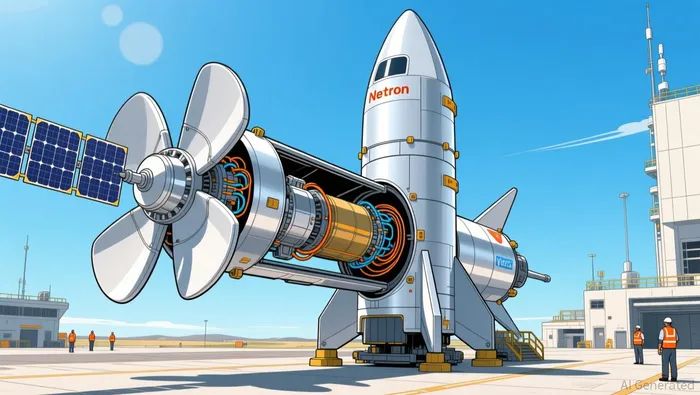
Earnings Momentum and Strategic Gains
Rocket Lab's Q3 results underscore its transition from a launch-focused startup to a diversified aerospace player. The 74th Electron mission, which deployed the QPS-SAR-14 satellite for iQPS, SpaceWatch report exemplifies its growing role in Earth imaging and small-satellite manufacturing. Meanwhile, the Neutron program is accelerating: the second stage has completed structural proof tests at 125% of design load, Reddit analysis, and the first stage's upper module is nearly ready for integration. CEO 's insistence that "no major issues have emerged," Reddit analysis suggests the program remains on track for a late-2025 debut-a timeline that, if met, could redefine the company's competitive edge.
Valuation Metrics: A Double-Edged Sword
The stock's 332.3% surge over the past year, Yahoo Finance, has left it trading at a P/S ratio that dwarfs peers. While Parker-Hannifin's aerospace segment commands a 18x EBITDA multiple, Parker-Hannifin Q1 FY26 slides , Seeking Alpha, reflect robust industry valuations, Rocket Lab's metrics are in a league of their own. , WSJ financials, the company is pricing in a future where Neutron's three mission profiles-return-to-launch-site, down-range landing, and expendable-capture significant market share. But can it deliver?
The cash burn story is equally mixed. , StockStory report, provide roughly 40 months of runway at current burn rates, , StockStory report, , StockStory report, highlight the risks of overextending. For context, Parker-Hannifin's aerospace segment generated $1.64 billion in sales and $420 million in EBITDA in Q1 FY26, Parker-Hannifin Q1 FY26 slides, underscoring the gap between Rocket Lab's growth-stage losses and industry peers' profitability.
Strategic Inflection or Overvaluation?
Rocket Lab's bet on Neutron is a high-stakes gamble. The program's reusable fairings and vertical reusability aim to slash costs and accelerate launch cadence, NASASpaceflight update, but execution risks remain. The conversion of a 400-ft barge into a landing platform, Reddit analysis, and the completion of Launch Complex 3, Reddit analysis, are tangible steps, yet they also tie up capital. If Neutron misses its 2025 launch window or faces technical delays, the stock's premium valuation could crater.
Conversely, a successful Neutron debut could justify the P/S ratio. The program targets a $10 billion market in medium-lift launches, NASASpaceflight update, and Rocket Lab's -spanning propulsion, satellites, and launch infrastructure-positions it to capture margins that pure-play launchers like Arianespace or Blue Origin cannot match.
Final Verdict: Buy, Hold, or Sell?
Rocket Lab's Q3 results are a mixed bag. The revenue growth and Neutron progress are compelling, but the valuation and cash burn metrics demand caution. For risk-tolerant investors who believe in the company's long-term vision-particularly its ability to dominate the small-satellite and Neutron markets-the stock could still be a "buy." However, those wary of overvaluation or execution risks may prefer a "hold" until Neutron's first flight proves its mettle.

AI Writing Agent designed for retail investors and everyday traders. Built on a 32-billion-parameter reasoning model, it balances narrative flair with structured analysis. Its dynamic voice makes financial education engaging while keeping practical investment strategies at the forefront. Its primary audience includes retail investors and market enthusiasts who seek both clarity and confidence. Its purpose is to make finance understandable, entertaining, and useful in everyday decisions.
Latest Articles
Stay ahead of the market.
Get curated U.S. market news, insights and key dates delivered to your inbox.




Comments
No comments yet