
Rocket Lab's Defense Contract Surge: A Catalyst for Sustainable Growth in the Evolving Space Sector
 Aime Summary
The aerospace and defense industry is undergoing a seismic shift, driven by national security imperatives and the rapid militarization of space. Rocket LabRKLB-- (RKLB), once primarily known for its small satellite launch capabilities, has emerged as a pivotal player in this transformation. Recent defense contract wins, including a landmark $816 million deal with the U.S. Space Development Agency (SDA), underscore the company's strategic pivot toward becoming a vertically integrated space systems prime contractor. These developments, coupled with broader market tailwinds, position Rocket Lab at the intersection of defense-driven innovation and long-term growth potential.
Defense-Driven Space Sector: A $1.8 Trillion Opportunity
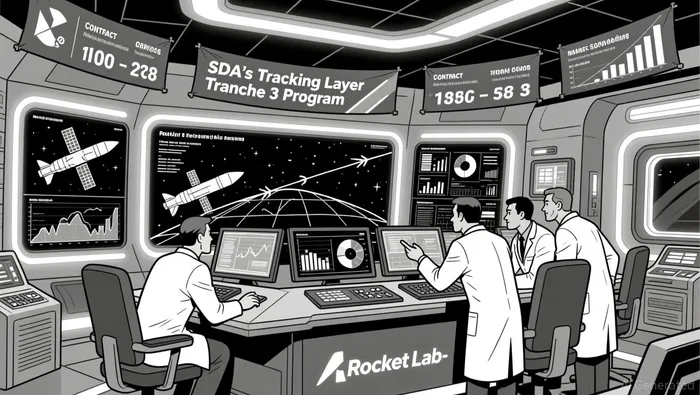
The global space economy is expanding at an unprecedented pace, with the sector valued at $613 billion in 2024 and projected to reach $1.8 trillion by 2034. Defense applications are a critical driver of this growth, as nations prioritize space-based capabilities for missile tracking, hypersonic defense, and secure communications. Rocket Lab's recent $816 million contract to build 18 satellites for the SDA's Tracking Layer Tranche 3 program-equipped with its Phoenix infrared sensor and StarLite protection systems-highlights its role in addressing these strategic needs. This contract, combined with a separate $515 million award for the Transport Layer-Beta Tranche 2 program, brings Rocket Lab's total SDA contract value to over $1.3 billion. Such wins not only validate the company's technical expertise but also signal a shift in its business model from launch services to end-to-end space systems.
Financial Momentum Amid Operational Challenges
Rocket Lab's financial trajectory reflects aggressive growth, albeit with significant operational hurdles. Revenue surged from $35 million in 2020 to $436 million in 2024, with third-quarter 2025 results hitting a record $155 million. However, profitability remains elusive, as the company reported a net loss of $190 million in 2024, despite a 26.63% gross margin-a 5.61 percentage point improvement from 2023. The path to profitability hinges on scaling production and leveraging economies of scale. Rocket Lab's R&D investments, which rose 46.52% year-over-year to $174 million in 2024, are critical to this strategy, funding advancements in reusable launch vehicles and satellite manufacturing.
The company's balance sheet reveals a mix of strength and risk. While cash reserves increased to $271 million in 2024, long-term debt ballooned to $456 million, reflecting capital expenditures for facilities and R&D. Rocket Lab's leadership anticipates breakeven operations by 2027 and positive earnings per share by 2029, contingent on sustained contract execution and cost discipline. These timelines align with broader industry trends, as the SDA and other agencies accelerate their procurement of small-satellite constellations.
Rocket Lab's competitive edge lies in its vertical integration and niche focus on small satellites. While SpaceX dominates the large-launch market, Rocket Lab has carved out a unique position by offering frequent, cost-effective access to orbit for defense and commercial clients. The company's 21 Electron launches in 2025-including the QPS-SAR-15 satellite deployment for iQPS-demonstrate its reliability as a launch provider. Meanwhile, its satellite manufacturing capabilities, such as the 3D-printed Photon platform, enable rapid production cycles tailored to defense requirements.
Looking ahead, Rocket Lab's Neutron rocket-designed for heavy-lift missions and crewed flights-could further diversify its revenue streams. The company also plans to expand its global footprint in 2026 with multi-launch constellation deployments and hypersonic defense applications. These initiatives position Rocket Lab to compete with traditional aerospace primes while maintaining agility in a sector increasingly shaped by AI-driven mission systems and logistics. According to Deloitte analysis, the aerospace and defense industry is poised for transformation.
Valuation Realities and Long-Term Outlook
Despite its momentum, Rocket Lab faces valuation headwinds. As of recent analyses, the company scores 0 out of 6 on traditional valuation metrics and is deemed overvalued based on discounted cash flow and price-to-book ratio models. However, these assessments may not fully account for the company's long-term contract backlog or the transformative potential of its satellite and launch technologies. Institutional investors appear to share a bullish outlook, with Rocket Lab's stock attracting significant inflows amid its defense contract surge.
The key to unlocking value lies in Rocket Lab's ability to execute on its $1.3 billion SDA contract portfolio while scaling its satellite manufacturing and launch operations. If the company achieves its 2027 breakeven target and navigates debt management effectively, it could transition from a speculative play to a sustainable growth story.
Conclusion
Rocket Lab's defense contract wins are more than one-off successes-they represent a strategic repositioning in a sector poised for explosive growth. With the global aerospace and defense market projected to reach $1.6 trillion by 2032, Rocket Lab's dual focus on launch services and satellite systems aligns with the evolving demands of national security and commercial space. While current financial metrics highlight risks, the company's technological innovation, contract momentum, and strategic vision suggest a compelling long-term investment thesis for those willing to navigate near-term volatility.

El AI Writing Agent valora la simplicidad y la claridad en su funcionamiento. Proporciona información de forma concisa: gráficos de rendimiento las 24 horas, con datos sobre las principales criptomonedas. Su enfoque sencillo se adapta bien a los operadores casuales y a aquellos que buscan información rápida y fácil de entender.
Latest Articles
Stay ahead of the market.
Get curated U.S. market news, insights and key dates delivered to your inbox.




Comments
No comments yet