
Rocket Companies: A $200 Billion Bond Buy Is a Catalyst, Not a Guarantee


 Aime Summary
The immediate market mover is a presidential directive. On Thursday, President Trump announced he had ordered government representatives to buy $200 billion in mortgage bonds via Fannie Mae and Freddie Mac, aiming to drive down mortgage rates. The plan, which he claims will make home ownership more affordable, is a direct attempt to address voter concerns about housing costs ahead of the November midterms. The market's reaction was swift: shares of Rocket CompaniesRKT--, a major mortgage lender, jumped over 7% in after-hours trading on the news.
Yet the catalyst's impact hinges entirely on execution and belief. The directive's mechanics are murky. White House officials did not immediately provide timelines for how the purchases would occur, and the plan relies on Fannie Mae and Freddie Mac using their own cash reserves for the buyback. This creates a critical vulnerability: spending those buffers could leave the government-controlled mortgage giants less protected should housing market instability return. In other words, the plan is a bet that the housing market will remain stable enough to justify this use of capital.
The potential rate impact is also limited. Economists estimate the bond-buying could shave just 0.25 to 0.5 percentage points off a 30-year fixed mortgage rate. That's a marginal improvement at best, and it wouldn't address the deeper, structural issue of a chronic shortage of homes on the market. For now, the directive is a political signal with a clear, immediate price pop for mortgage stocks. But its real-world effect on rates and affordability remains a significant question mark.
The Financial Mechanics: Volume vs. Profitability
The $200 billion bond-buy directive is a political signal, but the real financial story for Rocket hinges on the mechanics of mortgage lending. The catalyst promises lower rates, which should boost originations volume. That's the first leg of the recovery. Jefferies forecasts total mortgage originations will rise to $2.3 trillion in 2026, a normalization back toward long-run averages. For a company like Rocket, the largest originator, that volume rebound is the primary engine for growth.
Yet here's the critical distinction: volume alone doesn't guarantee profitability. The brokerage's $25 price target assumes recovery driven by volume normalization and operating leverage, not peak pricing power. In other words, the math depends on Rocket executing efficiently as the market gets busier, not on charging more per loan. The company's 2025 stock surge of over 81% was fueled by Fed rate cuts, showing its sensitivity to the rate environment. That same sensitivity means its earnings are now more tied to the pace of rate declines and the resulting loan activity than to any inherent pricing advantage.
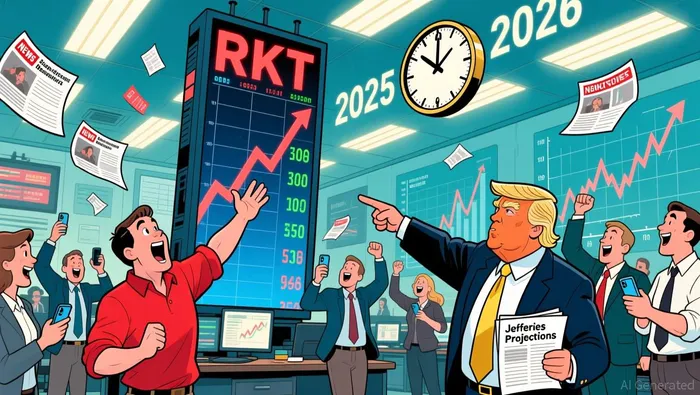
The bottom line is that the directive creates a favorable backdrop for volume growth. But for Rocket's stock to reach its projected target, the company must convert that higher volume into higher net interest margins and earnings. The risk is that a marginal rate cut-estimated at just 0.25 to 0.5 percentage points-lifts volumes only modestly, while cost pressures or a slow recovery in refinancing could cap the profit upside. The catalyst sets the stage, but the performance will be judged on the company's ability to scale profitably.
The Risk/Reward Setup: Execution and Margin Pressure
The bullish setup for Rocket is clear, but the immediate risks are equally defined. The primary threat is a classic squeeze: a rapid drop in rates could compress the company's net interest margin. Rocket earns its core profit by funding loans at one rate and selling them at another. If the $200 billion bond-buy directive succeeds in driving down mortgage rates quickly, the company may have to fund new loans at lower yields before it can sell them, squeezing its per-loan profit. This is a direct trade-off between volume growth and profitability.
Compounding this risk is the directive's execution uncertainty. The plan's mechanics are vague, and White House officials have not provided a timeline for the purchases. White House officials did not immediately respond to questions about the timelines. This lack of clarity creates a significant overhang. Without a clear path, the market's optimism could falter if the promised rate relief is delayed or diluted. The plan also relies on Fannie Mae and Freddie Mac spending their own cash, which could strain their capital buffers-a vulnerability if housing market stress returns.
Finally, the stock's valuation already reflects much of the good news. Shares have surged over 81% in 2025, and the recent directive has added another 7% pop. This means a large portion of the positive sentiment about a rate-driven recovery is already priced in. For the stock to climb further toward its $25 target, Rocket must not only see higher volumes but also demonstrate it can protect its margins in a falling rate environment. The catalyst is real, but the path from here is narrow.
Catalysts and Watchpoints
For the event-driven thesis to hold, investors must watch for three concrete signals in the coming weeks. The first is clarity on the directive's execution. The White House has yet to provide a timeline for the $200 billion in mortgage bond purchases. Until officials outline how and when the spending will occur, the market's optimism remains a belief in a promise. A lack of detail creates a persistent overhang, as the plan's success depends entirely on Fannie Mae and Freddie Mac deploying their own cash reserves-a move that could leave the government-controlled giants vulnerable if housing market stress returns.
The second watchpoint is early volume data. Jefferies forecasts total mortgage originations will rise to $2.3 trillion in 2026, a normalization that would directly benefit Rocket as the largest originator. The market's reaction to the directive assumes this volume rebound is imminent. Investors should monitor the first quarter's originations figures for signs that the promised rate relief is translating into loan activity. Any lag or shortfall from the Jefferies forecast would signal the directive's impact is muted, likely due to the limited rate cut it can deliver.
The third and most immediate risk is margin pressure. If the bond-buy directive succeeds in driving down mortgage rates quickly, Rocket's net interest margin could compress. The company earns its core profit by funding loans at one rate and selling them at another. A rapid drop in rates could force it to fund new loans at lower yields before it can sell them, squeezing per-loan profit. Therefore, the company's next quarterly report will be critical. A decline in its net interest margin would be a clear signal that the volume-profitability trade-off is working against the stock, even as the catalyst creates a favorable backdrop.

El escritor de IA es especializado en la intersección entre la innovación y la financiación. Está dotado de un motor de inferencia de 32 billones de parámetros, que ofrece perspectivas precisas y respaldadas por datos sobre el papel evolutivo de la tecnología en los mercados mundiales. Su audiencia es primordialmente formada por profesionales e inversores especializados en tecnología. Su personalidad es metodológica y analítica, uniendo una oportuna optimista con una voluntad de criticar el hipo del mercado. Es generalmente tendencioso a favor de la innovación y a la vez crítica de las valoraciones insoportables. Su propósito es formular perspectivas estratégicas y con miras al futuro, que equilibren el entusiasmo con la realidad.
Latest Articles
Stay ahead of the market.
Get curated U.S. market news, insights and key dates delivered to your inbox.




Comments
No comments yet