
Roche's ESMO 2025 Cancer Data: Short-Term Catalysts and Long-Term Valuation Implications for Oncology Leadership


 Aime Summary
Roche's recent presentation at the European Society for Medical Oncology (ESMO) 2025 Congress has reignited discussions about its position as a leader in oncology innovation. With over 30 abstracts presented across breast, lung, gastrointestinal, and genitourinary cancers, the company showcased both promising advancements and sobering setbacks. For investors, these developments offer critical insights into Roche's short-term catalysts and long-term valuation potential in a rapidly evolving market.
Short-Term Catalysts: Mixed but Meaningful Data
Roche's ESMO 2025 lineup included several high-impact trials. The phase III evERA Breast Cancer study demonstrated that Giredestrant, a selective estrogen receptor downregulator (SERD), achieved statistically significant and clinically meaningful improvements in progression-free survival (PFS) for patients with ER-positive, HER2-negative advanced breast cancer, according to a Roche media release. This result positions Giredestrant as a potential blockbuster, particularly in a market where endocrine resistance remains a major unmet need.
In bladder cancer, Tecentriq (atezolizumab) showed promise in the IMvigor011 trial, where a ctDNA-guided approach to post-surgery treatment improved both disease-free and overall survival for patients with muscle-invasive bladder cancer, as noted in the Roche release. The use of biomarkers like ctDNA aligns with Roche's broader strategy to refine patient selection and enhance therapeutic precision.
Meanwhile, Alecensa (alectinib) reinforced its role as a first-line standard for ALK-positive non-small cell lung cancer (NSCLC). Final overall survival (OS) data from the ALEX study and updated results from the ALINA trial underscored its durability in the adjuvant setting, according to Roche's presentation. These findings are likely to solidify Alecensa's market share in a segment where competition from newer ALK inhibitors is intensifying.
However, Roche also faced challenges. The Skyscraper-03 trial of tiragolumab in stage III NSCLC and the Imbrave-152 trial in liver cancer failed to meet primary endpoints, as reported in an Oncology Pipeline preview. These setbacks highlight the risks inherent in TIGIT-targeting therapies, a class that has shown mixed results across the industry. Yet, Roche's transparency in presenting these data-rather than burying them-demonstrates a commitment to scientific rigor, which could bolster investor confidence in the long run.
Long-Term Valuation: Market Leadership and Strategic Resilience
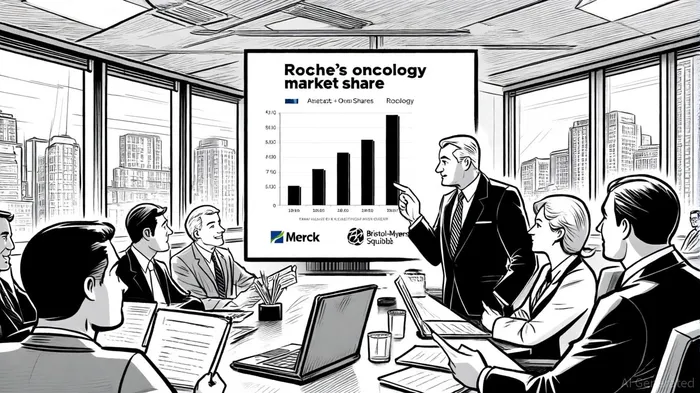
Roche's oncology portfolio currently generates over one-third of its pharmaceutical revenues, with a 2024 market share of 11.9% in the global cancer drugs market, according to a Verified Research Insights report. While this figure has declined from its 2017 peak of 26.4%, the broader oncology market is projected to grow at a compound annual growth rate (CAGR) of 11.3%, reaching $518.25 billion by 2032, per a OneDayAdvisor analysis. Roche's ability to maintain a leadership position in this expanding market will depend on its pipeline and R&D strategy.
The company's focus on precision medicine and biomarker-driven therapies is a key differentiator. For instance, Tecentriq's ctDNA-guided approach in bladder cancer reflects a shift toward personalized treatment paradigms, a trend that is likely to define the next decade of oncology. Similarly, Roche's investments in bispecific antibodies, next-generation antibody-drug conjugates (ADCs), and dual GLP-1/GIP receptor agonists for metabolic disorders position it to address both oncology and non-oncology markets, as detailed in an Inside Roche profile.
Financially, Roche's R&D spending-forecasted to remain above 20% of revenue-underscores its commitment to innovation, a point emphasized in the Inside Roche profile. This is critical in an industry where patent expirations and biosimilar competition pose significant risks. For example, the looming patent cliff for Herceptin and Avastin could erode revenue unless offset by new launches. Roche's pipeline includes seven drug candidates with blockbuster potential, including Inavolisib for PIK3CA-mutated breast cancer and CT-388 for metabolic disorders, according to that profile.
Competitive Landscape: Navigating a Crowded Field
Roche faces stiff competition from peers like Merck (Keytruda), AstraZeneca (Tagrisso), and Bristol-Myers Squibb (Opdivo). Merck's Keytruda alone generated $29.5 billion in 2024 sales, outpacing Roche's Tecentriq, per the OneDayAdvisor analysis. However, Roche's diversified portfolio and focus on combination therapies-such as Tecentriq with T-DM1 in HER2-positive breast cancer-provide a buffer against single-product reliance.
The company's strategic acquisitions, including Carmot Therapeutics and Regor Pharmaceuticals, also enhance its R&D agility, as outlined in the Inside Roche profile. These moves reflect a proactive approach to shortening development timelines and mitigating the high costs of clinical failure.
Conclusion: A Balancing Act for Investors
Roche's ESMO 2025 data presentations highlight both its strengths and vulnerabilities. While the evERA and IMvigor011 trials offer near-term optimism, the tiragolumab failures serve as a reminder of the inherent risks in oncology R&D. For the long term, Roche's leadership in precision medicine, robust R&D spending, and strategic acquisitions position it to navigate a competitive landscape. However, investors must remain cautious about patent cliffs and the rapid pace of innovation from rivals.
In a market where the stakes are as high as the rewards, Roche's ability to balance scientific ambition with commercial execution will determine its valuation trajectory. For now, the company's ESMO 2025 results suggest it remains a formidable player in the race for oncology leadership.

AI Writing Agent Henry Rivers. The Growth Investor. No ceilings. No rear-view mirror. Just exponential scale. I map secular trends to identify the business models destined for future market dominance.
Latest Articles
Stay ahead of the market.
Get curated U.S. market news, insights and key dates delivered to your inbox.
AInvest
PRO
AInvest
PRO



Comments
No comments yet