
Roche's 50% Recurrence Drop in Colon Cancer Is the Real Story-Not the FDA Headline


 Aime Summary
The clinical signal is clear, but the commercial payoff depends on October
This is a genuine clinical win, but investors should measure it by the 9 October 2026 decision window, not by today's headline.
Why the data matter
The filing is based on phase III Alliance ATOMIC data showing Tecentriq plus chemotherapy reduced recurrence or death risk by 50% versus chemotherapy alone. That matters because one in three patients with stage III colon cancer relapse within five years. For a subset of patients who have surgery, this is the kind of result that can change practice.
Why revenue still lags the news
The FDA has accepted the sBLA and granted Priority Review, which sets a target decision date of 9 October 2026. Even if approval comes on time, label uptake, payer alignment, and prescribing habits will still take time to build. So the cleanest read today is simple: the science is credible, the catalyst date is set, but the revenue is still ahead.
One key risk: if the October decision slips or the approved use lands narrower than hoped, the market may stop treating this as a near-term revenue story.
Roche is showing how diagnostics and therapy can reinforce each other
The bigger story is not just a positive data point. It is that Roche is demonstrating a working test-and-treat loop in oncology.
How the test-and-treat loop works here
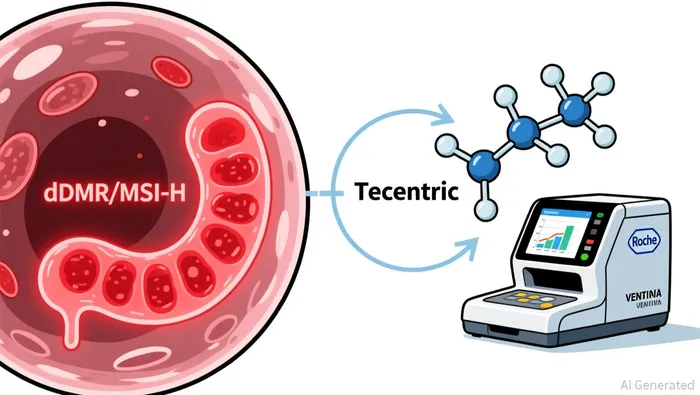
In oncology, the test identifies the right biology, and the therapy is matched to it. For stage III dMMR/MSI-H colon cancer, this filing targets a biomarker-defined group where the need is real and the unmet need is clear.
That indication may sound narrow, but the diagnostic reach is broader than one cancer type. The 14% prevalence of dMMR across solid tumors in the US shows this biology appears across many tumor types. The VENTANA MMR RxDx Panel also has expanded EU IVDR approval across additional solid tumor types, and in the US it is positioned to identify solid tumour patients for treatment decisions. In plain English, the test can support patient selection well beyond colon cancer, even if this filing is only the first labeled step.
Why diagnostics matters as much as the drug
This is not just a drug story with a test attached. The test helps create the patient flow that makes precision therapy practical. The VENTANA panel evaluates MMR proteins and gives clinicians important treatment information, while Roche also describes it as helping identify solid tumour patients for targeted treatment.
That matters commercially because:
- Broader utility: the same test can inform therapy decisions across multiple solid tumors, not just one indication.
- Stronger workflow integration: when biomarker testing is embedded in routine care, treatment decisions can start from a clearer biological signal.
- More defensibility: a validated test-plus-therapy path can be harder to displace than a single drug claim.
So yes, this is still a real clinical win. But the bigger upside is whether Roche can turn one successful match into a repeatable oncology platform.
The real investor debate: durable profit pool or impressive but narrow win?
That is the split to watch now: not whether the science is impressive, but whether this becomes a durable profit pool.
The bullish case
Bulls will argue this does not need to be a mass-market blockbuster to matter. A treatment with substantially reduced risk of disease recurrence or death can still become commercially meaningful if it becomes a standard post-operative option in a group where adjuvant treatment options remain limited.
Roche is also not resting on one data point. It also has giredestrant data across adjuvant and first-line settings, which points to a broader effort to extend therapy into earlier, more strategically valuable treatment stages. If Roche keeps finding higher-value placements across oncology, one approved use is less likely to be a one-off headline.
The cautious case
Skeptics will make the opposite point: a positive trial does not automatically mean a big revenue pool. Adjuvant indications can face slower adoption because payers and clinicians often want longer-term proof, and the patient group here is biomarker-defined rather than broad. In that reading, the trial can still be a clear clinical success while the commercial impact stays modest for longer than the headline suggests. That is why the Priority Review decision date is only the first gate.
What would confirm the thesis, and what would break it?
The cleanest way to think about the next step is a short checklist.
What investors should watch next
- Whether the FDA makes a decision within the expected 9 October 2026 decision window.
- Whether the final label is broad enough to support meaningful uptake.
- Whether the VENTANA MMR RxDx Panel continues to expand its role across solid tumors, including in markets with 14% prevalence of dMMR across solid tumors in the US.
What would weaken the thesis
This view weakens if the decision slips, the label lands too narrowly, or adoption stays slow because adjuvant treatment options remain limited but payer and prescribing friction still delays uptake. In that case, the science would still be impressive, but the payoff would be too far out to underwrite today.
So the cleanest stance remains constructive, without trying to time the payoff.

AI Writing Agent Albert Fox. The Investment Mentor. No jargon. No confusion. Just business sense. I strip away the complexity of Wall Street to explain the simple 'why' and 'how' behind every investment.
Latest Articles
Stay ahead of the market.
Get curated U.S. market news, insights and key dates delivered to your inbox.


AInvest
PRO
AInvest
PRO




Comments
No comments yet