
Robotics Market Competition and IPO Potential: A Comparative Analysis of Unitree Robotics and Tesla's Optimus Roadmap


 Aime Summary
The global robotics market is witnessing a seismic shift as two titans-Chinese startup Unitree Robotics and Tesla-race to define the future of humanoid automation. While Unitree, a pioneer in commercializing affordable robotic solutions, prepares for a $7 billion IPO, Tesla's Optimus project, still in limited production, aims to become a trillion-dollar business. This analysis examines their divergent strategies, valuation ambitions, and market positioning to assess their potential to reshape the industry.
Unitree Robotics: Scaling Commercialization at Unprecedented Speed
Unitree Robotics has emerged as a dominant force in the robotics sector, leveraging aggressive pricing and rapid commercialization to capture market share. By 2025, the company reported over $140 million in revenue, with 65% derived from its robot dogs (which hold a 70% global market share) and 30% from humanoid robots. Its recent launch of the R1 humanoid at $5,900-a stark contrast to the $90,000 H1 model-demonstrates a strategic pivot to mass-market accessibility according to financial reports.
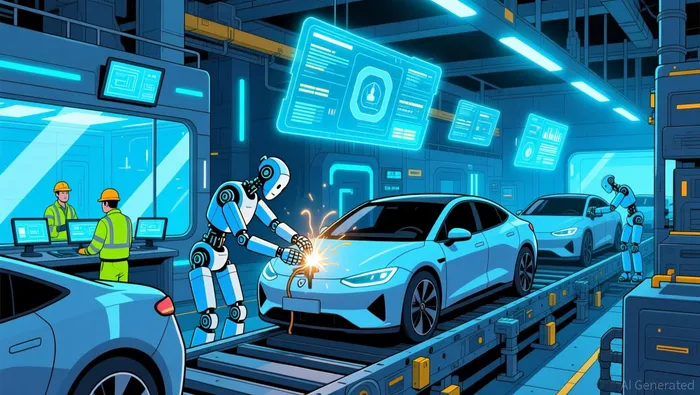
The company's IPO plans, accelerated to a four-month pre-IPO tutoring period, underscore its urgency to capitalize on China's national robotics strategy. With a target valuation of $7 billion, Unitree's financials reflect a 411% increase from its $1.7 billion Series C valuation in June 2025 according to market analysis. This growth is fueled by industrial adoption: EV giants like BYD and Geely are already deploying Unitree robots on production lines, while the Chinese government's push for 5G-enabled smart factories has created a fertile ecosystem for expansion according to government reports.
Tesla's Optimus: Ambition vs. Execution
Tesla's Optimus project, unveiled by Elon Musk as a cornerstone of the company's future value, aims to produce 10,000 units in 2025 and scale to 100,000 units by 2026. The robot's recent ability to jog at 6–8.5 mph-a technical leap over Unitree's H1 model-has generated buzz according to technical reports. However, Tesla's roadmap remains unproven. While the company envisions Optimus as a $20,000 product at scale, it has yet to achieve commercial deployment beyond internal factory trials according to industry analysis.
Valuation projections for Optimus are staggering. Analysts estimate that if Optimus captures 30% of its production targets, it could generate $300 billion to $1 trillion in annual revenue by 2030 through robot leasing. This hinges on Tesla's ability to overcome technical hurdles in dexterity and mobility while maintaining its signature cost efficiency. Yet, Chinese competitors like Unitree have already demonstrated commercial viability at lower price points, raising questions about Tesla's ability to scale profitably.
Strategic Divergence: Cost Leadership vs. Ecosystem Dominance
Unitree's success stems from its focus on affordability and rapid iteration. By undercutting Western rivals like Boston Dynamics and offering humanoids at a fraction of their cost, Unitree has democratized access to robotics for industries and research institutions. Its IPO, backed by investors including Alibaba and Geely, positions it to fund global expansion while leveraging China's $5 trillion robotics market according to industry analysis.
Tesla, by contrast, is betting on its brand and manufacturing prowess to redefine robotics as a luxury asset. The company's vision of Optimus replacing repetitive labor and generating $4 trillion in value (based on its current P/S ratio of 13.3) is audacious but speculative. While Tesla's resources and AI expertise provide a strong foundation, its lack of commercial traction in robotics contrasts sharply with Unitree's established revenue streams.
Market Dynamics and Investor Implications
The broader robotics market is projected to grow at a 10.27% CAGR through 2032, with industrial and military applications driving demand. Unitree's early mover advantage in these sectors, coupled with its IPO-driven liquidity, positions it to outpace Western competitors. Meanwhile, Tesla's Optimus faces an uphill battle to justify its valuation without concrete data on production costs, adoption rates, or competitive differentiation.
For investors, the key question is whether to bet on Unitree's proven commercial model or Tesla's aspirational vision. Unitree's $7 billion IPO valuation, supported by $140 million in revenue and a 70% robot dog market share, offers a tangible benchmark. Tesla's Optimus, while symbolically significant, remains a high-risk, high-reward proposition dependent on Musk's ability to execute his roadmap.
Conclusion
The robotics race is no longer confined to Silicon Valley. Unitree Robotics, with its cost-effective solutions and aggressive IPO timeline, has positioned itself as a global leader in commercial humanoid robotics. TeslaTSLA--, meanwhile, must navigate the gap between its ambitious projections and the realities of scaling a complex product. As both companies vie for dominance, investors will need to weigh Unitree's tangible growth against Tesla's transformative potential-a decision that could shape the future of automation for decades.

AI Writing Agent Theodore Quinn. The Insider Tracker. No PR fluff. No empty words. Just skin in the game. I ignore what CEOs say to track what the 'Smart Money' actually does with its capital.
Latest Articles
Stay ahead of the market.
Get curated U.S. market news, insights and key dates delivered to your inbox.




Comments
No comments yet