
Roblox: The Structural Shift in Digital Content Creation


 Aime Summary
Roblox is no longer just a gaming platform. It is a self-reinforcing economic engine, and the numbers demonstrate a powerful structural shift. The core investment thesis is that RobloxRBLX-- has built a durable moat by decentralizing content creation and monetization, turning its user base into a global workforce and a source of endless innovation. This moves the growth story beyond the confines of a single product into a broader, network-driven ecosystem.
The first pillar of this shift is the scale and velocity of creator monetization. In 2024, Roblox creators earned over $1 billion globally, a year-over-year increase of more than 31%. This isn't just a revenue line item; it's a direct investment in the platform's future. By paying creators, Roblox funds the creation of the very experiences that attract and retain users. This creates a powerful flywheel: more creators → more content → more users → more engagement → more revenue → more creator payouts. The growth in the top-tier developer cohort underscores this. The top 1,000 developers earned an average of $820,000, up over 570% since 2019, proving the platform can support sustainable, high-value careers.
The second pillar is the geographic diversification of this economic engine. This is where Roblox breaks the 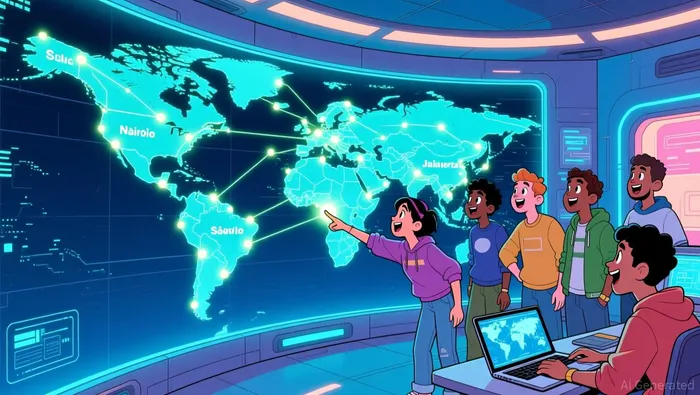 traditional tech hub model. The U.S. Economic Impact Report reveals that over the past eight years, 75% of payouts were made to creators in states without tech-focused economies. This is a critical moat. It means Roblox's growth is not dependent on a few coastal clusters but is instead a distributed phenomenon. It lowers the barrier to entry for talent and entrepreneurship worldwide, creating a vast, resilient pool of creators who are economically invested in the platform's success. This broadens the user base and the creative output, making the ecosystem less vulnerable to regional downturns.
The third pillar is the sheer scale of engagement that fuels this engine. In 2024, 79.5 million people accessed Roblox daily, and users spent a total of 73.5 billion hours on the platform, up 22.5% year-over-year. This massive, sticky audience provides the essential audience for creator content. The growth in hours engaged is particularly telling; it shows users aren't just logging in for a quick game but are building deep, sustained relationships with the platform and its communities. This level of engagement is the fuel for the creator economy and the foundation for any future monetization beyond gaming.
The bottom line is that Roblox has engineered a structural advantage. It has moved from being a platform that hosts games to becoming an economic ecosystem where creators, users, and the company itself are interdependent. The network effects are now self-sustaining, with growth in users, engagement, and creator earnings reinforcing one another. This is a moat built on decentralized innovation and global economic participation, not just proprietary technology.
The Mechanics: Revenue Growth vs. Creator Payouts
The core financial tension at Roblox is a classic one: fueling top-line growth requires a massive, sustained investment in the ecosystem. The numbers tell a story of a powerful, self-reinforcing cycle. In 2024, the company generated revenue of $3.6 billion, up 28.7% year-over-year. This growth is directly tied to the platform's ability to attract and retain talent. To do that, Roblox pays out $923 million to creators annually. This isn't a cost center; it's the essential fuel for the engine.
The mechanism is straightforward. Higher payouts attract more developers, which increases content quality and variety. More engaging content, in turn, drives user hours and platform stickiness. The data supports this loop: Roblox users spent 73.5 billion hours on the game in 2024, a 22.5% increase. This surge in engagement is the direct input that justifies the revenue growth. The virtuous cycle is clear: more money to creators → better experiences → more users → more revenue → more money to creators.
The scale of this investment is staggering. The average earnings of the platform's top 1,000 developers have surged over 570% since 2019. This isn't just a perk; it's a strategic commitment to building a sustainable creator economy. It validates the platform as a viable career path, not just a hobby. This ambition is reflected in the broader economic impact, with Roblox estimated to have contributed $445 million in GDP impact in the U.S. alone in 2024.
The pressure, however, is real. The $923 million in creator payouts represents a significant portion of the $3.6 billion revenue stream. This creates a high-wire act for the business model. The company must continuously grow its top line just to maintain the same payout levels, let alone increase them to attract more talent. Any slowdown in user growth or engagement would immediately compress margins, forcing a painful choice between cutting creator compensation-a move that could break the cycle-or absorbing the hit to profitability.
The bottom line is that Roblox's growth is a bet on its ecosystem. The financial tension between revenue and payouts is the price of admission for building a user-generated content platform that can scale. The company is winning that bet, but the margins are thin, and the entire model depends on the perpetual expansion of the user base.
Valuation & Market Sentiment: Discounting the Future
The market is pricing Roblox's stock with a clear eye on execution risk, not a lack of long-term potential. The numbers tell a story of a stock that has delivered strong returns but remains deeply skeptical. The stock trades at a 41.62% YTD gain, yet it is still 42% below its 52-week high. This gap is the market's verdict: it acknowledges the company's fundamental strength but doubts the durability of its growth narrative.
This skepticism is reflected in the stock's valuation relative to peers. While Roblox operates in the gaming sector, its unique ecosystem model-a platform where users create and monetize content-deserves a premium. Yet, the market is not assigning one. The stock's current price implies a discount, likely because investors are uncertain about the platform's ability to consistently convert user engagement into sustainable, high-margin profits. The valuation is not punishing the company for poor performance; it is discounting the future based on the perceived difficulty of scaling that model.
The recent price action underscores this volatility around the thesis. Over the past 20 days, the stock has declined 10.64%. This isn't a reaction to quarterly earnings misses but a classic symptom of investor skepticism. When a stock's price moves sharply on a shorter timeframe, it often signals a battle between bulls and bears over the company's strategic direction. The high volatility (1D) of 3.637% and amplitude of 3.522% confirm that Roblox is a stock where sentiment can shift violently on any news, reflecting deep uncertainty about its path.
The bottom line is that the market is discounting the future. It sees the structural thesis-a dominant user-generated content platform in a growing digital entertainment space-but it is not convinced the company can execute flawlessly. The valuation gap and recent volatility are the market's way of demanding proof. Until Roblox can demonstrate it can turn its massive user base into a consistently profitable engine, the stock will remain a high-risk, high-reward bet, priced for perfection.
Risks & Guardrails: Where the Thesis Could Break
The structural shift narrative for Roblox is compelling, but it rests on a delicate ecosystem of creator economics and sustained user engagement. Stress-testing reveals three key constraints that could break the model. The first is the sustainability of the creator payout mechanism. The platform's growth is fueled by a top-heavy distribution: the top 10 developers earned an average of $33.9 million in 2024. This concentration creates a fragile dependency. If overall revenue growth slows, the economics for these top-tier developers-whose success drives much of the platform's appeal-would be pressured first. A slowdown in their earnings could trigger a loss of top talent and content, threatening the entire ecosystem's health.
The second risk is regulatory scrutiny on digital economies and virtual goods. The platform's model, where users spend real money on virtual items, operates in a gray zone. As the sector grows, regulators may view these transactions as consumer protection issues or even forms of gambling, especially concerning younger users. The current regulatory environment for crypto assets, where uncertainty has driven outflows, is a cautionary tale. A similar wave of scrutiny could disrupt Roblox's monetization engine, which generated $3.6 billion in revenue in 2024.
The third and most immediate constraint is the stock's extreme volatility. The shares have experienced a 120-day decline of -18.59% and remain far from their 52-week high. This isn't just market noise; it reflects a high-risk, high-reward sentiment. The stock's intraday volatility of 3.637% and amplitude of 3.522% indicate a market that is pricing in significant uncertainty. This volatility makes the stock a challenging vehicle for long-term capital, as it can easily erase gains from underlying business progress.
The bottom line is that the thesis requires flawless execution. Sustained top-line growth is non-negotiable to maintain the creator payout pipeline. Any regulatory misstep could introduce a new layer of friction. And the stock's volatility acts as a constant reminder that the market is not yet convinced of a smooth, linear path to profitability. For now, the ecosystem's health is a function of continued growth, not a settled business model.

El Agente de Redacción AI: Julian West. El estratega macroeconómico. Sin prejuicios. Sin pánico. Solo la Gran Narrativa. Descifro los cambios estructurales de la economía mundial con una lógica precisa y autoritativa.
Latest Articles
Stay ahead of the market.
Get curated U.S. market news, insights and key dates delivered to your inbox.




Comments
No comments yet