
Robinhood Markets Inc.: A Tailwind in the Crosswinds of U.S.-China Trade Tensions
The escalating U.S.-China trade conflict, marked by tit-for-tat tariffs and technological decoupling, has injected unprecedented volatility into global markets. For retail trading platforms like Robinhood Markets Inc. (HOOD), this turbulence is not merely a risk—it is an opportunity. As geopolitical tensions reshape supply chains, consumer behavior, and investment patterns, RobinhoodHOOD-- stands at the intersection of a structural shift toward retail-driven markets. Let's dissect how this dynamic could position the company as a beneficiary of one of the defining economic stories of the decade.
The Crosscurrents of Trade Tensions and Market Volatility
The U.S.-China trade dispute has evolved from tariffs on goods to a broader battle over technological dominance. By June 2025, effective tariffs on Chinese imports averaged over 30%, with non-tariff barriers—such as export controls on semiconductors and critical minerals—further complicating global supply chains. This has created a “decoupling dividend” for platforms like Robinhood:
- Sector-Specific Volatility: Tariffs on sectors like automotive, consumer electronics, and semiconductors have led to wild swings in stock prices. For instance, companies such as Tesla (TSLA) and NVIDIA (NVDA) face dual pressures of rising input costs and supply chain disruptions, making their equities prime targets for short-term trading.
- Currency Fluctuations: The U.S. dollar's decline to a three-year low in mid-2025 (amid fears of a full-blown trade embargo) has spurred retail investors to speculate on forex and commodities.
- Geopolitical Anxiety: A slowdown in global growth (World Bank projects 2.3% in 2025, the lowest since 2008) has pushed investors toward riskier assets, driving trading volumes higher.
Robinhood's Strategic Exposure
Robinhood's business model—built on zero-commission trading and user-friendly platforms—aligns perfectly with the “trade volatility = retail participation” equation. Key tailwinds include:
- Democratized Access to Volatile Markets:
- As tariffs disrupt supply chains and corporate earnings, retail investors are increasingly turning to equities and ETFs (e.g., iShares China Large-Cap ETF (FXI)) to hedge against uncertainty. Robinhood's dominance in millennial and Gen Z demographics positions it to capture this demand.
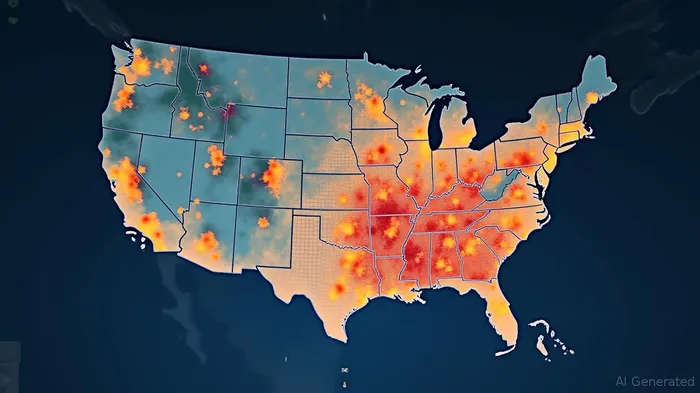
- Example: The 28.5% year-over-year drop in U.S. imports from China (May 2025) correlated with a surge in short-selling of firms reliant on Chinese suppliers, such as Apple (AAPL) and Ford (F).
- Tech Decoupling and the “New Normal” of Trading:
- The shift to decentralized supply chains has created opportunities for speculative plays on companies pivoting to reshoring (e.g., Flex Ltd. (FLEX)) or diversifying to ASEAN (e.g., BYD (002594.SZ)). Robinhood's app simplifies access to these geographically dispersed opportunities.
Meanwhile, blockchain and crypto—alternative assets gaining traction as trust in traditional markets wanes—complement Robinhood's expansion into digital currencies.
Structural Shifts in Financial Behavior:
- The $2.58 trillion rise in U.S. logistics costs (2025) reflects a broader theme of economic uncertainty, pushing individuals to take control of their finances. Robinhood's gamified interface and fractional shares offerings make it a gateway for first-time investors.
Risks and Considerations
While the tailwinds are compelling, investors must weigh Robinhood's risks:
- Regulatory Overhang: U.S. regulators are scrutinizing Robinhood's “gamification” of trading, which could lead to restrictions on features like stock-based memes.
- Market Saturation: Competitors like Webull and E*TRADE are gaining traction, and sustained volatility could drive price wars.
- Geopolitical Uncertainty: A sudden truce between the U.S. and China could temporarily reduce trading volumes, though the long-term decoupling trend remains intact.
Investment Thesis: Positioning for the Decoupling Era
For long-term investors, Robinhood represents a leveraged play on two secular trends:
1. The Rise of Retail Trading: A generational shift toward self-directed investing is irreversible, driven by technology and distrust in traditional institutions.
2. Geopolitical Fragmentation: As global trade frays, the demand for platforms that simplify access to volatile markets will grow.
Recommendation:
- Buy: For investors with a 3–5 year horizon, HOOD's valuation (currently at ~20x trailing revenue) offers asymmetric upside if trade tensions persist.
- Wait: Short-term traders should monitor the June 2025 tariff truce in London; a breakdown could trigger another volatility spike.
Conclusion
In the crosswinds of U.S.-China trade dynamics, Robinhood MarketsHOOD-- Inc. is a barometer of market fragility—and a beneficiary of it. While risks exist, the structural tailwind of democratized trading and geopolitical fragmentation makes HOODHOOD-- a compelling pick for investors betting on a world where volatility is the new normal.
Stay vigilant, and position accordingly.
Data as of June 19, 2025. Past performance does not guarantee future results.

Stay ahead of the market.
Get curated U.S. market news, insights and key dates delivered to your inbox.
AInvest
PRO
AInvest
PRO



Comments
No comments yet