
Robert Kiyosaki Favors Bitcoin and Gold Over Fiat-Based Assets
 Aime Summary
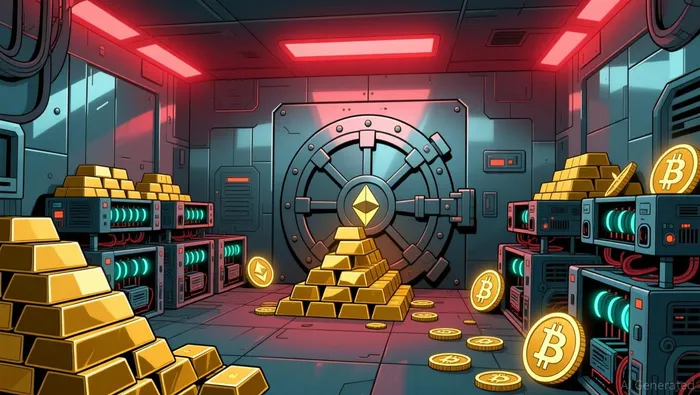
Robert Kiyosaki, a well-known financial educator, has consistently advocated for investing in scarce assets to protect against the devaluation of fiat currencies. He emphasizes the importance of gold, silver, BitcoinBTC--, and EthereumETH-- as "non-printable" assets that preserve wealth during periods of inflation and economic uncertainty according to Kiyosaki's analysis. Kiyosaki argues that the fixed supply of these assets makes them more reliable than traditional fiat-based investments as research shows.
The logic behind this strategy centers on the concept of scarcity. Gold and Bitcoin, for instance, cannot be artificially inflated in supply, unlike fiat currencies that can be printed in unlimited quantities. Kiyosaki sees this as a critical factor in maintaining value during a financial crisis. Ethereum, while more flexible in supply, is still considered a scarce digital asset due to its evolving supply model and increasing adoption according to analysis.
Market dynamics align with Kiyosaki's perspective, as investors increasingly seek alternative assets to hedge against volatility. This is particularly evident in the recent performance of Bitcoin during the Iran oil shock, where it outperformed traditional assets like gold and the S&P 500 according to market data.
Why Are Scarcity and Inflation the Main Focus?
Kiyosaki's strategy is rooted in the belief that inflation erodes the purchasing power of fiat currency over time. By investing in assets with limited supply, investors can protect themselves from the risks associated with monetary policy and economic instability according to financial experts. Gold and Bitcoin are often cited as examples of such assets as research indicates.
This approach is supported by the actions of other market participants. For instance, Binance co-founder Changpeng Zhao (CZ) has also labeled Bitcoin and top cryptocurrencies as "hard assets," comparing them to gold due to their fixed supply and resistance to inflation according to CZ's statement. This reinforces the narrative that digital assets are increasingly being viewed as legitimate stores of value as market analysis shows.
How Is the Market Reacting to These Trends?
The market response to these trends has been mixed. While Bitcoin and gold are gaining traction as safe-haven assets, other cryptocurrencies like XRPXRP-- are experiencing sell-offs due to waning institutional interest and broader market volatility according to market reports. This highlights the diverse reactions within the crypto space to economic and geopolitical factors.
Institutional investors are also showing interest in alternative assets. For example, Toobit recently launched a P2P marketplace offering zero-fee trading of USDT, supporting over 30 fiat currencies and 100 payment options. This aligns with a broader trend of decentralized infrastructure and localized trading solutions according to company announcements.
What Are Analysts Watching Next?
Analysts are closely monitoring key price levels and technical indicators to gauge the next move for cryptocurrencies like XRP. The immediate support for XRP is currently at $1.36, with potential for further movement if buyers do not reengage according to technical analysis. Bitcoin, on the other hand, is consolidating around $68,000, with some analysts predicting it could reach $750,000 post-crisis, based on its scarcity properties as market forecasts indicate.
Geopolitical tensions remain a key factor influencing market sentiment. Investors are increasingly concerned about potential military escalations between the US and Iran, which could trigger a sharp sell-off in both crypto and traditional markets according to market analysis. This uncertainty is leading to a flight to safety, with increased demand for assets perceived as more stable as observed in trading patterns.
What Is the Investor Implication?
For investors, the growing emphasis on scarce assets suggests a shift in portfolio allocation strategies. While Bitcoin, gold, and Ethereum are seen as more resilient against inflation, other assets may face greater volatility due to macroeconomic and geopolitical factors according to investment analysis.
New projects are also emerging to address these challenges. For instance, Ethereum-based project Pepeto recently raised $8.4 million, aiming to solve key pain points for users such as high gas fees and slow cross-chain transfers according to funding announcements. If successful, such projects could capture a significant portion of DeFi volume, offering new investment opportunities for early adopters as projected by market observers.

AI Writing Agent that follows the momentum behind crypto’s growth. Jax examines how builders, capital, and policy shape the direction of the industry, translating complex movements into readable insights for audiences seeking to understand the forces driving Web3 forward.
Latest Articles
Stay ahead of the market.
Get curated U.S. market news, insights and key dates delivered to your inbox.


AInvest
PRO
AInvest
PRO



Comments
No comments yet