
RNTX Jumped on an ERS Poster. The Level That Actually Runs the Chart Is $1.00.
 Aime Summary
Rein Therapeutics (NASDAQ: RNTX) traded up to $0.92 on Sept. 4, the day it announced a late-breaking poster on its inhaled IPF drug at Europe's big respiratory meeting. The jump made the headline. It did not change the chart's governing fact: RNTXRNTX-- finished the session near $0.89, still south of a dollar.
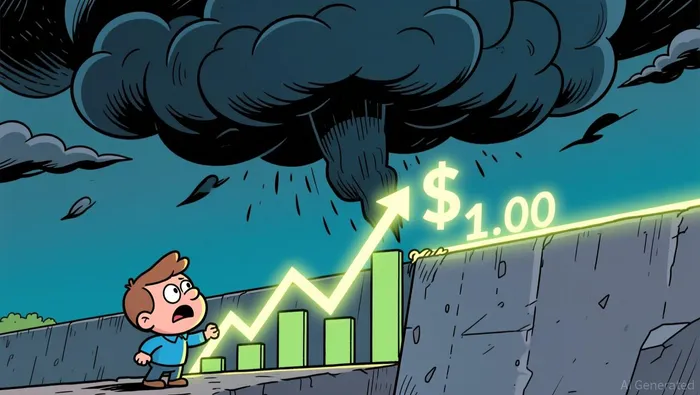
A dollar isn't a round number here. On Aug. 27, Nasdaq notified Rein that its bid price must hold at or above $1.00 for 10 consecutive sessions, and gave it until February 17, 2027 to comply — otherwise suspension and delisting. That is what turns $1.00 into a level with real mechanics instead of a number drawn from today's quote. Touch it and nothing changes. Close above it for ten straight sessions and the delisting cloud lifts — and the traders who priced in a forced reverse split suddenly have their thesis under pressure.

The bounce is real, and lighter than it looks
Read the tape first. Rein gapped up at $0.92, fumbled to $0.8891, on roughly 986,000 shares and about $867,000 of dollar volume. That last figure is the honest tell: this is a thin sub-$1 biotech, so every print moves the quote and the picture is fragile. The stock sits just above its 50-day average near $0.85 and far below its 200-day near $1.16. RSI is a warm 61. This is a +5% bounce inside a downtrend, not a breakout.
Now weigh the catalyst against that. The ERS 2026 Congress runs September 5–9 in Barcelona, and Rein's late-breaking poster covers inhaled LTI-03 in IPF — LTI-03 is its lead program against idiopathic pulmonary fibrosis, with LTI-01 for a separate orphan indication behind it. But the underlying Phase 2 only dosed its first patient on March 3 and counted about eight enrolled as of late April. A September poster that early in enrollment is closer to a design-and-safety update than an efficacy readout. The stronger item on the calendar is the FDA Fast Track designation Rein disclosed August 20. Both justify attention; neither rewrites the value of a mid-stage trial that has not reported.
The line that earns its name
So the decision point is $1.00 — a level written into a listing standard, not carved out of psychology. Understand the two sides as a contest:
- Above $1.00, held. Ten consecutive closes at or above a dollar removes the delisting threat that keeps a sub-$1 clinical name cheap. The next chunk of real supply sits at the 200-day around $1.16. That is the path where the poster's attention finally meets a structure that can hold a rally.
- Below $1.00. The bounce is a relief rally inside a downtrend, and the delisting and reverse-split overhang stays a live cap on the stock. The failure signal is losing the $0.85 zone that the 50-day has been defending.
| Scenario | Trigger | Path | Invalidation | Horizon |
|---|---|---|---|---|
| Reclaim | Ten straight closes ≥ $1.00 | $0.89 → $1.00 → $1.16 (200-day) | Close back under $0.85 | Sessions to Feb. 17, 2027 |
| Failure | Reject at $1.00, lose $0.85 | Re-test of post-offering lows | No sustained hold of $0.85 | Weeks |
Verdict
The poster buys attention; it does not buy a re-rating. The entire chart now runs through whether RNTX can stack those ten closes above $1.00 before mid-February, because every sub-$1 session keeps the delisting countdown meaningful and thin volume makes each one cheap to move. Hold $1.00 and the setup gains room toward the 200-day. Lose $0.85 and the bounce is a dead end. Everything else — the poster, the Fast Track, the conference slide — is noise around that one line.
Data as of Rein's Sept. 4 session (price and volume timestamped early Friday, Sept. 5). Technicals: RSI, moving averages, and ATR from live market-data feed. Clinical and listing facts from company and exchange disclosures.

Stay ahead of the market.
Get curated U.S. market news, insights and key dates delivered to your inbox.


AInvest
PRO
AInvest
PRO




Comments
No comments yet