
RLUSD-XRP AMM Pools as a Strategic On-Ramp for Institutional DeFi Exposure


 Aime Summary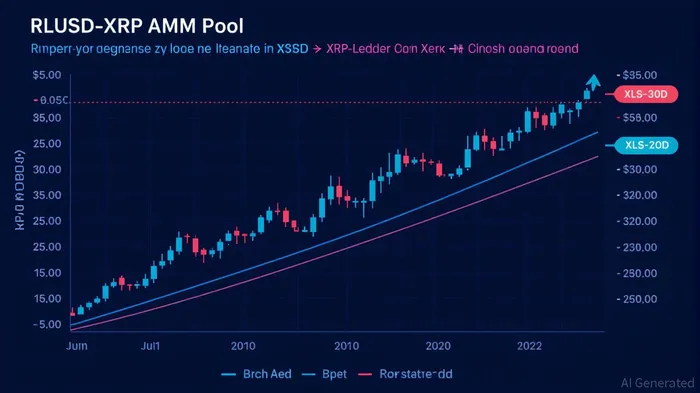
Institutional investors seeking exposure to decentralized finance (DeFi) face a critical challenge: balancing innovation with risk. The RLUSD-XRP Automated Market Maker (AMM) pools on the XRPXRP-- Ledger (XRPL) offer a compelling solution. By combining XRP’s speculative potential with RLUSD’s stability, these pools automate rebalancing, stabilize value, and generate fees—all while aligning with institutional-grade risk frameworks. This innovation, supported by protocol upgrades and strategic design, positions RLUSD-XRP AMM pools as a bridge between traditional finance and DeFi.
Liquidity Innovation: Automated Rebalancing and Protocol Upgrades
The RLUSD-XRP AMM pools operate on a constant product model, maintaining equilibrium by algorithmically converting RLUSD to XRP when prices fall and XRP to RLUSD when prices rise [1]. This dynamic rebalancing reduces effective volatility for liquidity providers (LPs) compared to holding XRP outright [2]. For example, if XRP’s price drops, the pool automatically converts RLUSD into XRP, preserving the pool’s value and mitigating downside risk.
This mechanism is enabled by protocol upgrades such as the XLS-30D amendment (March 2024) and the RLUSD clawback amendment (January 2025). These updates allow direct on-chain trading of RLUSD and enhance AMM functionality, fostering liquidity and DeFi activity [3]. Ripple CTO David Schwartz emphasizes that the pools maintain equal value holdings of RLUSD and XRP, ensuring that LPs retain proportional exposure to both assets while benefiting from automated adjustments [4].
Risk-Adjusted Returns: Dynamic Fees and Fee Generation
A key differentiator of RLUSD-XRP AMM pools is their dynamic fee structure. Standard pools cap fees at 2.5%, while bootstrapping pools—designed to incentivize early liquidity—can charge up to 20% [1]. This tiered model aligns LP rewards with market conditions, ensuring profitability during high-volatility periods. For instance, during a sharp XRP price swing, higher fees compensate LPs for increased risk, while lower fees during stable periods preserve capital efficiency.
Fee generation is further amplified by the pools’ design. As traders swap XRP for RLUSD, liquidity tokens issued to LPs appreciate in value, reflecting the growing pool constant (the product of RLUSD and XRP values divided by liquidity tokens) [5]. This creates a compounding effect, where LPs earn both trading spreads and value appreciation from the pool’s operational efficiency.
Institutional Adoption: Stability, Scarcity, and Infrastructure
Institutional investors demand robust risk management frameworks, and RLUSD-XRP AMM pools deliver on this front. RLUSD, a USD-pegged stablecoin fully backed by U.S. dollars, provides institutional-grade collateralization, enhancing trust in the pools [1]. Meanwhile, XRP’s deflationary burn mechanism—where 2 XRP is burned for each liquidity pool created—accelerates supply reduction, reinforcing scarcity and long-term value [6].
The XRP Ledger’s 2025 roadmap further strengthens institutional appeal. Upgrades like permissioned DEX and credit-based lending aim to improve transparency and compliance, addressing regulatory concerns [4]. Additionally, the integration of RLUSD into Aave’s Horizon RWA market has already generated $408 million in DeFi volume, demonstrating XRP’s utility in real-world asset tokenization [2].
Conclusion: A Strategic On-Ramp for DeFi
RLUSD-XRP AMM pools exemplify how DeFi can evolve to meet institutional demands. By automating rebalancing, stabilizing value, and generating fees, these pools offer risk-adjusted returns that align with traditional finance principles. Protocol upgrades and institutional-grade infrastructure further solidify their role as a strategic on-ramp. For investors seeking to hedge volatility while capturing XRP’s long-term potential, the RLUSD-XRP AMM ecosystem represents a compelling opportunity in 2025.
Source:
[1] Ripple CTO on How XRP, RLUSD Drive Liquidity on AMM [https://u.today/ripple-cto-on-how-xrp-rlusd-drive-liquidity-on-amm-details]
[2] XRP and the Future of Decentralized Governance in Global Finance [https://www.bitget.com/news/detail/12560604934037]
[3] How RLUSD-XRP AMM Pools Work on the XRPL [https://www.fomoed.io/news/ripple-cto-explains-rlusd-xrp-amm-pools-may-enhance-xrpl-defi-liquidity-and-stability]
[4] Understanding Ripple CTO's Explanation of XRP, RLUSD [https://www.ainvest.com/news/understanding-ripple-cto-explanation-xrp-rlusd-amm-liquidity-pools-2508/]
[5] Ripple's RLUSD Liquidity Pools and XRP Holder Protection [https://intellectia.ai/news/crypto/ripple-cto-reveals-how-rlusd-liquidity-pools-protect-xrp-holders]
[6] XRP's Technical Breakout and Strategic Position in the [https://www.ainvest.com/news/xrp-technical-breakout-strategic-position-rwa-ecosystem-2508/]

Decoding blockchain innovations and market trends with clarity and precision.
Latest Articles
Stay ahead of the market.
Get curated U.S. market news, insights and key dates delivered to your inbox.


AInvest
PRO
AInvest
PRO



Comments
No comments yet