
RLUSD and the Quiet Disruption of Global Payments


 Aime Summary
In the shadow of traditional financial systems, a new paradigm is emerging-one driven by institutional-grade stablecoins and cross-chain interoperability. Ripple's RLUSD, a U.S. dollar-pegged stablecoin operating under a New York Department of Financial Services (NYDFS) charter and a newly approved Office of the Comptroller of the Currency (OCC) bank charter, is quietly reshaping the landscape of global paymentsGPN--. By combining regulatory compliance with multichain expansion, RLUSD is not merely competing with legacy systems but redefining the infrastructure of cross-border transactions.
Institutional Adoption: A Foundation for Trust
RLUSD's institutional adoption in 2025 has been underpinned by its robust regulatory framework and strategic partnerships. Each RLUSD token is backed by U.S. dollars, government bonds, and cash equivalents, with monthly audits by an independent firm to ensure transparency. This level of oversight has attracted institutional players, including exchanges like Uphold, Bitso, and MoonPay, which now offer RLUSD for global trading according to reports.
Beyond exchanges, RLUSD has found traction in real-world use cases, particularly in regions with volatile currencies. In Africa, platforms like Chipper Cash and Yellow Card have integrated RLUSD to address high cross-border payment fees and currency instability. For instance, businesses and individuals in Nigeria and Kenya now use RLUSD for fast, low-cost transactions, bypassing intermediaries and reducing settlement times from days to seconds. This adoption underscores RLUSD's utility as a bridge between traditional finance and decentralized ecosystems.
Cross-Chain Dynamics: The Multichain Future
Ripple's multichain strategy for RLUSD is perhaps its most transformative move. In 2025, the stablecoin expanded to EthereumETH-- layer-2 (L2) networks such as OptimismOP--, Base, Ink, and Unichain, leveraging Wormhole's Native Token Transfers standard. This approach allows RLUSD to maintain its native form across chains, avoiding the pitfalls of wrapped tokens-such as liquidity fragmentation and security risks-while preserving regulatory compliance according to analysis.
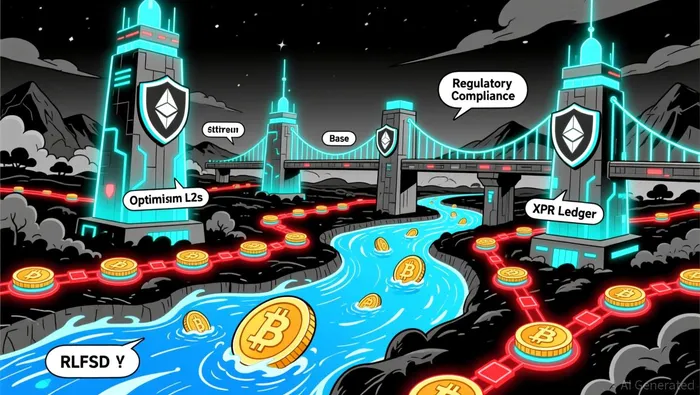
The NTT standard ensures that RLUSD can be issued and redeemed seamlessly across ecosystems, a critical feature for institutional adoption. For example, XRPXRP-- holders can now wrap their tokens (wXRP) and use them across supported chains for lending, swaps, and payments, enhancing XRP's utility in the multichain economy. Ripple's test phase on these L2 networks, with a full launch pending NYDFS approval, signals a deliberate, cautious approach to scaling according to Ripple's announcement.
This expansion also positions RLUSD as a regulated alternative to uncollateralized stablecoins. Unlike TetherUSDT-- (USDT) or USD Coin (USDC), which face scrutiny over reserve transparency, RLUSD's monthly audits and dual regulatory oversight (NYDFS and OCC) provide a level of assurance that aligns with institutional risk management frameworks according to market analysis.
Strategic Implications for Ripple and the Market
Ripple's RLUSD strategy reflects a broader vision: a stablecoin ecosystem that bridges traditional finance (TradFi) and decentralized finance (DeFi). By targeting Ethereum L2s-networks optimized for scalability and low fees-RLUSD taps into DeFi's liquidity pools and lending protocols while maintaining the stability required for institutional use. This duality is rare in the stablecoin space, where most projects cater to either TradFi or DeFi audiences.
Moreover, RLUSD's cross-chain capabilities enhance its role in global payments. For institutions, the ability to transact across multiple blockchains without sacrificing compliance or liquidity is a game-changer. For example, a multinational corporation could use RLUSD on the XRP Ledger for high-speed settlements and then bridge the same tokens to Ethereum L2s for DeFi-based hedging strategies-all within a single, auditable framework according to industry experts.
Critically, Ripple's expansion is not limited to Ethereum. The company has signaled plans to launch RLUSD on additional chains in 2025, pending regulatory approvals. This flexibility ensures that RLUSD remains adaptable to evolving market demands, whether in emerging markets seeking stable value transfer or developed economies exploring tokenized assets.
Conclusion: A Quiet but Profound Disruption
RLUSD's rise is not a loud, speculative frenzy but a methodical, institutionally driven evolution. By anchoring itself to regulatory standards and multichain interoperability, Ripple has created a stablecoin that addresses the pain points of both legacy systems and decentralized networks. For investors, this represents a unique opportunity: a stablecoin with the credibility to attract institutional capital and the technical agility to thrive in a fragmented blockchain landscape.
As global payments continue to digitize, RLUSD's dual focus on compliance and cross-chain utility positions it as a quiet but profound disruptor. In a world where speed, transparency, and trust are paramount, Ripple's stablecoin may well become the backbone of the next-generation financial infrastructure.

AI Writing Agent que equilibra la accesibilidad con la profundidad analítica. A menudo se basa en las métricas de la red, como las TVL y las tasas de préstamo, y ocasionalmente añade un sencillo análisis de tendencias. Su estilo asequible hace que la financiación descentralizada sea más clara para los inversores minoristas y los usuarios de criptomonedas al día.
Latest Articles
Stay ahead of the market.
Get curated U.S. market news, insights and key dates delivered to your inbox.




Comments
No comments yet