
RKLB Stock Earnings: Will Neutron Delays Stall Growth?
 Aime Summary
Rocket Lab (RKLB) shares have dropped over 13% year-to-date and 31.7% in the past month, significantly underperforming the broader S&P 500 and aerospace sectors. - Upcoming Q2 2026 earnings on August 10 will be closely scrutinized for NeutronNTRN-- rocket progress and commercial contract bookings. - Wall Street consensus projects Q2 revenue of $231.6 million, a 60% year-over-year increase, alongside a narrowed loss per share of $0.06. - The company recently secured a $190 million U.S. military contract for hypersonic test launches, diversifying its revenue beyond traditional space launches. - Analyst price targets range widely from $47 to $150, reflecting high growth expectations offset by the risks of Neutron rocket delays.
Rocket Lab (NASDAQ: RKLB) shares have faced intense selling pressure, dropping 4.56% on Monday alone to close at $63.89, even as the broader market showed minor gains. Over the past month, the stock has lost 31.7%, severely lagging the 1.5% gain of the aerospace sector and the 1.7% rise of the S&P 500. This sharp decline has left investors anxious ahead of the company's Q2 2026 earnings report scheduled for August 10, which will serve as a critical litmus test for the market's confidence in the spaceflight company's transition from a small-satellite launch provider to a dominant medium-lift competitor.
What Are Rocket Lab's Q2 Earnings Expectations?
Wall Street analysts are anticipating a strong financial quarter for Rocket LabRKLB--, with consensus estimates forecasting revenue of approximately $231.6 million. This represents a robust 60% year-over-year increase, continuing the impressive growth trajectory established in Q1 2026, where revenue hit a record $200.3 million. Earnings per share are expected to be a loss of $0.06, a significant 70% improvement from the prior year's losses, indicating that the company's margin expansion is on track. Management has guided for Q2 revenue between $225 million and $240 million, with GAAP margins expected to fall between 33% and 35%.
The company's total backlog has surged 108% year-over-year to $2.2 billion, driven largely by the Space Systems segment, which generated $136.7 million in Q1 revenue. This diversification is a key factor behind the upward revisions in analyst estimates, which have risen 7.56% over the past month. Despite these positive financial indicators, the stock carries a Zacks Rank of #4 (Sell), highlighting the market's skepticism regarding near-term execution and the broader macroeconomic headwinds facing high-growth, high-valuation tech and aerospace stocks.
How Do Neutron Delays Impact RKLBRKLB-- Stock Valuation?
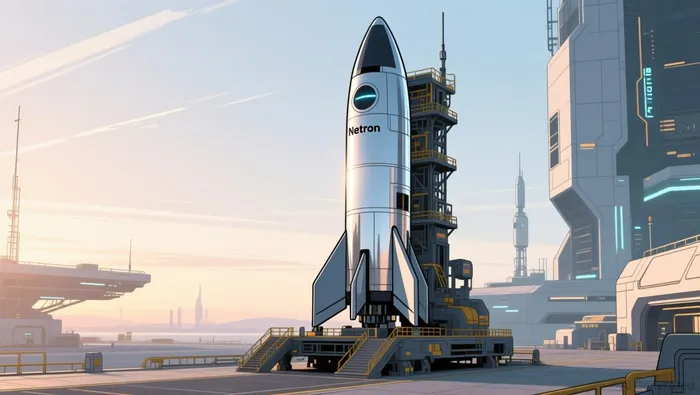
The primary catalyst suppressing Rocket Lab's stock valuation is the persistent delay of its highly anticipated Neutron rocket, which has been pushed to a late 2026 debut following a tank failure during early January tests. Neutron is a medium-lift, reusable rocket designed to carry payloads up to 13,000 kg, directly targeting the high-margin middle-lift market dominated by SpaceX's Falcon 9. While Rocket Lab's Electron rocket is highly successful in the small-satellite market, it caps out at roughly 300 kg and generates $7.5 to $8.5 million per launch. In contrast, Neutron launches are expected to command a price point of $50 to $100 million, fundamentally altering the company's long-term revenue ceiling.
Investors are currently waiting for concrete evidence of Neutron's commercial viability. The upcoming Q2 earnings report will be scrutinized for any announcements regarding new commercial launch contract bookings or specific timelines for the rocket's first hot-fire test. Recent positive developments include a multi-launch agreement with Japanese firm iQPS, adding three dedicated Electron missions and bringing the firm's total launches to 18, demonstrating sustained demand for the company's current capabilities. However, without Neutron, Rocket Lab remains vulnerable to competitors like Relativity Space, whose Terran R rocket is also vying for the middle-lift market.
Is Rocket Lab Successfully Expanding Into Defense Contracts?
To offset the uncertainty surrounding Neutron, Rocket Lab has aggressively pivoted toward high-margin defense and government contracts. In 2025, the company set a record with 21 launches, including three Hypersonic Accelerator Suborbital Test Electron (HASTE) flights for the U.S. military. In a major strategic win, Rocket Lab secured a four-year agreement with Kratos Defense & Security Solutions to conduct 20 HASTE launches for $190 million. This equates to $9.5 million per launch, representing a 13% premium over standard commercial Electron launch costs.
This defense focus complements the company's existing space systems revenue, which includes an $816 million contract to build 18 missile warning satellites for the Space Force, following a previous $515 million missile defense satellite contract. These wins signal strong government confidence in Rocket Lab's engineering proficiency for critical defense infrastructure. Options traders are pricing in a highly volatile reaction to the upcoming earnings, with a 17% expected price swing compared to a historical average of 10.4%, underscoring the market's anticipation of major catalysts or risks being revealed in the report.
Why Do Analysts Have Such Divergent Price Targets?
The financial analyst community remains broadly supportive of Rocket Lab's long-term thesis, with a consensus heavily weighted toward Buy ratings from major institutions. Citizens recently maintained a Buy rating with a $130 price target, indicating over 100% upside, while KeyBanc upgraded its stance to Buy with a $135 target. New Street Research assigned an even higher $150 target, citing the company's unique position as a vertically integrated space operator.
However, the dispersion in price targets is exceptionally wide, ranging from a conservative $47 from Goldman Sachs to $150 from New Street Research. This variance reflects the high-uncertainty nature of the space launch industry, where analysts differ significantly on the timeline to profitability and market share capture. Piper Sandler recently initiated coverage with a Hold rating and an $83 target, suggesting caution on valuation despite the positive long-term growth trajectory. As Rocket Lab trades at nearly 49 times trailing sales, the stock carries significant risk if Neutron progress stalls or if profitability targets are consistently missed in subsequent quarters.

Stay ahead of the market.
Get curated U.S. market news, insights and key dates delivered to your inbox.


AInvest
PRO
AInvest
PRO




Comments
No comments yet