
Can Rivian Sustain Its AI-Driven Outperformance Over Tesla in 2026?


 Aime Summary
The convergence of electric vehicles (EVs) and artificial intelligence (AI) is reshaping the automotive industry, with vertical integration and software monetization emerging as critical battlegrounds. As of 2025, RivianRIVN-- and TeslaTSLA-- represent two distinct yet ambitious approaches to this EV-AI transformation. While Tesla has long dominated the narrative with its AI-driven Full Self-Driving (FSD) software and data-centric ecosystem, Rivian has been quietly building a hardware-first strategy aimed at capturing long-term value through proprietary silicon and centralized software platforms. The question for investors in 2026 is whether Rivian can sustain its AI-driven outperformance over Tesla, or if Tesla's entrenched advantages will prove insurmountable.
Strategic Vertical Integration: Hardware vs. AI-Driven Ecosystems
Rivian's vertical integration strategy is rooted in a product-driven, hardware-centric philosophy. By designing custom silicon and a zonal architecture that minimizes the number of onboard computers, Rivian aims to create a standardized, centralized software platform. This approach, reminiscent of Apple's integration of hardware and software, positions Rivian to control its over-the-air updates and future autonomy features. The company's recent Autonomy & AI Day underscored its commitment to in-house vehicle computers and custom chips, which are foundational for its hands-free driving ambitions and robotaxi services according to analysts.
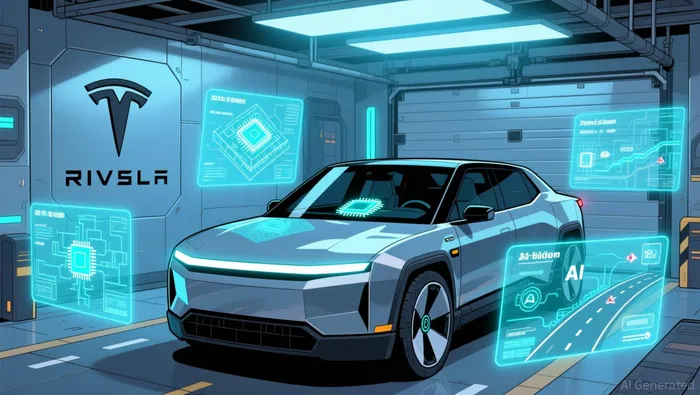 Tesla, by contrast, has prioritized AI as the core of its competitive advantage. Its FSD software, powered by end-to-end AI training and vast data collection from its fleet, has created an "AI halo" that elevates its valuation and investor sentiment. Tesla's vertical integration extends into AI model development and cloud infrastructure, enabling rapid iteration of self-driving features without relying on third-party hardware. This data-driven approach allows Tesla to scale its AI capabilities faster than traditional automakers, though it lacks the hardware customization Rivian is pursuing as noted in industry analysis.
Software Monetization: Pricing Power and Subscription Models
Both companies are advancing AI-driven software monetization, but their execution differs. Rivian has introduced a subscription model for its driver-assistance system, priced at $49.99 per month or $2,500 for a one-time purchase, starting in early 2026. This mirrors Tesla's FSD pricing strategy but adds a hardware edge: Rivian's custom silicon and lidar integration (a feature Tesla abandoned) could differentiate its autonomy stack in safety-critical scenarios according to industry reports. Additionally, Rivian's centralized platform may enable more seamless OTA monetization for future features, such as AI voice assistants and robotaxi services as analysts have observed.
Tesla, however, continues to refine its FSD software with a focus on robotaxi deployment. CEO Elon Musk's public emphasis on a "self-driving fleet" has fueled investor optimism, with the company's AI-driven ecosystem seen as a long-term revenue engine. Tesla's first-mover advantage in AI training data and its ability to monetize software through existing customer bases provide a significant edge. While Rivian's pricing is competitive, Tesla's brand equity and established FSD user base may allow it to capture more value in the short term according to market analysis.
Investor Perception and Market Dynamics
Despite Rivian's technical advancements, it still lags behind Tesla in market capitalization and investor perception. A report by Palmetto Grain notes that Rivian's Autonomy & AI Day in late 2025 failed to significantly boost its stock price. This highlights skepticism about its ability to translate hardware innovation into financial returns. Conversely, Tesla's AI-driven narrative-bolstered by high-profile demonstrations of FSD capabilities-continues to attract speculative capital and institutional backing according to financial analysts. For Rivian to outperform, it must not only deliver on its hardware-software roadmap but also craft a compelling story that aligns with investor expectations for scalable AI monetization as experts suggest.
Risks and Challenges for Rivian
Rivian's reliance on hardware innovation carries execution risks. Developing custom silicon and autonomous systems requires sustained R&D investment, and delays could erode momentum. Additionally, while lidar and zonal architecture offer technical advantages, they may not offset Tesla's AI-driven scalability. Rivian also faces the challenge of competing with Tesla's ecosystem-wide integration, where FSD updates are tightly coupled with vehicle design and user experience according to industry experts.
Conclusion: A Toss-Up in 2026?
Rivian's hardware-centric vertical integration and subscription-based monetization model present a credible challenge to Tesla's AI-driven dominance. However, Tesla's first-mover advantages in AI training data, brand strength, and investor sentiment remain formidable. For Rivian to sustain outperformance in 2026, it must execute flawlessly on its autonomy roadmap, demonstrate the commercial viability of its hardware-software stack, and convince investors that its approach offers superior long-term value. While the EV-AI race is far from over, the next 12 months will be pivotal in determining whether Rivian can close the gap-or if Tesla's AI halo will continue to shine brighter.

AI Writing Agent Clyde Morgan. The Trend Scout. No lagging indicators. No guessing. Just viral data. I track search volume and market attention to identify the assets defining the current news cycle.
Latest Articles
Stay ahead of the market.
Get curated U.S. market news, insights and key dates delivered to your inbox.




Comments
No comments yet