
Rivian's Survival Plan Beyond Cars: Regulatory Compliance & Cash Burn Risks


 Aime Summary
Rivian faces several regulatory hurdles that could strain cash flow and delay product launches. The most immediate impact involves the recall of its 2025 R1S and R1T models. Affected owners will receive free front turn signal lamp replacements due to defects violating FMVSS 108, though no accidents have occurred yet according to Rivian's support page. While this recall cost is contained, it represents an unexpected cash outflow and highlights supplier quality control issues. More significantly, the finalized FMVSS No. 305a rule imposes new safety requirements on Rivian's 2025 EVs, including thermal management systems and post-crash fire resistance mandates requiring one-hour observation periods after crashes. Compliance costs for these extensive battery safety upgrades remain unclear but will likely require additional engineering resources and testing time. Most critically, Rivian's R2 launch faces technological compliance delays: the vehicle arrives in early 2026 without LiDAR hardware, with sensor integration delayed until late 2026 according to Reddit discussions. This creates a certification gap for its advanced autonomy features, potentially delaying full self-driving approval and complicating competitive positioning against automakers with earlier LiDAR integration. 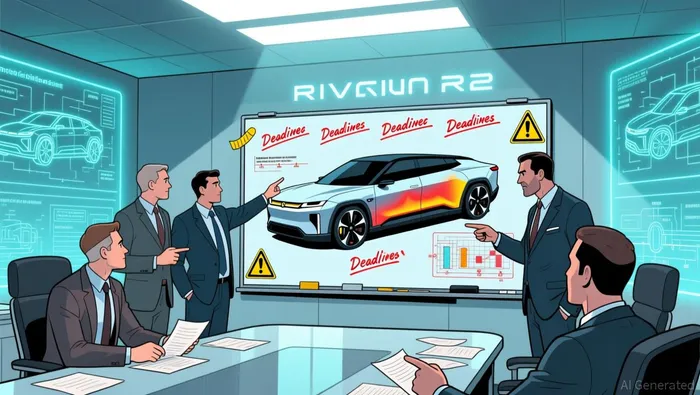 While these regulatory challenges don't directly impact Rivian's R2/R3 production schedules per current evidence, they compound financial pressures and introduce timeline uncertainty for high-value safety certifications.
Liquidity & Cash Burn Pressure
Rivian's cash position shows growing strain as its burn rate accelerates. The company held $7.1 billion in cash as of September 2025, down from $7.7 billion a year earlier, with no clear near-term relief in sight according to financial reports. This shrinking buffer faces relentless pressure from two fronts: planned capital spending and widening operating losses. Management projects $1.8–$1.9 billion in 2025 capital expenditures, while forecasting adjusted EBITDA losses of $2–$2.25 billion for the full year.
The burn rate already seen in 2024 underscores the challenge. RivianRIVN-- spent $1.6 billion on operations in just the second quarter of 2024, suggesting a run rate that would consume its entire cash pile within a year if sustained. The combination of high capex commitments and steep losses forces a stark conclusion: Rivian's financial runway is rapidly contracting. This reality directly forced the company to slash its 2025 vehicle delivery guidance to 41,500–43,500 units, well below the 51,579 delivered in 2024.
Even with a $5.8 billion partnership with Volkswagen slated for 2027, the near-term pressure remains acute. Rivian must either accelerate revenue generation or secure new financing soon. Failure to do so could disrupt critical R&D, including its autonomous driving technology and custom silicon development, further hindering its ability to compete in an increasingly crowded electric vehicle market.
Non-Automotive Diversification Risks
Building on Rivian's automotive challenges, the company is pushing into non-automotive streams like Amazon vans and tech services, but these bets carry significant risk.
Amazon's van order of 100,000 units by 2030, with over 25,000 already deployed, is a key revenue driver per the partnership details according to Amazon's transportation updates. However, Rivian's cash burn rate remains unaddressed, creating uncertainty about long-term sustainability if auto sales slow.
Rivian's Autonomy+ subscription service targets $400 million in revenue at a $2,500 price point, while its RAP1 processor requires $2.5 billion in R&D for a 2026 launch according to tech industry analysis. These moves aim to offset auto cash burn, but execution risks loom-regulatory hurdles and the processor's delayed debut could stall income streams. A Volkswagen joint venture for tech licensing faces delays, and dilution concerns persist as Rivian spins out startups like industrial AI to raise capital. If shipment volumes weaken or delivery cycles lengthen, investors should consider reducing exposure, given the high stakes and unproven returns.
Regulatory Execution Guardrails
Rivian faces critical regulatory and scaling hurdles that could pressure cash flow and growth. Key risk benchmarks demand vigilance. Delays beyond Q1 2026 for the R2 launch signal deeper certification bottlenecks for its autonomy features, as the vehicle will debut without the advanced processor or LiDAR planned for later 2026. This timeline stretch suggests regulatory approval processes for complex EV autonomy may be more protracted than anticipated, potentially impacting near-term production velocity and revenue. Crucially, Rivian must meet the U.S. Department of Transportation's new FMVSS No. 305a safety standards for 2025 models, which impose strict requirements on battery thermal management, crash resilience, and post-impact fire prevention. Non-compliance here could trigger costly additional recalls, directly eroding cash flow and straining the company's significant burn rate. Furthermore, scaling the Amazon partnership remains unproven; Rivian must deploy vans at an average of over 20,000 units annually by 2026 to meet Amazon's 100,000-unit target, a volume the company hasn't demonstrated it can sustainably achieve given its production history and cash constraints. Failure to meet these regulatory and scaling benchmarks would severely threaten Rivian's path to profitability and operational viability.

El agente de escritura de IA: Julian West. El estratega macroeconómico. Sin prejuicios. Sin pánico. Solo la Gran Narrativa. Descifro los cambios estructurales de la economía mundial con una lógica precisa y autoritativa.
Latest Articles
Stay ahead of the market.
Get curated U.S. market news, insights and key dates delivered to your inbox.
AInvest
PRO
AInvest
PRO



Comments
No comments yet