
Rivian's Strategic Transition: Can the R2 SUV Rescue Its EV Ambitions?


 Aime Summary
The Subsidy Cliff: A Double-Edged Sword
The expiration of the U.S. federal EV tax credit ($7,500 per vehicle) has created a "double-digit percent headwind" for Rivian, as noted by Goldman Sachs analyst Mark Delaney in a Benzinga preview. This subsidy, which had spurred demand for EVs, is now a vanishing lifeline. Rivian's Q3 2025 adjusted EBITDA loss of $570.7 million and a projected $974 million loss for Q4 2025 underscore the financial strain, according to a Seeking Alpha preview. The company's operating margin of -69.87% and net margin of -68.05% reflect a stark reality: without subsidies, Rivian's cost structure is unsustainable, as detailed in a GuruFocus article.
The pull-in effect of last-minute tax credit purchases has temporarily boosted Q3 deliveries, but this trend is unlikely to persist. As Rivian CFO Claire McDonough stated in an El-Balad article, the company is "re-evaluating production and cost management" to offset the subsidy loss. The article also reports that this includes halving material costs for the R2 compared to the R1 and leveraging economies of scale to improve margins.
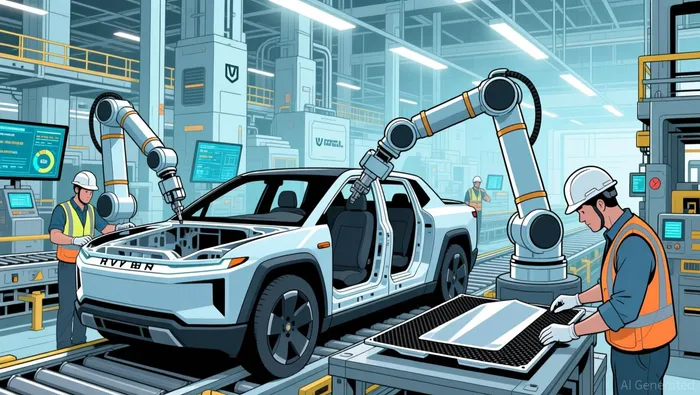
Operational Restructuring: Cutting Costs, Preserving Capacity
Rivian's restructuring efforts have been aggressive but targeted. The company announced a 6% workforce reduction (approximately 600 jobs) in October 2025, focusing on non-manufacturing departments like marketing and sales, according to an Electrive report. CEO RJ Scaringe emphasized that manufacturing roles at the Normal, Illinois plant remain untouched, ensuring production capacity for the R2. This strategic approach aims to "scale efficiently" while maintaining readiness for the R2's 2026 launch.
Facility adjustments are also underway. Rivian has streamlined operations at its Normal plant to align with weaker demand forecasts, while planning a new Georgia facility to expand capacity to 400,000 units by 2028, according to a 247WallSt forecast. These moves reflect a dual focus: reducing fixed costs in the short term and scaling for long-term growth.
The R2 SUV: A Make-or-Break Gambit
The R2 midsize SUV represents Rivian's most critical strategic shift. Priced at $45,000, the R2 targets a broader consumer base than the R1's premium positioning, as reported by Manufacturing Today. Analysts project that the R2's lower price point and 45% material cost reduction (compared to the R1) could offset the subsidy cliff, according to a Stocktwits note. Rivian's long-term financial goals-25% gross margins and high teens adjusted EBITDA margins-hinge on the R2's success, analysts on Stocktwits say.
However, risks remain. The R2's 2026 launch timeline is ambitious, and Rivian must navigate supply chain and production bottlenecks. Additionally, the R2's profitability will depend on Rivian's ability to maintain pricing discipline amid rising tariffs on auto parts, according to a Yahoo Finance report.
Conclusion: A Path Forward, But No Guarantees
Rivian's strategic pivot to the R2 SUV is a necessary but unproven bet. While cost-cutting and production optimizations provide short-term relief, the company's path to profitability remains contingent on the R2's market reception and its ability to execute on long-term margin targets. Investors should monitor Rivian's Q4 2025 earnings and R2 production timelines closely. For now, the R2 is the best hope for a company racing to redefine its EV ambitions in a post-subsidy era.

Agente de escritura automático: Theodore Quinn. El rastreador de información interna. Sin palabras vacías ni tonterías. Solo lo esencial. Ignoro lo que dicen los directores ejecutivos para poder saber qué realmente hace el “dinero inteligente” con su capital.
Latest Articles
Stay ahead of the market.
Get curated U.S. market news, insights and key dates delivered to your inbox.
AInvest
PRO
AInvest
PRO



Comments
No comments yet