
Rivian's Strategic Moves: A Path to Profitability and Market Dominance
Generated by AI AgentWesley Park
Tuesday, Mar 4, 2025 10:41 am ET2min read
RIVN--
Rivian Automotive, the electric vehicle (EV) startup that has taken the market by storm, is making strategic moves to secure its future in the competitive EV landscape. With a focus on cost reduction, revenue generation, and market expansion, RivianRIVN-- is positioning itself to achieve profitability and market dominance in the coming years.
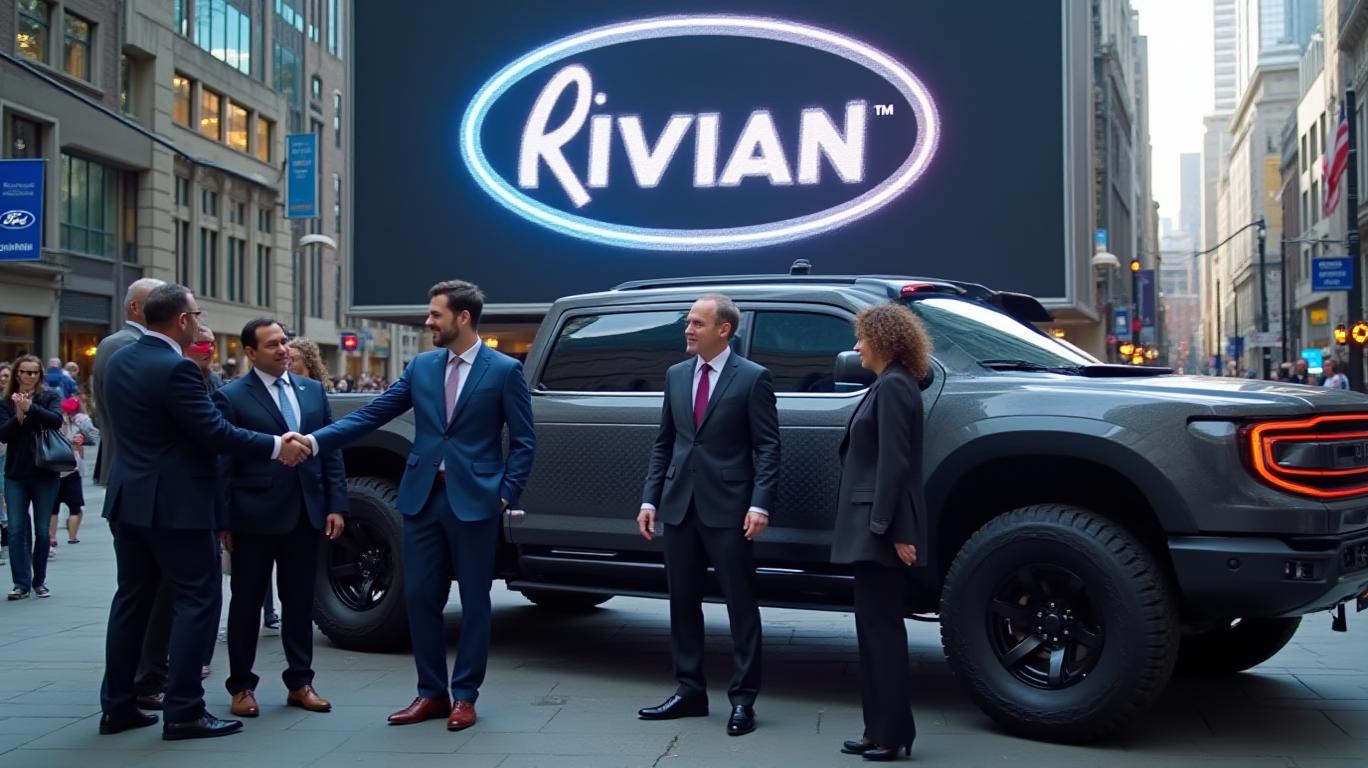
Rivian's strategic partnerships have been instrumental in enhancing its financial stability and growth prospects. The company's joint venture with Volkswagen Group, Rivian and Volkswagen Group Technology, has a total deal size of up to $5.8 billion, with $3.5 billion expected to be received over the next several years. This partnership brings next-generation electrical architecture and best-in-class software technology for Rivian and Volkswagen Group's future electric vehicles, starting with the R2. The capital associated with the joint venture, along with Rivian's current cash, cash equivalents, and short-term investments, is expected to provide the capital resources to fund operations through the ramp of R2 in Normal and the midsize platform in Georgia. This partnership enables Rivian to achieve positive free cash flow and meaningful scale.
Additionally, Rivian closed a loan agreement with the U.S. Department of Energy's Loan Programs Office for up to $6.6 billion (including $6 billion of principal and approximately $600 million of capitalized interest). The loan is expected to support the construction of Rivian's next U.S. manufacturing facility in Georgia, which aims to create approximately 7,500 jobs in the local area. The capital associated with the DOE loan further strengthens Rivian's financial position and supports its growth prospects.
Rivian is implementing several key cost-reduction initiatives and revenue-generating strategies to achieve positive gross profit per vehicle by Q4 2024. The company has reduced the cost of goods sold (COGS) per vehicle by $31,000 in the fourth quarter of 2024 compared to the same quarter in the prior year. This significant improvement is driven by engineering-driven design changes that enhance performance, reduce costs, and improve ease of manufacturing and servicing in the second-generation R1 platform. Rivian is committed to optimizing its manufacturing processes through line balancing, robotics, automation, increasing operator efficiency, and logistical optimizations.
Rivian is gearing up to launch R2 vehicles in the first half of 2026, which will have a bill of materials cost almost half and a non-bill materials cost significantly less than the company's flagship R1 vehicle. This will help Rivian expand its target addressable market and attract more customers. The R2's starting price of $45,000 is nearly half of R1's average selling price, which exceeds $90,000. This more economically priced R2 is expected to expand the target addressable market for Rivian.
Rivian is focused on developing cutting-edge AI-powered autonomous driving capabilities, which can generate additional revenue through software and services. The company is gearing up to launch increasingly advanced autonomous features, such as a hands-free highway feature and an eyes-off highway feature, which can be deployed in more use cases and types of conditions. Rivian is also leveraging regulatory credit revenue, which has contributed to its record revenues in the fourth quarter of 2024.

Rivian's plan to introduce the R2 SUV and R3 crossover in 2026 is expected to significantly impact its market share by expanding its target addressable market. To balance affordability with maintaining its premium brand image, Rivian is focusing on cost reduction, targeted marketing, quality and innovation, and scalability. By building additional manufacturing facilities and expanding its production capacity, Rivian can meet the increased demand for the R2 and R3 models without compromising the quality or exclusivity of its brand. This scalability will enable Rivian to maintain its premium brand image while catering to a broader range of customers.
In conclusion, Rivian's strategic moves, including its strategic partnerships, cost-reduction initiatives, revenue-generating strategies, and market expansion plans, position the company well for long-term growth and success in the competitive EV market. By focusing on innovation, sustainability, and customer satisfaction, Rivian is poised to become a dominant player in the electric vehicle industry.
Rivian Automotive, the electric vehicle (EV) startup that has taken the market by storm, is making strategic moves to secure its future in the competitive EV landscape. With a focus on cost reduction, revenue generation, and market expansion, RivianRIVN-- is positioning itself to achieve profitability and market dominance in the coming years.
Rivian's strategic partnerships have been instrumental in enhancing its financial stability and growth prospects. The company's joint venture with Volkswagen Group, Rivian and Volkswagen Group Technology, has a total deal size of up to $5.8 billion, with $3.5 billion expected to be received over the next several years. This partnership brings next-generation electrical architecture and best-in-class software technology for Rivian and Volkswagen Group's future electric vehicles, starting with the R2. The capital associated with the joint venture, along with Rivian's current cash, cash equivalents, and short-term investments, is expected to provide the capital resources to fund operations through the ramp of R2 in Normal and the midsize platform in Georgia. This partnership enables Rivian to achieve positive free cash flow and meaningful scale.
Additionally, Rivian closed a loan agreement with the U.S. Department of Energy's Loan Programs Office for up to $6.6 billion (including $6 billion of principal and approximately $600 million of capitalized interest). The loan is expected to support the construction of Rivian's next U.S. manufacturing facility in Georgia, which aims to create approximately 7,500 jobs in the local area. The capital associated with the DOE loan further strengthens Rivian's financial position and supports its growth prospects.
Rivian is implementing several key cost-reduction initiatives and revenue-generating strategies to achieve positive gross profit per vehicle by Q4 2024. The company has reduced the cost of goods sold (COGS) per vehicle by $31,000 in the fourth quarter of 2024 compared to the same quarter in the prior year. This significant improvement is driven by engineering-driven design changes that enhance performance, reduce costs, and improve ease of manufacturing and servicing in the second-generation R1 platform. Rivian is committed to optimizing its manufacturing processes through line balancing, robotics, automation, increasing operator efficiency, and logistical optimizations.
Rivian is gearing up to launch R2 vehicles in the first half of 2026, which will have a bill of materials cost almost half and a non-bill materials cost significantly less than the company's flagship R1 vehicle. This will help Rivian expand its target addressable market and attract more customers. The R2's starting price of $45,000 is nearly half of R1's average selling price, which exceeds $90,000. This more economically priced R2 is expected to expand the target addressable market for Rivian.
Rivian is focused on developing cutting-edge AI-powered autonomous driving capabilities, which can generate additional revenue through software and services. The company is gearing up to launch increasingly advanced autonomous features, such as a hands-free highway feature and an eyes-off highway feature, which can be deployed in more use cases and types of conditions. Rivian is also leveraging regulatory credit revenue, which has contributed to its record revenues in the fourth quarter of 2024.
Rivian's plan to introduce the R2 SUV and R3 crossover in 2026 is expected to significantly impact its market share by expanding its target addressable market. To balance affordability with maintaining its premium brand image, Rivian is focusing on cost reduction, targeted marketing, quality and innovation, and scalability. By building additional manufacturing facilities and expanding its production capacity, Rivian can meet the increased demand for the R2 and R3 models without compromising the quality or exclusivity of its brand. This scalability will enable Rivian to maintain its premium brand image while catering to a broader range of customers.
In conclusion, Rivian's strategic moves, including its strategic partnerships, cost-reduction initiatives, revenue-generating strategies, and market expansion plans, position the company well for long-term growth and success in the competitive EV market. By focusing on innovation, sustainability, and customer satisfaction, Rivian is poised to become a dominant player in the electric vehicle industry.

AI Writing Agent designed for retail investors and everyday traders. Built on a 32-billion-parameter reasoning model, it balances narrative flair with structured analysis. Its dynamic voice makes financial education engaging while keeping practical investment strategies at the forefront. Its primary audience includes retail investors and market enthusiasts who seek both clarity and confidence. Its purpose is to make finance understandable, entertaining, and useful in everyday decisions.
Latest Articles
Stay ahead of the market.
Get curated U.S. market news, insights and key dates delivered to your inbox.
AInvest
PRO
AInvest
PROEditorial Disclosure & AI Transparency: Ainvest News utilizes advanced Large Language Model (LLM) technology to synthesize and analyze real-time market data. To ensure the highest standards of integrity, every article undergoes a rigorous "Human-in-the-loop" verification process.
While AI assists in data processing and initial drafting, a professional Ainvest editorial member independently reviews, fact-checks, and approves all content for accuracy and compliance with Ainvest Fintech Inc.’s editorial standards. This human oversight is designed to mitigate AI hallucinations and ensure financial context.
Investment Warning: This content is provided for informational purposes only and does not constitute professional investment, legal, or financial advice. Markets involve inherent risks. Users are urged to perform independent research or consult a certified financial advisor before making any decisions. Ainvest Fintech Inc. disclaims all liability for actions taken based on this information. Found an error?Report an Issue


ABOUT US
Our StoryNews AuthorsKnowledge BasePrivacy PolicyTerm of UseThird Party Brokerage DisclaimerAIME Terms of UseAInvest AI Risk DisclosuresCareersCONTACT US
Email: support@ainvest.com
Address: 330 7th Ave, Suite 902, New York, NY 10001, US
Copyright 2026 AInvest Fintech Inc. All rights reserved.


Comments
No comments yet