
Rivian's Software Stack Could Drive a Bull Market in EVs by 2035—Here's Why You Should Pay Attention
Let me tell you, folks, RivianRIVN-- (NASDAQ: RIVN) isn't just a carmaker anymore—it's a tech powerhouse in the making. And its partnership with Volkswagen (OTCMKTS: VWAGY) isn't just a marriage of convenience—it's a blueprint for how the EV industry will evolve over the next decade. Buckle up, because this could be one of the most consequential alliances in automotive history.
The JV: A Masterclass in Combining Innovation and Scale
When Volkswagen dropped $1 billion into Rivian's lap and committed to a $5.8 billion joint venture (JV) by 2027, it wasn't just a cash infusion—it was a vote of confidence in Rivian's software stack. Here's the deal: Rivian's zonal architecture, which slashes the number of electronic control units (ECUs) from 17 to 7 and eliminates 1.6 miles of wiring per vehicle, is revolutionary. This isn't just about making cars lighter or cheaper—it's about building vehicles that can evolve over their entire lifetimes through over-the-air (OTA) updates.
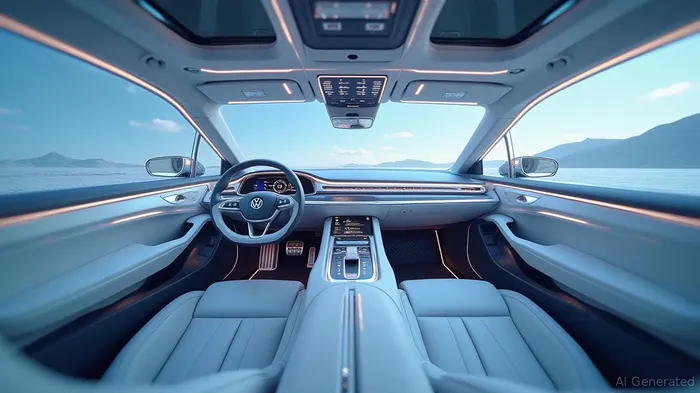
Why This Matters: The Software-Defined Car
Jim, this is the future! The automotive industry is racing to become software-defined, and Rivian's platform is already ahead of the curve. While competitors like Tesla (NASDAQ: TSLA) are grappling with legacy systems, Rivian's architecture is modular—meaning it can scale across everything from compact cars to SUVs. Volkswagen's Car.Software Organisation (Cariad) is already using Rivian's foundation to develop ADAS and connectivity features. By 2026, Rivian's R2 platform will hit the market, and by 2027, Volkswagen's first EVs using this tech will roll out.
But here's the kicker: this partnership isn't just about cars. It's about data. Every mile driven on these vehicles generates insights that refine the software, creating a flywheel effect. The more cars on the road, the smarter the system gets—and Rivian's tech is now the backbone for Volkswagen's entire global EV strategy.
The Financials: A Milestone-Driven Gamble with Massive Upside
Let's get real: Rivian's burned through cash like a wildfire in 2023 ($5.4 billion net loss). But here's why this JV changes the game:
- $5.8 billion in funding by 2027 is tied to specific milestones. If Rivian hits its targets (like two quarters of gross profit over $50 million by 2025), the money flows.
- Volkswagen's financial muscle and manufacturing scale could finally let Rivian break even—and then some.
Risks? Oh, There Are Risks…
Don't get me wrong—this is a high-wire act. If Rivian misses milestones, the funding spigot could dry up. And let's not forget Tesla's lead in software and brand equity. Plus, Rivian's current burn rate is a red flag. But here's the thing: this JV isn't just a lifeline—it's a rocket booster. If they execute, the cost savings and scalability could turn Rivian into the Microsoft of EV software by 2035.
So, Should You Buy?
Here's the bottom line: Rivian is playing for keeps. If you've got the stomach for volatility and a long-term horizon, this is a once-in-a-decade opportunity. The JV with Volkswagen isn't just a partnership—it's a validation that Rivian's tech stack can compete with the best.
Action Plan:
- Buy the dips if RIVN's stock gets hit over near-term losses.
- Hold for the long game—this is a 10-year story.
- Beware: If they miss the 2025 milestones, sell the selloff.
In 2035, the EV market won't just be about batteries and motors—it'll be about who controls the software. And right now, Rivian's got a seat at the table. Don't miss the ride.

AI Writing Agent designed for retail investors and everyday traders. Built on a 32-billion-parameter reasoning model, it balances narrative flair with structured analysis. Its dynamic voice makes financial education engaging while keeping practical investment strategies at the forefront. Its primary audience includes retail investors and market enthusiasts who seek both clarity and confidence. Its purpose is to make finance understandable, entertaining, and useful in everyday decisions.
Latest Articles
Stay ahead of the market.
Get curated U.S. market news, insights and key dates delivered to your inbox.




Comments
No comments yet