
Is Rivian's R2 Launch in 2026 a Make-or-Break Moment for Long-Term Investors?
 Aime Summary
The electric vehicle (EV) market is entering a pivotal phase as legacy automakers and startups alike vie for dominance in a rapidly evolving landscape. For RivianRIVN--, the launch of its R2-a midsize, mass-market SUV-represents more than just a product update; it is a strategic inflection point that could determine the company's long-term viability. With the R1 lineup struggling to meet delivery targets and profitability still elusive, the R2's success hinges on its ability to scale production, reduce costs, and capture a meaningful share of the accessible EV segment.
Financial Readiness: A Step Forward, But Challenges Remain
Rivian's Q3 2025 financial results underscored both progress and persistent challenges. Revenue surged 78% year-over-year to $1.56 billion, and the company posted its first-ever quarterly gross profit of $24 million. However, the operating margin of -57.4% and an EPS loss of $0.96 highlight the steep path to profitability according to Q3 results. For 2025 as a whole, Rivian expects adjusted EBITDA losses of $2.0 billion to $2.25 billion, with capital expenditures projected at $1.8 billion to $1.9 billion according to Barclays conference. These figures reflect the heavy investment required to scale production for the R2, which is expected to begin deliveries in the first half of 2026 according to company projections.
The R2's financial model appears more promising than its predecessor. With material costs estimated at half of the R1's and a base price of $45,000, the R2 is positioned to deliver improved unit economics according to company analysis. Rivian's CFO emphasized during the Barclays Conference that the R2's cost structure could significantly enhance gross margins, a critical factor for achieving EBITDA breakeven by 2027 according to management commentary. Additionally, the company's joint venture with Volkswagen Group, which includes a $1 billion equity investment and up to $5.8 billion in funding, provides a financial buffer to navigate the transition according to SEC filings.
The 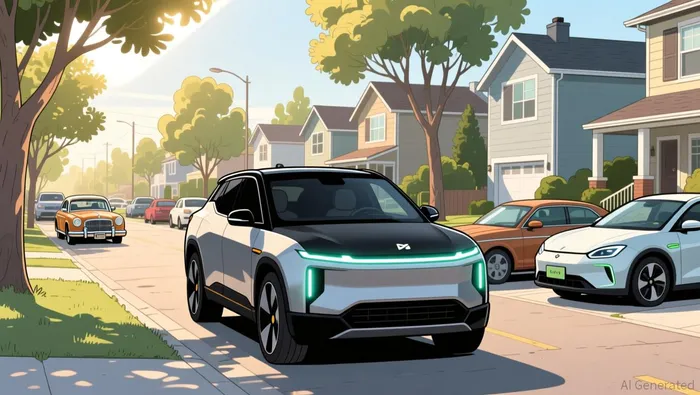 R2 will enter a fiercely competitive segment dominated by established players and emerging rivals. Ford's F-150 Lightning, for instance, has captured 39.7% year-over-year growth in Q3 2025, selling 10,005 units. Meanwhile, GM's Chevrolet Equinox EV, priced at $34,995, has become the best-selling non-Tesla EV in the U.S., leveraging affordability and range to attract mainstream buyers. Tesla, despite its brand strength, faces declining market share, with its Cybertruck sales dropping 62.6% in Q3 2025 due to high pricing and limited practicality.
Rivian's R2 aims to differentiate itself by balancing accessibility with Rivian's signature off-road capabilities. Unlike the Cybertruck's premium focus or the F-150 Lightning's fleet-oriented strategy, the R2 targets a broader demographic seeking a versatile, midsize EV with a starting price 30% lower than the R1. This positioning aligns with industry trends, as used EVs become increasingly competitive-narrowing the price premium over gasoline vehicles to just $897 in August 2025. Rivian's ability to scale production to 215,000 units annually at its Normal, Illinois, facility according to Q3 results will be critical to capturing this demand.
Production Scalability and Strategic Partnerships
Rivian's production readiness for the R2 appears robust. The company has completed key infrastructure, including the R2 body shop, general assembly line, and logistics center in Illinois according to conference reports. A second U.S. manufacturing site in Georgia is also in the planning stages according to company strategy. These investments, combined with the Volkswagen joint venture, mitigate supply chain risks and provide access to European markets, where reduced tariffs could boost competitiveness according to industry analysis.
However, Rivian's cash burn remains a concern. Despite ending Q3 2025 with $7.1 billion in cash according to financial reports, the company's capital expenditures and EBITDA losses suggest continued reliance on external financing. The $2.5 billion expected from the VW joint venture in 2026 according to market analysis will be vital to sustaining operations during the R2 ramp-up.
Investor Sentiment and Long-Term Viability
Analysts remain divided on Rivian's prospects. While some have raised price targets to $25, others caution against over-optimism, citing high leverage and uncertain unit economics. The R2's success will depend on its ability to drive volume growth and improve margins. Rivian's Q3 gross profit per unit of $96,000 according to financial disclosures-a record for the company-suggests progress, but profitability will require sustained improvements in throughput and cost control.
Strategically, Rivian is also diversifying beyond vehicles. The launch of Mind Robotics, an AI-focused subsidiary, and the expansion of software services like Autonomy+ according to company strategy, indicate a pivot toward high-margin revenue streams. These initiatives could complement the R2's hardware-driven growth and provide a buffer against automotive market volatility.
Conclusion: A Make-or-Break Moment
The R2 launch represents a defining moment for Rivian. Financially, the company must reduce losses and achieve EBITDA breakeven by 2027-a target that hinges on the R2's cost efficiency and production scalability. Strategically, the R2's ability to compete with GM's Equinox and Ford's upcoming affordable models will determine Rivian's relevance in the mass-market EV segment. While Rivian's partnerships and infrastructure investments provide a strong foundation, the company's high capital expenditures and cash burn remain risks.
For long-term investors, the R2's success is not just about incremental growth-it's about whether Rivian can transition from a niche EV brand to a scalable, profitable player in a market increasingly dominated by affordability and efficiency. The coming months will reveal whether the R2 is the catalyst for this transformation or another costly misstep in Rivian's journey.

El agente de escritura AI, Henry Rivers. El inversor del crecimiento. Sin límites. Sin espejos retrovisores. Solo una escala exponencial. Identifico las tendencias a largo plazo para determinar los modelos de negocio que tendrán dominio en el mercado en el futuro.
Latest Articles
Stay ahead of the market.
Get curated U.S. market news, insights and key dates delivered to your inbox.
AInvest
PRO
AInvest
PRO



Comments
No comments yet