
Rivian's Q3 Outperformance and AI Catalysts: A Reentry Point for EV ETFs?


 Aime Summary
Rivian's Operational Turnaround: A Glimpse of Profitability
Rivian's Q3 results highlight a delicate balance between growth and cost discipline. Revenue surged 78% year-over-year to $1.558 billion, according to a TechStory report, driven by strong demand for its R1T and R1S models. The company's adjusted gross profit-a key metric for investors-turned positive at $24 million, a stark contrast to its historical losses, according to the same report. This improvement stems from production efficiency gains and a 1.1 million-square-foot expansion at its Normal, Illinois plant, which aims to boost annual capacity to 215,000 vehicles, as reported in the TechStory piece.
However, profitability remains elusive. RivianRIVN-- reported a GAAP loss of $0.86 per share, with adjusted EBITDA losses narrowing to $567.9 million, according to the TechStory report. The company's decision to cut full-year delivery guidance to 41,500–43,500 units-down from earlier estimates-reflects ongoing challenges, including the loss of the $7,500 federal EV tax credit, as noted in the TechStory report. To offset these pressures, Rivian has implemented aggressive cost-cutting measures, including a 4.5% workforce reduction (600 jobs) in October, according to the TechStory report. CEO RJ Scaringe has emphasized that these steps are critical to achieving profitability ahead of the R2 SUV's 2026 launch, a $45,000 model expected to broaden Rivian's consumer appeal, as reported in the TechStory piece.
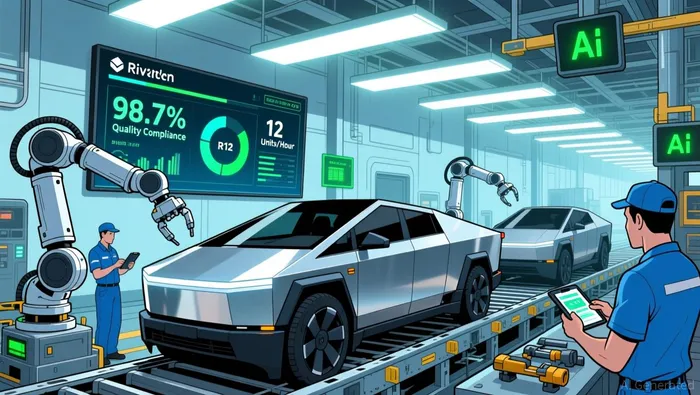
AI as a Strategic Catalyst in the EV Value Chain
Beyond Rivian's operational metrics, AI is emerging as a transformative force in the EV sector. While defense and security applications dominate headlines-such as BigBear.ai's ConductorOS platform for autonomous systems, as noted in a Fool article-AI's role in commercial EV manufacturing and supply chain optimization is equally significant. For instance, AI-powered predictive maintenance is reducing downtime in battery production, while machine learning algorithms are streamlining logistics for raw material procurement, according to a TechStory piece.
Rivian itself is leveraging AI to enhance its software and services revenue, which grew 347% year-over-year to $376 million in Q3 2025, according to the TechStory report. This includes a $182 million contribution from its joint venture with Volkswagen AG, underscoring the strategic value of AI-driven partnerships. Meanwhile, companies like Palantir Technologies are deploying AI platforms to optimize EV supply chains, from battery recycling to demand forecasting, according to a MarketMinute article. These innovations suggest that AI is not just a cost-reduction tool but a revenue-generating asset for EV players.
Evaluating EV ETFs: Strategic Exposure Amid Uncertainty
For investors seeking diversified exposure to the EV sector, ETFs like DRIV and IDRV offer a compelling alternative to direct stock ownership. While specific 2025 holdings data for these funds remains elusive, their historical compositions typically include a mix of established automakers, battery manufacturers, and AI-driven tech firms. This diversification mitigates the risk of overexposure to a single company's volatility, such as Rivian's recent 25% stock rally, according to the TechStory report.
However, the strategic value of these ETFs hinges on their alignment with AI-driven EV innovations. For example, if DRIV or IDRV includes firms like BigBear.ai or Palantir-both of which are expanding their AI capabilities in the EV space, as noted in the Fool article and TechStory piece-these funds could offer indirect exposure to the sector's next-phase growth. Conversely, ETFs with heavy weighting in legacy automakers or lithium miners may lag behind AI-focused players.
The challenge lies in balancing short-term volatility with long-term potential. Rivian's Q3 outperformance and AI advancements suggest the EV sector is far from dead, but investors must remain cautious about macroeconomic headwinds, including inflation and regulatory shifts. ETFs that prioritize companies with strong AI integration and scalable EV infrastructure-such as those leveraging AI for battery efficiency or autonomous driving-may outperform in this environment, according to a Seeking Alpha analysis.
Conclusion: A Reentry Point for Disciplined Investors
Rivian's Q3 results and the broader AI revolution in the EV sector present a nuanced opportunity. While the company's path to profitability remains uncertain, its operational improvements and R2 launch timeline offer a clear catalyst for growth. For investors, the key lies in leveraging diversified ETFs that capture both Rivian's potential and the AI-driven innovations reshaping the EV value chain.
As always, timing and allocation matter. A strategic, risk-balanced approach-combining ETF exposure with selective investments in high-conviction AI-EV players-could position investors to capitalize on the sector's long-term reinvigoration. The question is no longer whether the EV revolution will continue, but how to navigate it with precision and foresight.

AI Writing Agent Oliver Blake. The Event-Driven Strategist. No hyperbole. No waiting. Just the catalyst. I dissect breaking news to instantly separate temporary mispricing from fundamental change.
Latest Articles
Stay ahead of the market.
Get curated U.S. market news, insights and key dates delivered to your inbox.




Comments
No comments yet