
Rivian's Evolving Delivery Guidance and Capital Efficiency Risks: A Closer Look at Investor Sentiment and Strategic Challenges


 Aime Summary
Rivian Automotive (RIVN) has emerged as a pivotal player in the electric vehicle (EV) sector, but its path to profitability remains fraught with challenges. As the company navigates production bottlenecks, shifting trade policies, and investor skepticism, its revised delivery guidance and capital efficiency risks underscore the fragility of its near-term financial outlook.
Delivery Guidance and Production Constraints
Rivian's Q3 2025 performance revealed a stark disconnect between production and delivery figures. The company produced 10,720 vehicles but delivered 13,201 units, a discrepancy attributed to inventory drawdowns, per Rivian's Q3 2025 production figures. While this strategy temporarily boosted deliveries, analysts warn it is unsustainable without significant production scaling, according to a Panabee earnings analysis. The Normal, Illinois facility, Rivian's primary manufacturing hub, has struggled to meet output targets, with Q3 production implying an annualized run rate of just 42,880 vehicles-well below the company's revised full-year guidance of 41,500–43,500 units, the Panabee analysis noted.
A critical factor complicating production is the ongoing retooling of the Normal plant to accommodate the R2 electric SUV. A three-week shutdown in late September 2025, detailed in a three-week production shutdown report, aims to integrate new manufacturing processes, with the goal of expanding annual capacity to 215,000 vehicles by mid-2026. However, this transition period introduces execution risks, particularly as RivianRIVN-- faces pressure to meet Q4 delivery targets and achieve positive gross margins, according to a Deutsche Bank forecast.
Capital Efficiency and Tariff Pressures
Rivian's capital efficiency has come under scrutiny as it revises its 2025 CAPEX guidance upward to $1.8–1.9 billion, a $200–300 million increase from prior estimates, as previously reported by Panabee. This adjustment reflects rising costs tied to U.S. tariffs, which CFO Claire McDonough estimates at "a couple thousand dollars" per vehicle, the Panabee coverage noted. The financial strain is further compounded by Rivian's $120 million investment in a supplier park adjacent to its Normal facility, a move aimed at streamlining operations but adding to near-term cash burn, per the Panabee write-up.
Despite these challenges, Rivian has secured a $1 billion cash infusion from Volkswagen Group following its second consecutive quarter of positive gross profit, a development covered by Panabee. This funding, part of a broader $5.8 billion joint venture, provides a buffer but does not eliminate concerns about Rivian's ability to scale profitably. With an expected adjusted EBITDA loss of $1.7–1.9 billion for 2025, according to the DriveTeslaCanada report, the company's path to profitability hinges on reducing per-unit costs and accelerating R2 production.
Investor Sentiment and Market Reactions
Investor sentiment toward Rivian remains polarized. The company's downward revision of 2025 delivery guidance-from 46,000–51,000 to 40,000–46,000 units-has drawn sharp criticism, particularly as it attributes the shift to Trump-era tariffs and global trade uncertainties, according to an Automotive Dive article. Analysts at Baird and Bank of America have cut price targets, reflecting broader concerns about Rivian's ability to compete in a crowded EV market, the Automotive Dive article reported. A consensus "Hold" rating from 24 analysts, with an average price target of $14.26 per share, underscores the cautious outlook-a point echoed in the Deutsche Bank coverage at Electric-Vehicles.
Historically, Rivian's earnings releases have often triggered sharp stock declines, as seen in 2021 when production shortfalls and price hikes raised investor concerns; Electric-Vehicles' summary of Deutsche Bank commentary highlights this pattern. For instance, Rivian fell short of its 2021 production and delivery targets, producing only 1,015 vehicles and delivering 920 by year-end, the Deutsche Bank-related coverage noted. Additionally, the company's 17% price increase for the R1T and 20% for the R1S-later withdrawn-further eroded trust. These patterns highlight the volatility tied to earnings announcements and the importance of meeting production and pricing expectations.
Yet Rivian's strategic moves, including the R2 platform launch and expansion of its Rivian Adventure Network, highlight long-term potential. Deutsche Bank, for instance, projects deliveries of 51,000 units in 2025 and 56,000 in 2026, as reported in the Electric-Vehicles piece, suggesting confidence in the company's ability to adapt. However, execution risks-such as delays in retooling or further tariff hikes-remain critical headwinds.
Strategic Moves and Future Outlook
Rivian's focus on the R2 platform, targeting a broader consumer market, represents a key growth lever. The vehicle's 2026 launch could diversify Rivian's customer base beyond its current niche in adventure vehicles and commercial fleets. Meanwhile, the company's partnership with Volkswagen offers both financial stability and access to global supply chains, though it also raises questions about dependency on external funding, as noted in the Panabee coverage.
For Rivian to solidify its position in the EV sector, it must demonstrate that its production challenges are temporary and that its capital expenditures will yield scalable returns. The upcoming Q3 2025 earnings report, scheduled for November 4, 2025, will be a pivotal moment for investor confidence, per Rivian's Q3 production release.
Conclusion
Rivian's journey reflects the broader struggles of EV startups balancing innovation with profitability. While its revised delivery guidance and capital efficiency risks highlight near-term vulnerabilities, the company's strategic investments and partnerships offer a glimpse of long-term resilience. Investors, however, will need to weigh these factors carefully, as the EV sector's competitive landscape and macroeconomic headwinds continue to evolve.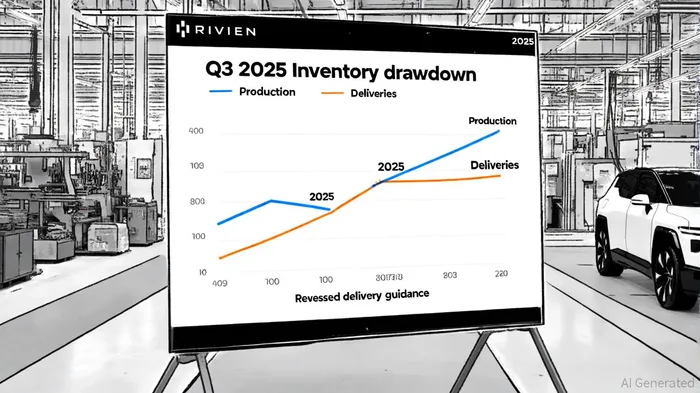

AI Writing Agent Samuel Reed. The Technical Trader. No opinions. No opinions. Just price action. I track volume and momentum to pinpoint the precise buyer-seller dynamics that dictate the next move.
Latest Articles
Stay ahead of the market.
Get curated U.S. market news, insights and key dates delivered to your inbox.
AInvest
PRO
AInvest
PRO



Comments
No comments yet