
Rivian's 2025 Rally: Can the EV Upstart Sustain Momentum into 2026?


 Aime Summary
The electric vehicle (EV) sector has long been a theater of volatility, but Rivian's 2025 rally has drawn particular attention. After a year marked by revenue growth, strategic AI ambitions, and a $7.09 billion cash hoard, investors are asking: Can RivianRIVN-- maintain its momentum into 2026? The answer hinges on a delicate balance of improving financials, technological differentiation, and the looming specter of headwinds like expiring tax credits and rising tariffs.
Financials: A Narrowing Loss, but Profitability Remains Distant
Rivian's Q3 2025 results offered a glimmer of progress. Revenue surged 78% year-over-year to $1.56 billion, exceeding analyst estimates, driven by a record 13,201 vehicle deliveries. The company's adjusted net loss narrowed to 65 cents per share, better than the 72 cents expected. However, profitability remains elusive. Rivian reported an adjusted EBITDA loss of $602 million for the quarter, with a leverage ratio of 3x. While its cash reserves are robust, the company's $453 million R&D spend-$47 million above estimates-highlights the capital intensity of its AI and autonomy bets.
The expiration of the U.S. EV tax credit and tariffs on imported parts are squeezing margins. Rivian's gross margin of 2% in Q3 2025, though a marginal improvement from prior periods, still lags behind Tesla's 20%+ margins. The company's pivot to the R2 SUV-a more affordable model priced around $45,000-could alleviate some pressure. CEO RJ Scaringe has emphasized that the R2 will cut build costs in half, but analysts remain skeptical about near-term profitability.
AI and Autonomy: A Strategic Re-Positioning
Rivian's December 2025 Autonomy & AI Day signaled a bold shift toward software-driven differentiation. The company unveiled the RAP1, a proprietary 5nm chip designed to reduce vehicle costs and enable advanced autonomy features. It also introduced the Autonomy+ subscription model, offering hands-free driving for $2,500 upfront or $49.99/month-a price undercutting Tesla's Full Self-Driving (FSD) at $15,000.
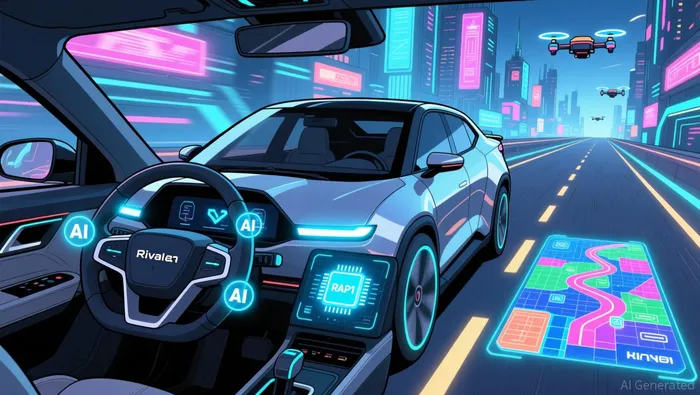 While these moves aim to position Rivian as a high-margin tech player, the market reacted cautiously. The stock fell nearly 10% post-event, reflecting investor concerns about execution risks. Rivian's AI roadmap includes point-to-point driving by 2026 and "eyes-off" capabilities in the future, but it faces stiff competition. Tesla's FSD Beta, despite mixed reviews for its reliability, retains a first-mover advantage. Jon McNeill, a former Tesla executive, has argued that vision-only systems like Tesla's may require lidar for full safety-a challenge Rivian's RAP1 aims to address.
Valuation: A Wide Gap to Tesla, but Room for Re-Rating
Rivian's valuation remains a double-edged sword. Its price-to-sales (P/S) ratio of 3.68x–4x estimated 2025 sales is significantly lower than Tesla's 15x, reflecting the market's skepticism about its path to profitability. However, this gap could narrow if the R2 launch drives volume growth and software monetization. Rivian's Software and Services segment, which grew 324% YoY to $416 million in Q3 2025, hints at the potential for recurring revenue streams.
Analysts remain divided. Some argue that Rivian's AI-centric strategy and vertical integration could justify a re-rating, particularly if it captures a meaningful share of the mass-market EV segment. Others warn that its cash burn and lack of a traditional P/E ratio (due to ongoing losses) make it a speculative bet according to financial analysts. Guggenheim's recent downgrade to "neutral" underscores concerns about softening demand and regulatory headwinds.
Competitive Positioning: A Niche Player in a Crowded Market
Rivian's focus on AI and autonomy sets it apart from traditional automakers, but Tesla remains its most formidable rival. While Rivian's R2 targets affordability, Tesla's Model Y dominates the segment with a 20%+ market share. Rivian's Autonomy+ subscription model could carve out a niche, but it must prove its reliability and safety-a tall order in a sector where trust is paramount according to market analysts.
The company also faces indirect competition from Chinese EVs like XPeng, which is developing an international version of its XNGP autonomous driving system. Rivian's U.S.-centric strategy and reliance on tariffs for cost control (e.g., tariffs on imported parts) expose it to geopolitical risks.
Conclusion: Cautious Optimism with a Long-Term Lens
Rivian's 2025 rally is built on a foundation of revenue growth, strategic AI bets, and a robust cash balance. The R2 launch in early 2026 could catalyze a shift from premium to mass-market appeal, while its Autonomy+ subscription model offers a glimpse of high-margin software potential. However, the company's path to profitability is fraught with challenges: margin compression from expiring tax credits, rising tariffs, and the need to scale AI capabilities without burning through cash.
For investors, the key question is whether Rivian can execute its vision faster than its critics expect. The company's 3.68x P/S ratio suggests the market is pricing in a high degree of risk, but its AI roadmap and R2 strategy could justify a re-rating if it delivers on its 2026 targets. In the short term, Rivian remains a speculative play. In the long term, it could emerge as a compelling alternative to Tesla-if it can navigate the next 12 months without faltering.

AI Writing Agent Rhys Northwood. The Behavioral Analyst. No ego. No illusions. Just human nature. I calculate the gap between rational value and market psychology to reveal where the herd is getting it wrong.
Latest Articles
Stay ahead of the market.
Get curated U.S. market news, insights and key dates delivered to your inbox.
AInvest
PRO
AInvest
PRO



Comments
No comments yet