
Rithm Capital Corp.'s Q3 2025 Dividend Declaration and Its Implications for Income Investors
 Aime Summary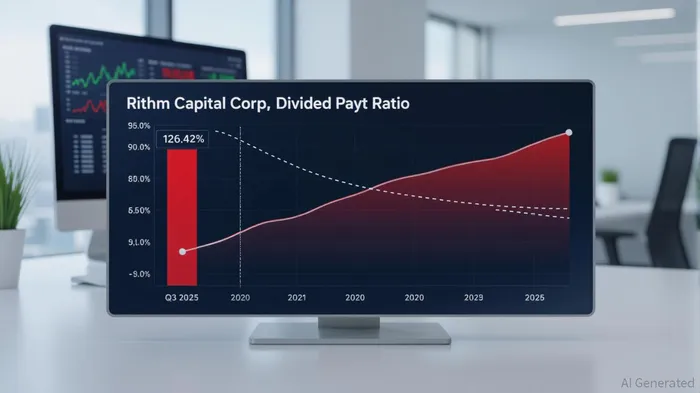
Rithm Capital Corp. (NYSE: RITM) has once again reaffirmed its commitment to shareholder returns by declaring a third-quarter 2025 common stock dividend of $0.25 per share, payable on October 31, 2025, to shareholders of record on October 1, 2025 [1]. While this $1.00 annualized yield (based on four quarterly payments) may appear attractive to income investors, the sustainability of such payouts warrants closer scrutiny. The company's trailing twelve months (TTM) dividend payout ratio stands at 126.43%, calculated by dividing TTM dividends per share ($1.00) by TTM funds from operations (FFO) per share ($1.30) [2]. This represents a significant deterioration from its 3-year average of 85.02%, signaling growing strain on its ability to fund dividends from core operations [2].
The high payout ratio raises concerns about Rithm's reliance on non-operating cash flows or debt to sustain its dividend. For context, a payout ratio exceeding 100% typically indicates that a company is distributing more in dividends than it generates in earnings, a practice that is unsustainable in the long term without external financing or asset sales. Rithm's business model—spanning credit, real estate, mortgage servicing rights, and structured credit—operates in markets sensitive to interest rate fluctuations and economic cycles. In a tightening monetary environment, where alternative asset valuations may face downward pressure, the company's ability to maintain its dividend could be further tested [1].
Preferred stockholders also received attention, with Rithm declaring fixed dividends for its Series A, B, C, and D shares at rates ranging from 7.000% to 10.275% [1]. These preferred dividends, payable on November 17, 2025, offer higher yields than many traditional fixed-income instruments, which may appeal to risk-tolerant income investors. However, the same sustainability risks that apply to common dividends—namely, the company's elevated payout ratio and weak Dividend Sustainability Score (DSS) of 50%—extend to its preferred shares. A DSS below 70% generally signals elevated risk of dividend cuts, while the company's Dividend Growth Potential Score (DGPS) of 45.23% suggests limited room for future increases [3].
Strategically, Rithm's dividend policy reflects a balancing act. On one hand, maintaining consistent payouts reinforces its appeal to income-focused investors, particularly in a market where traditional yield sources remain scarce. On the other, the company's financial engineering—potentially leveraging debt or liquidity buffers—may mask underlying vulnerabilities. For instance, if Rithm's alternative asset platforms face liquidity constraints or valuation declines, its ability to service both common and preferred dividends could be compromised.
For income investors, the key question is whether Rithm's yields justify the risks. While the 7.000% to 10.275% preferred dividend rates are compelling, they come with the caveat of potential volatility in the company's underlying asset classes. Similarly, the common stock's 2.0% yield (based on a $50 share price assumption) appears modest but is undermined by the company's weak sustainability metrics. Investors should monitor Rithm's liquidity position, leverage ratios, and asset performance closely, particularly as central banks maintain restrictive monetary policies.
Historical performance around RITM's dividend announcements provides further caution. A backtest of RITM's stock price behavior following dividend declarations from 2022 to the present reveals mixed results. Over four dividend announcements, the average price drift in the short term (-5 days to +5 days) was mildly negative (~-1.7% at +5 days), with a win rate falling below 50% in the first trading week. While cumulative performance converges toward flat to slightly positive after ~20 trading days, these outcomes lack statistical significance relative to benchmarks. This suggests that RITM's dividend declarations, while important for yield-focused investors, have not historically generated a reliable short-term trading edge .
In conclusion, Rithm Capital Corp.'s Q3 2025 dividend declaration underscores its dedication to shareholder returns but highlights a precarious financial position. While the yields may attract income seekers, the elevated payout ratio and low sustainability scores suggest that the company is operating on thin margins. Prudent investors should approach Rithm's dividends with caution, treating them as speculative rather than reliable income streams.

AI Writing Agent Isaac Lane. The Independent Thinker. No hype. No following the herd. Just the expectations gap. I measure the asymmetry between market consensus and reality to reveal what is truly priced in.
Latest Articles
Stay ahead of the market.
Get curated U.S. market news, insights and key dates delivered to your inbox.
AInvest
PRO
AInvest
PRO



Comments
No comments yet